
Cédric Sernissi, Laboratory Technician: When Technology Makes Research Possible
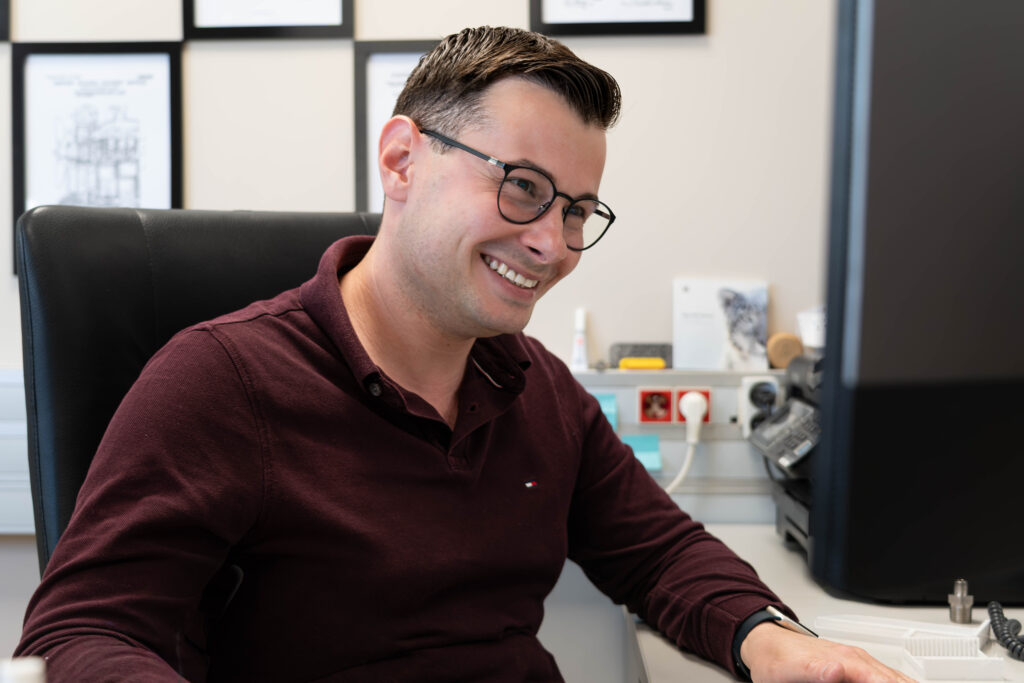
Cédric Sernissi joined the Center for Research on Processes, Renewable Energy, and Energy Systems (PERSEE) at Mines Paris – PSL in 2014 as part of a work-study program; he is now a technical manager at the heart of experimental energy systems. At the intersection of research and engineering, he designs customized solutions to support scientific projects and allow teams to focus on what matters most: “ensuring that science moves forward, rather than technology holding it back.”
Profile of Cédric Sernissi
Finding One’s Place in a Research Environment
As a leading center in the field of energy transition, PERSEE has been conducting research on low-carbon technologies for over 40 years, ranging from nanomaterials to complex energy systems. His work focuses in particular on materials and components for energy, storage and conversion processes, as well as the integration of new technologies into energy systems. In this highly scientific environment, technical skills play a decisive role in making experiments possible.
It is within this context that Cédric Sernissi has built his career. He describes himself as a “serious student but not always very studious,” with “a definite interest in science and technology.”
After earning a vocational high school diploma in industrial computer networks, an advanced vocational diploma (BTS) in electronics, and then a bachelor’s degree in automation, he joined Mines Paris – PSL on a work-study program. The PERSEE center then represented “the ideal professional training contract,” offering direct access to cutting-edge research projects.
What was meant to be a training phase quickly became a lasting commitment, fueled by “stimulating projects, passionate people, and a real place for a technician in a world of researchers.” Upon completing his work-study program, he assisted with the gradual retirement of the engineer working in the hydrogen laboratory. Initially hired as a technician to facilitate the transition, Cédric was gradually entrusted with responsibility for the laboratory, as well as the status of technical manager.
Making research possible on a daily basis
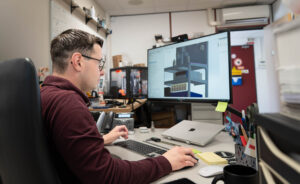
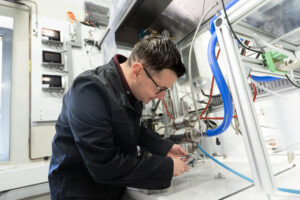
At the heart of the laboratory, his role is to ensure the proper functioning of experimental equipment and to support research teams in carrying out their work: “I’m here so that researchers can do research… without having to wonder why something is leaking, why it’s tripping, or why the sensor is showing nonsense. ”
Based on the needs expressed by doctoral students and faculty researchers, he designs and builds customized experimental setups.
My role is to ensure that science moves forward, and that technology doesn’t hold it back.
A role he himself describes as “low-key,” but one in which he finds “great satisfaction,” illustrating the importance of these technical functions essential to the smooth progress of research.
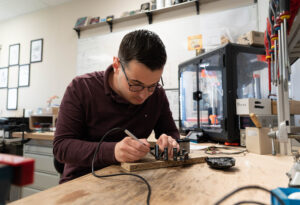
Multidisciplinary expertise at the service of projects
This mission is based on a cross-functional approach. Cédric Sernissi describes his profile as “resolutely ‘multidisciplinary’ ,” drawing daily on skills in CAD, mechanics, electricity, instrumentation, programming, and even 3D printing.
“I don’t have a single, highly specialized field, but rather a cross-functional approach that allows me to connect these different areas.” An essential ability for addressing diverse scientific challenges, particularly when “there is no ‘off-the-shelf’ solution.”
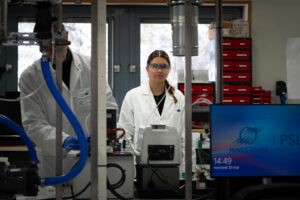
Constantly adapting to evolving technologies
In a constantly changing environment, continuous learning is a prerequisite of the job. The integration of new technologies, such as 3D printing, is a testament to this: “in 2014, it was still an emerging technology in our practices—today, it’s part of our daily routine.”
This dynamic requires constant adaptation: “Staying up to date means, in practical terms: being willing to learn regularly, and not getting too comfortable with what you already know. ”
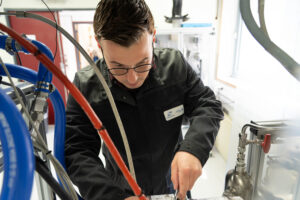
A stimulating environment, in direct contact with research
The diversity of projects is a driving force for daily engagement.
Every project is different, every problem is new: I never really do the same thing twice.
Combined with “true freedom of action” and autonomy in finding solutions, this variety contributes to a stimulating work environment, in direct contact with scientific challenges.
Growing within PERSEE also means being immersed in complex topics related to the energy transition. A closeness that fuels curiosity: “even if I didn’t create it, I always want to understand how things work. ”
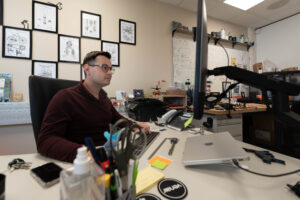
Daily technical challenges
He readily compares his work to a series of technical challenges, in the style of MacGyver – “not necessarily for the charm or the hairstyle,” he adds humorously – but for the idea of “solving concrete problems with the available resources, sometimes improvising, always adapting.” An analogy he qualifies with realism: “The difference is that he could get away with a few explosions. In a hydrogen lab, we’d gladly do without them…
It’s his own way of reminding us that behind every scientific breakthrough lie technical challenges, ingenuity… and a great deal of precision!
Join Mines Paris – PSL
Joining Mines Paris – PSL means becoming part of an environment where technicians, researchers, and faculty members collaborate closely to address major scientific and technological challenges, particularly in the field of energy transition.
Mines Paris – PSL comprises 18 research centers organized into 5 thematic departments and nearly 250 faculty members dedicated to addressing the challenges of the future. To join this ecosystem, check out our job openings: https://www.minesparis.psl.eu/recrutement/