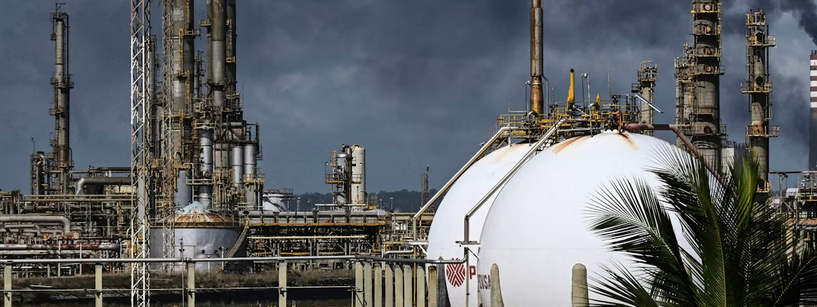
On January 3, 2026, a U.S. military operation resulted in the capture and kidnapping of Venezuelan President Nicolas Maduro and his wife. Donald Trump immediately announced that the United States would temporarily rule the country and stated his intention to revive the country’s oil production, with more than $100 billion (€84.78 billion) in investments from US oil companies.
Venezuela has enormous oil reserves estimated at around 300 billion barrels. The country currently exploits little of this potential, mainly due to storage constraints and, more generally, low investment.
However, this oil is a particularly significant source of greenhouse gas (GHG) emissions. This is due to the heavy and viscous nature of the crude oil, which makes extraction energy-intensive, and to the carbon dioxide emissions from flaring and methane leaks. Extracting a barrel of oil in Venezuela emits, on average, about twice as much GHG as extracting a barrel in Saudi Arabia or Norway. Rehabilitating such polluting fields makes no ecological sense.
However, these planned investments are part of a persistent global trend. As climate change worsens and two-thirds of global GHG emissions come from fossil fuels, the oil industry continues to expand its global supply. Every year, tens of billions of dollars are spent on discovering new fields and increasing available fossil fuel reserves.
Beyond its geopolitical significance, this news clearly illustrates the climate risk posed by the continued expansion of oil production around the world. It would be not only an ecological aberration, but also an economic one.
A dilemma for the global economy
Betting today on the expansion of oil reserves, in Venezuela as elsewhere, is tantamount to betting financially on the failure of the transition.
The profitability of these assets is structurally incompatible with compliance with climate agreements: for these projects to be profitable, decarbonization policies must fail. As a result, these investments reinforce the economic interest of their promoters in defending the status quo, including by weighing in against tougher climate policies.
In fact, the minimal agreement reached at the last COP30 climate conference illustrates this difficulty. The text referred to vague “efforts” and “solutions,” while continuing to sidestep basic arithmetic: to stay below a 2°C (or ideally 1.5°C) increase in temperatures, fossil fuel production must fall rapidly and immediately. In other words, a significant portion of proven reserves must be left unexploited.
Continuing these investments exposes the global economy to two distinct risks:
- First scenario: current climate policies fail. Each new barrel discovered then fuels oversupply, drives down prices, and delays the transition to a low-carbon economy. This locks the planet into a trajectory of far too much warming, which is the worst-case scenario for the climate and global well-being.
- Second scenario: climate regulations are tightened, but too late. New oil projects then become mostly “stranded assets,” meaning worthless investments that represent a massive waste of capital. Climate change is finally brought under control, but capital has been invested in the wrong place, when it could have been directed toward the energy transition.
Should oil exploration be banned?
To avoid such a dilemma, we could consider banning oil exploration and investments aimed at making recently discovered deposits exploitable. In a recent study, we assessed the effects of such a measure, based on a model built from data on more than 14,000 oil deposits.
The issue of limiting oil exploration has attracted increasing political attention in recent years. France, for example, banned all new exploration for fossil fuels in 2017. In 2024, the United Kingdom announced that it would stop granting new oil and gas licenses.
Can such a measure be effective? The results of our study are clear. As long as other climate policies—such as global carbon pricing—remain limited or non-existent, a ban on exploration would prevent the emission of approximately 114 billion tons of CO₂ equivalent. And, at the same time, it would save the global economy trillions of dollars in cumulative climate damage.
Indeed, every ton of CO₂ emitted today will generate real costs tomorrow: an increase in extreme weather events, rising sea levels, health impacts, productivity losses, and more.
Continuing exploration therefore means exploiting resources whose social costs far outweigh the private benefits they generate. This social cost is currently overlooked in the fossil fuel industry’s arguments.
When the fossil fuel industry’s arguments don’t hold water
The industry regularly cites the need to replace aging fields, whose production declines naturally each year. Some experts also believe that new deposits could emit less GHG than the oil fields currently in production.
However, our results show that, on a path compatible with carbon neutrality, neither the natural decline of deposits nor their heterogeneity in terms of carbon footprint is sufficient to justify the opening of new fields. These conclusions remain unchanged even if new deposits were to emit no GHGs during their exploitation.
Exploration would only generate net social benefits in a world where producers included almost the entire climate cost of emissions in their economic calculations. In concrete terms, this would require a carbon tax covering all emissions associated with a barrel—from exploration to combustion—in order to reflect the social cost of producing and using that barrel. Even in this very demanding scenario, the benefits would remain modest: they would be around 40 times lower than the environmental costs of exploration when these emissions are not taken into account by producers.
There is a simple explanation for this result: in a trajectory compatible with “Net Zero”, demand for oil becomes relatively low. However, this demand could be met by volumes of less carbon-intensive oil that are already available, with operating costs that remain moderate.
Current exploration efforts cannot therefore be justified on this basis:
Is a moratorium more acceptable than a tax for producing countries?
Our study clearly shows that banning exploration would be a powerful lever for limiting oil supply, reducing future emissions, and avoiding the creation of new assets that are likely to become unusable if the transition to a low-carbon economy materializes.
For some producing countries, such a moratorium could even prove more politically acceptable than a tax. By restricting supply, it would support oil prices and, by extension, the revenues of current producers, while serving climate ambitions.
This paradox—a climate measure that could benefit certain producers, notably in the United States and Saudi Arabia—could facilitate an international agreement.
But it would come at a cost to consumers and contravene the polluter pays principle, placing most of the cost of the transition on end consumers.
There remains a major obstacle: implementing such policies would be complex in a fragmented geopolitical context, marked by the erosion of multilateralism and the proliferation of non-cooperative strategies.
In the absence of an immediate global agreement, targeted bans could have a major impact. In this regard, the expansion of existing coalitions, such as the Beyond Oil and Gas alliance, of which France is a member, is fundamental. By strengthening this diplomatic base of pioneering states committed to no longer granting exploration licenses, a voluntary initiative could gradually evolve into a normative framework.
But the credibility of such bans depends on their permanence. In the United States, Donald Trump’s return to power has been accompanied by an open defense of the oil industry and a withdrawal from key international institutions, such as the United Nations Framework Convention on Climate Change and the Intergovernmental Panel on Climate Change (IPCC), two pillars of global climate cooperation.
London has also recently revised its position. The French case also illustrates the possibility of political reversals: on January 29, 2026, the Senate voted on a bill challenging the 2017 law banning oil and gas exploration.
Authors
This article is republished from The Conversation under a Creative Commons license. Read the original article.