Observing matter as it transforms
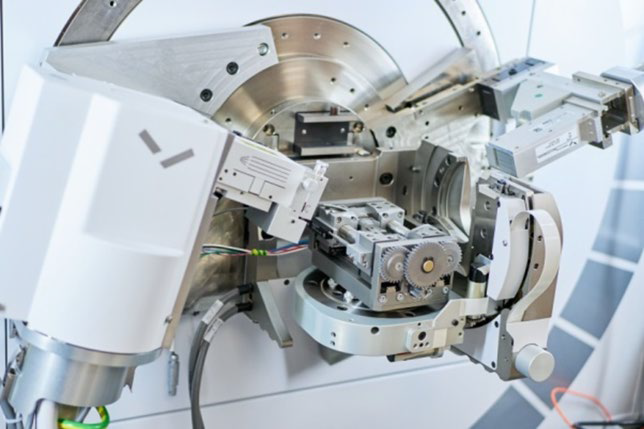
Polymers, which are found in many plastics and elastomers, have a complex internal structure organized at the microscopic level. When heated, stretched, or compressed, this organization changes, altering their mechanical properties: rigidity, strength, transparency, and durability.
Christelle Combeaud’s research falls precisely within this pivotal area between:
- the physics of matter: how polymer chains are organized
- mechanics: how the material deforms
- and industrial processes: extrusion, thermoforming, biaxial stretching
Her goal is to link microscopic phenomena to macroscopic behaviors observed at the scale of industrial objects.
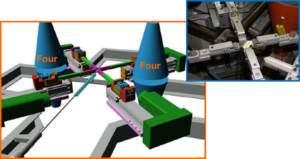
Diagram of a hot bi-stretching prototype
Stretching, heat, and microstructures
A material in motion
In her work, Christelle Combeaud studies in particular the stretchability of polymers above their glass transition temperature. At this critical temperature, an amorphous polymer changes from a hard/glass-like state to a soft/rubbery state, or vice versa, allowing it to be shaped.
By subjecting these polymers to controlled stretching, she shows that:
- their internal structure reorganizes,
- specific microstructures appear,
- and these transformations directly influence their mechanical performance.
This research thus provides an understanding of:
- why a material becomes more resistant after stretching
- how to avoid certain instabilities during shaping
- how to adapt processes to obtain targeted properties
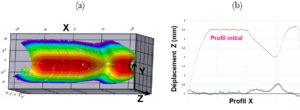
Measurement of three-dimensional displacement fields (a) and associated profiles (b) of a PET bottle
From fundamental research to industrial applications
Christelle Combeaud’s work is part of CEMEF’s strong tradition of collaborative research.
It has led to numerous industrial collaborations, particularly in the fields of:
- optics (organic glass)
- packaging
- technical polymers
Her research contributes in particular to:
- improving the reliability of manufacturing processes
- reducing production defects
- optimizing the mechanical performance of materials
- better predicting their behavior under real-world conditions
By combining mechanical experiments, microstructural observations, and modeling, she is developing an integrated approach that is essential for supporting industrial innovation.
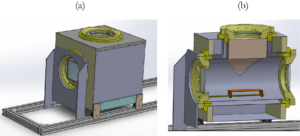
Transparent polymer heat treatment furnace (a), half-section plan (b)
A science of transformation
The common thread running through her work is clear: understanding how materials transform in order to better control them. By studying the links between temperature, deformation, and the internal organization of polymers, Christelle Combeaud sheds light on fundamental mechanisms while addressing very concrete issues of production and sustainability.
Her research thus contributes to:
- the design of higher-performance materials
- the control of complex industrial processes
- the improvement of everyday products
Women and science
Making scientific careers visible