
Summer Camp 2026 in Sophia Antipolis: Ten Days to Explore Science and Engineering Through a Female Lens

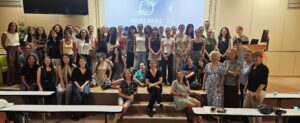
From August 11 to 20, 2026, about 30 middle and high school girls participated in the second edition of the Mines Paris–PSL All-Girls Summer Camp, held on the Pierre Laffitte campus in Sophia Antipolis. Over the course of ten days, science projects, meetings with female researchers and engineers, company visits, and group activities gave them a hands-on look at the diversity of the sciences and engineering professions.
Designed for girls in 9th, 10th, or 11th grade in the general track, the Mines Paris – PSL Summer Camp in Sophia Antipolis has one goal: to encourage more young women to consider scientific and technical studies and careers. The program is completely free and is based on an immersive experience in research, engineering, and the professional world.
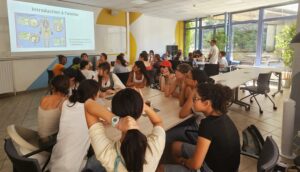
For this second edition, the participants gathered at the Pierre Laffitte campus, in the heart of the Sophia Antipolis technology park. After an initial period dedicated to exploring the campus, learning about Mines Paris–PSL, and building group cohesion, they met the teams that would be guiding them throughout the week. Female researchers, doctoral students, postdoctoral researchers, and engineers, in particular, shared their career paths and highlighted the diversity of their professions.
An introductory workshop on medical research also invited the participants to reflect, in small groups, on the various scientific professions and skills involved in addressing a health issue.
Three Projects to Step into the Shoes of a Female Engineer
At the heart of the program: three scientific projects carried out by groups of about ten participants. Over the course of six sessions, they progressed from identifying a problem to presenting their work to a panel of judges.
Materials Engineering for Healthcare
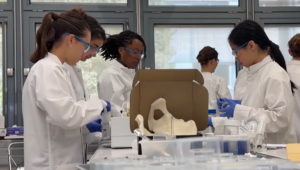
For this project, an initial group focused on polymer materials used in the medical field. Using a hip prosthesis as a case study, the participants worked on selecting a gel that would allow a drug to diffuse around the implant, with the goal of promoting its integration into the surrounding tissue.
Modeling Focused on Future Energy Sources
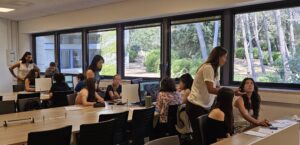
This project challenged the students with an applied engineering problem on the Pierre Laffitte campus: designing and sizing a photovoltaic system. Modeling, calculations, and technological choices—as well as financial and economic considerations—were all brought into play to develop a solution to a need articulated as if by a real client.
Low-tech Solar
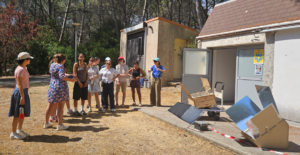
Finally, this third project began with a scenario: How can one meet one’s energy needs on a deserted island? The participants designed and built several solutions themselves, ranging from producing drinking water using a desalination unit to charging a battery with a solar panel, as well as designing a solar oven. These hands-on projects allowed them to apply their knowledge while examining everyday energy needs, life-cycle analysis, and, more broadly, the sustainability of technical solutions.
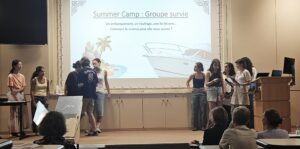
Three different experimental settings, but the same approach: starting with a real-world problem to observe, calculate, test, make decisions, and defend a solution.
Meeting Women in Science and Engineering
The immersive experience continued through conversations with women from diverse scientific and professional backgrounds.
Among them was Marion Négrier, a former postdoctoral researcher at the Center for Materials Processing (CEMEF) at Mines Paris – PSL and now a startup founder, who came to discuss her career path and her research focused on recycling textile waste. Having already been involved in the Summer Camp during the previous edition—where she co-led one of the three science workshops—this year she shared her experience in research and entrepreneurship with the participants. This encounter gave them the opportunity to interact with a young scientist who had chosen to extend her research through an entrepreneurial project.
We’re with girls who share our passions and what we love to do. We also got to visit companies to meet women who inspired us, because we need more girls in scientific careers.
Clarisse, high school student
Company Visits to Explore Careers in the Field
Several company visits complemented the science workshops, exposing the participants to professional environments in engineering and technology.
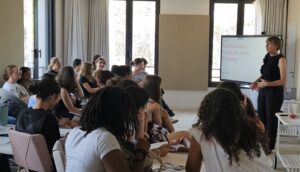
At Kyndryl, a specialist in IT infrastructure services, they learned about the company’s operations, various job roles, and career paths for women. A workshop focused on professional presentation skills and oral communication also helped them improve their public speaking skills and build confidence in a professional setting—essential skills to develop throughout their educational journey.
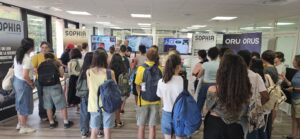
Other visits were organized to Amadeus (technology for the travel and tourism industry), Ampere Software Technology (software and technology for the automotive industry), and Orus (hyperspectral imaging and artificial intelligence applied to Earth observation), providing opportunities to explore different sectors, professions, and career paths.
Science, Creativity, and Community
The Summer Camp was also designed as a communal experience. The ten-day program alternated between scientific work and exploration, including a day in Antibes featuring a scavenger hunt through the city and time at the beach.
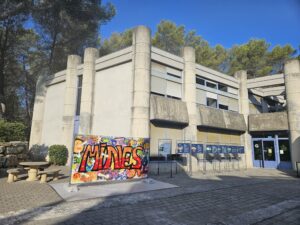
The interdisciplinary Science & Art project took the form of a street art workshop: guided by the arts organization Place for Art, founded by Florence Fabris, the participants used spray paint to create a mural on canvas centered on the theme of “Mines.” A cooking workshop and a dinner also punctuated the weekend.
These moments of shared experience complemented the workshops and professional meetings, with the goal of creating an environment conducive to exchanges among young women who came to explore science in a setting different from the classroom.
A Second Edition Made Possible Through Collective Effort
This second edition of the Summer Camp is part of Mines Paris – PSL’s commitment to diversifying student profiles in science and technology programs and fostering an interest in science starting in high school.
This initiative was made possible thanks to the support of partners committed to gender diversity in science: Petroineos and RTE, long-standing partners of the Summer Camp, as well as Kyndryl, the Sophia Antipolis Foundation, and the Science Azur project at the Université Côte d’Azur—along with its partners, who joined the initiative this year alongside the Mines Paris Foundation. They all share the same goal: to inspire an interest in science from a young age and to promote girls’ access to scientific and technical studies and careers.
Alongside them, the companies that hosted the participants, as well as the female researchers, doctoral students, postdoctoral researchers, engineers, and professionals who were involved throughout the program, helped make these ten days an immersive experience in science and engineering—from academic research to its applications in the professional world.
Following this second edition, the Mines Paris–PSL All-Female Summer Camp looks forward to hosting a third edition in 2027!
A Video Recap of the 2026 Event
Learn More
Check out the reports and articles dedicated to the second edition of the Mines Paris – PSL All-Girls Summer Camp:
- Nice-Matin – Women in Science: Thirty Young Women Immersed at the École des Mines in Sophia Antipolis
- Nice-Matin: “Proving to these students that they have a rightful place in the field.” It will be a summer of science for these 30 young women hosted at Sophia Antipolis by the École des Mines de Paris
- ICI Azur – A summer camp in Sophia Antipolis to inspire future female engineers
- France 3 Provence-Alpes-Côte d’Azur – Increasing the number of women in engineering is the goal of a prestigious school in Sophia-Antipolis
- Sophia Net : Sophia: Thirty Teenage Girls Participate in a Science Immersion Program at Mines Paris – PSL
- Inforadar : Mines Paris-PSL Launches a Free Summer Camp to Introduce 30 Girls to Science Careers