Recycled materials that are reshaping industry
Textiles transformed into bricks, industrial waste turned into furniture, shell waste converted into building materials, composite wood from forest products… The circular economy is now an industrial field subject to scientific, regulatory, and economic challenges. It involves, in particular:
- the physical and chemical characterization of available materials, which are often unstable or heterogeneous
- compliance with safety and performance standards (mechanical strength, fire resistance, durability)
- the industrialization of reproducible processes, compatible with viable costs and production rates
- regulatory developments (2020 environmental regulations, green taxonomy, eco-design requirements)
The invited entrepreneurs illustrated these challenges:
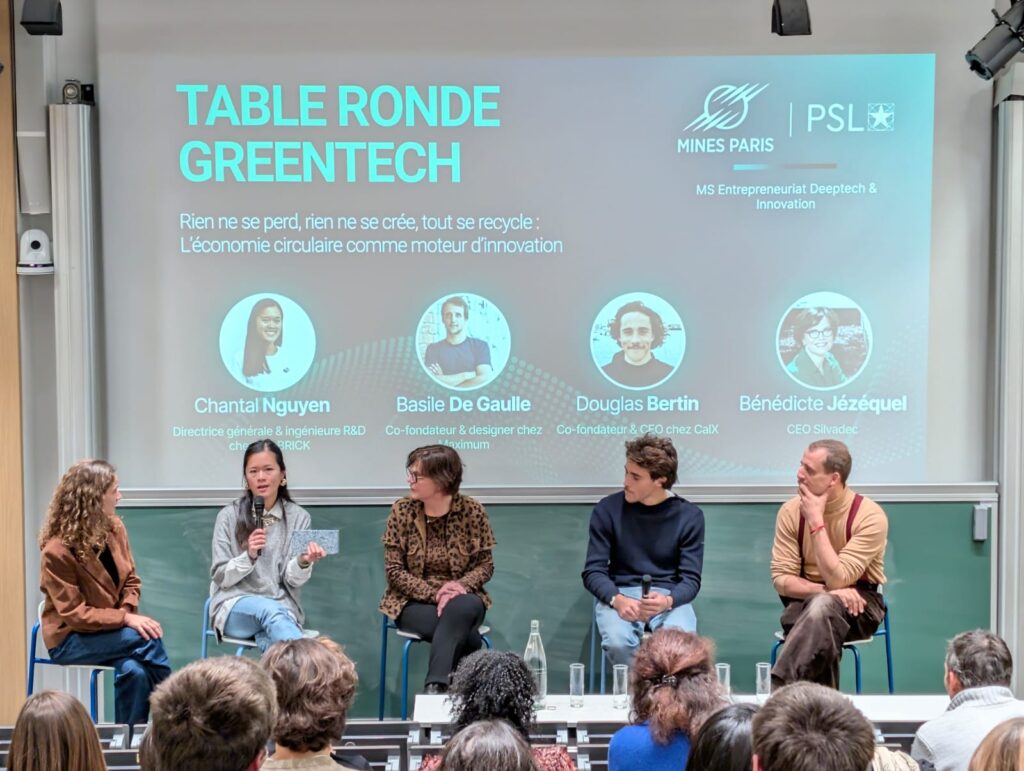
Chantal Nguyen, CEO and R&D engineer at FabBRICK, a company that recycles textiles for design and interior decoration. Handcrafted in their Parisian workshops, the materials and objects are subject to continuous improvement, monitoring of construction materials, and reflection on the industrialization of processes.
Basile de Gaulle, co-founder and designer at Maximum, whose mission is to transform industrial waste into sustainable furniture and materials. The company designs high-end furniture, manufactured in France, from recurring industrial production waste. It is also developing Tissium, a composite panel made from end-of-life textile fibers, intended for construction and furniture, and is on track to produce nearly 70,000 m² per year on a pilot scale by 2025.
Douglas Bertin, co-founder and CEO of CalX, which transforms shell waste into sustainable materials with a positive impact. The company is developing low-carbon marine concrete in partnership with the CNRS and IFREMER to help restore marine ecosystems, as well as Belle de CalX, a natural shell powder for agriculture, plastics, and construction, offering a sustainable alternative to traditional materials.
Bénédicte Jézéquel, CEO of Silvadec, a company that develops composite wood in Europe. Silvadec produces materials composed of two-thirds wood flour and one-third polyethylene, which are fully recyclable and comply with strict environmental standards. It combines industrial innovation and eco-responsibility, with certified products for decking and cladding, incorporating sustainable practices throughout the production chain.
These examples, presented during the round table, show that circularity is now a field of applied research, rooted in scientific and industrial issues, far from a symbolic or decorative approach.
Immersive education
Organizing events for the Deeptech & Innovation Entrepreneurship ecosystem as an educational project
This Greentech roundtable and other events are designed as educational tools for the MS’s “Deeptech Ecosystem” module, rather than as simple institutional gatherings.
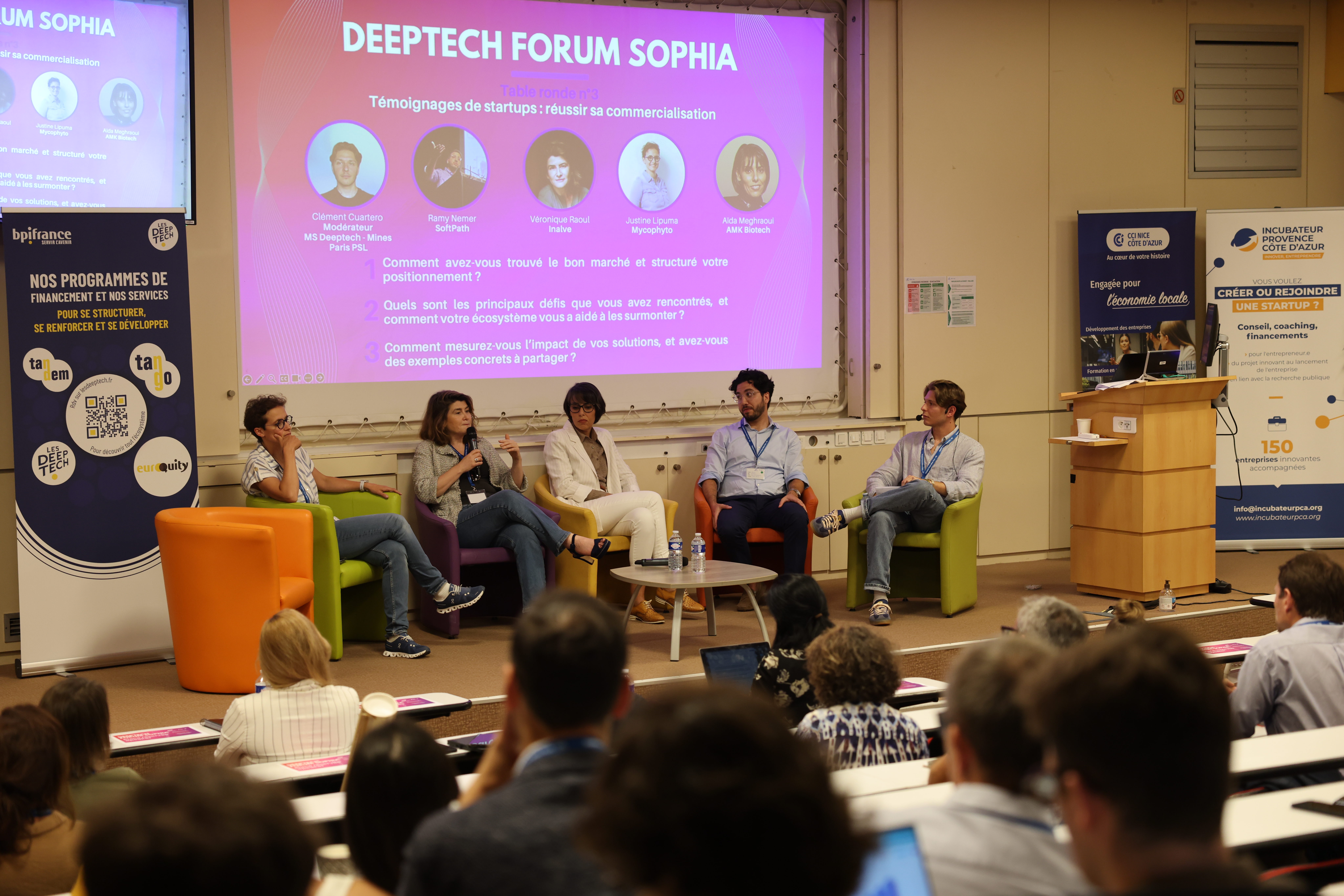
MS EDI students are responsible for the thematic design, organization, communication, and interaction with the deeptech ecosystem of several public events: monthly evening round tables followed by networking opportunities and annual public conferences, the deeptech forums, in Paris and Sophia Antipolis. This approach is part of the flipped classroom pedagogy promoted by the program’s academic team: students are not just spectators of the technological innovation ecosystem, but actively participate in it. Supervised by Wim Van Wassenhove, students mobilize:
- critical analysis of the issues, challenges, and opportunities of deep tech to choose relevant topics for discussion
- interpersonal skills to contact and engage with key players in the ecosystem
- networking with ecosystem players (research organizations and researchers, industrial players, startups, support organizations such as incubators, and financing and investment structures)
- project management and event management skills
A school at the heart of industrial, ecological, and social transitions
Through initiatives such as the Greentech round table and the Specialized Master’s in Deeptech Entrepreneurship & Innovation, Mines Paris – PSL reaffirms its commitment to training a new generation of engineers and entrepreneurs capable of meeting the complex challenges of our time. By closely combining research, engineering, and entrepreneurship, the School creates a unique ecosystem where technological innovation serves industrial, ecological, and social transitions. Concrete projects, partnerships with industrial players, and interdisciplinary collaborations illustrate this vision: that of responsible engineering, rooted in the reality of societal and environmental issues. Thus, Mines Paris – PSL does not merely anticipate the transformations of tomorrow—it builds them, by training players capable of reconciling economic performance, sustainability, and positive impact on society.