
Printing teeth the way nature designs them: the ANR CMADENT project led by Yannick Tillier
Essential at every meal, our teeth do their job so efficiently that we rarely notice—until a problem arises (a cavity, a fracture…) and disrupts daily life. What if dental restorations could finally reproduce the complexity of natural teeth? Behind their apparent simplicity lies an architecture capable of absorbing and distributing mechanical stresses. The ANR CMADENT project, coordinated by Yannick Tillier, a faculty researcher at the Center for Material Forming (CEMEF) at Mines Paris – PSL, is developing, through 3D printing, dental materials with graded properties inspired by living systems. Conducted in partnership with the CNRS Laboratory of Reactions and Process Engineering (LRGP), the Laboratory of Multimaterials and Interfaces (LMI) at Claude Bernard Lyon 1 University, the French company G Pharma, and the Clinical Research and Innovation Department (DRCI) at Nice University Hospital, this project—highlighted on World Creativity and Innovation Day—demonstrates research with the potential to durably transform dental practice.
The tooth: a natural engineering model still poorly replicated
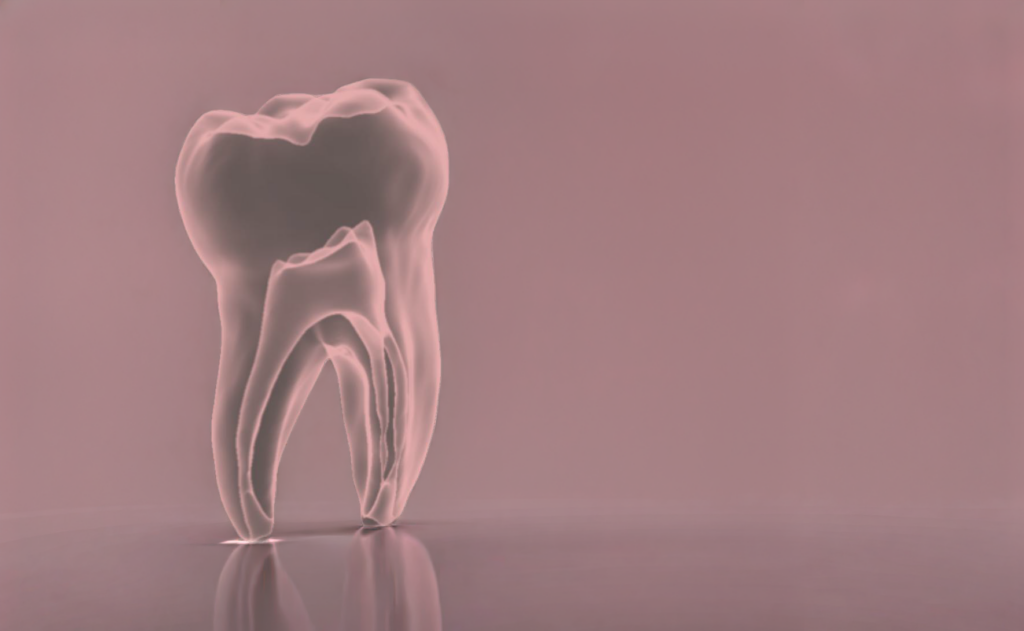
A tooth is not a homogeneous material. It is mainly composed of two tissues: enamel, which is very rigid, and dentin, which is more compliant. Between them, a transition zone—the dentin-enamel junction—ensures essential mechanical continuity.
Research conducted במסגרת the ANR CMADENT project shows that mechanical properties vary significantly from the outer surface to the core of the tooth: the elastic modulus of enamel can be four to five times higher than that of dentin. This natural gradient allows the tooth to resist cracking while absorbing stress.
However, most current restorative materials are homogeneous. While effective in practice, this simplification limits the durability of restorations and their ability to replicate the true biomechanical behavior of teeth.
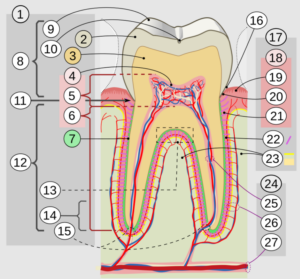
Representation of the complexity of a tooth:
1.Tooth; 2. Enamel; 3. Dentin; 4. Dental pulp; 5. Coronal pulp; 6. Radicular pulp; 7. Cementum; 8. Crown; 9. Cusp; 10. Groove; 11. Neck; 12. Root; 13. Furcation; 14. Root apex; 15. Apical foramen; 16. Sulcus; 17. Periodontium. 18. Gingiva: 19. Free gingiva; 20. Marginal gingiva; 21. Attached gingiva. 22. Periodontal ligament; 23. Alveolar bone. 24.Nerves and vessels: 25. Dental; 26. Periodontal; 27. Alveolar nerve.
CMADENT innovation
Reproducing living systems through additive manufacturing
The CMADENT project (Design of Dental Materials with Graded Properties via Additive Manufacturing) proposes a genuine technological shift by fundamentally rethinking how dental restorations are designed and produced:
- Changing manufacturing methods: moving from conventional techniques such as milling ceramic or composite blocks using CAD/CAM systems to 3D printing via Digital Light Processing (DLP). This technology uses light to cure resin layer by layer, enabling rapid production of precise, customized parts while reducing material waste.
- Creating tailored materials: the project develops printable composite resins. Adding mineral fillers is necessary to maintain optimal mechanical properties, but their quantity and type must be carefully controlled to ensure printability.
- Mimicking natural tooth behavior: a key innovation is introducing gradual variations in mechanical properties within a single printed piece. The material is no longer homogeneous: some regions are more rigid, others more flexible, as in a natural tooth. This progressive transition improves stress absorption and increases restoration durability by approaching the behavior of living tissues.
This biomimetic approach aims to align artificial restorations with real tooth function. It involves several scientific challenges: formulating printable materials, controlling polymerization, optimizing mechanical properties, and understanding the relationship between microstructure and behavior.
To address these challenges, the project brings together a full chain of expertise: chemists, mechanical engineers, additive manufacturing specialists, clinicians, and industry partners collaborate to ensure direct transfer to dental practice.
Additional strategies explored include:
- Varying printing patterns
- Alternating different resins
- Numerically optimizing material distribution
These approaches enable gradual approximation of enamel and dentin properties within a single structure.
The role of modeling
From understanding to design
Numerical models developed at CEMEF play a critical role. They allow simulation of multiple scenarios—homogeneous vs. heterogeneous teeth, with homogeneous or graded restorations—to predict the mechanical behavior of restored teeth.
Initial results show significant differences: graded materials distribute stress more effectively and more closely replicate natural tooth behavior.
Ultimately, numerical modeling aims to reduce reliance on complex and costly experimental campaigns, limiting them to model validation, while enabling patient-specific restorations with optimized gradients and improved longevity.
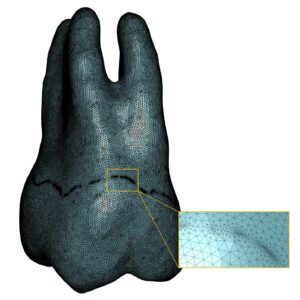
Highly detailed 3D model of a molar (approximately 1.3 million elements), created from medical imaging, enabling simulation of stress distribution within the tooth and its surrounding environment during mastication.
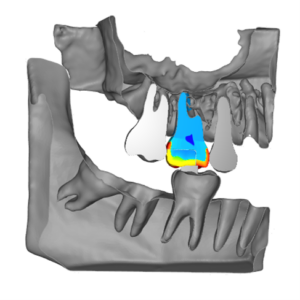 Distribution of elastic moduli (Young’s modulus) in a cross-sectional view (maxilla at the top and mandible at the bottom), showing the presence of a food bolus (a piece of food) between the two chewing teeth.
3D-printed teeth for training professionals
Beyond clinical applications, CMADENT opens new perspectives for dental education. Currently, students train either on natural teeth—which are scarce and variable—or on artificial models (often unfilled resins) that lack realism and can be costly.
The project offers an alternative:
- Composite (filled resin) 3D-printed teeth
- Improved realism (multi-material, graded properties) from the practitioner’s perspective
- Mechanical resistance to machining without melting, unlike conventional resins
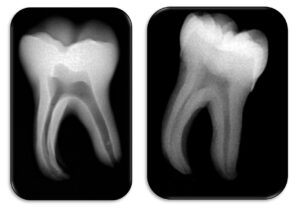
Left: 3D-printed tooth (without gradient); right: natural tooth.
The comparison highlights an accurate reproduction of the internal anatomy, particularly the pulp chamber and root canals.
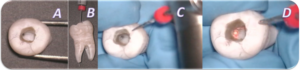
Root canal treatments were performed on the first printed training tooth models (intended for dental student practice):
A, B, C: a highly realistic tactile experience when working on the tooth, from cavity access to canal preparation. Mechanical resistance is close to that of a natural tooth.
D: no material melting occurred during canal filling, unlike with conventionally used resins.
These models enable more equitable, reproducible training at lower cost than ceramic teaching models, while remaining close to clinical reality.
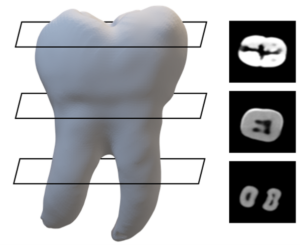
3D-printable tooth model. The property gradient is achieved through grayscale levels in the cross-sectional images. The intensity of the lamp used for polymerization (in the printer) is inversely proportional to the grayscale level: the whiter the area, the more the composite resin is polymerized during printing. Conversely, the darker the area, the less it is polymerized.
Combining creativity with societal impact
The ANR CMADENT project embodies the spirit of World Creativity and Innovation Day: leveraging scientific ingenuity to address concrete challenges—in this case, oral health.
Potential impacts include:
- Improved durability of dental restorations
- Cost reduction through additive manufacturing
- Development of safer, bioactive biomaterials
- Creation of new industrial markets and innovation opportunities
Through its multidisciplinary, transfer-oriented approach, the project reflects the ambition of Mines Paris – PSL: connecting fundamental science, engineering, and real-world applications.
Toward materials science–enhanced dentistry
By aiming to reproduce the complexity of living systems using advanced engineering tools, CMADENT paves the way for a new generation of biomaterials. Ultimately, the goal is not just to repair a tooth, but to reconstruct a functional, optimized, and durable structure inspired by nature itself.
The ANR CMADENT project led by Yannick Tillier illustrates what scientific creativity can achieve when combined with technological innovation. Deeply multidisciplinary, it brings together stakeholders from multiple institutions and fields. Two PhD projects are currently underway: one by Léa Guerandelle at CEMEF and another by Marie Bernabeu at Université Côte d’Azur, both co-supervised by Yannick Tillier and Nathalie Brulat-Bouchard, Professor of Dental Surgery at Nice University Hospital and affiliated researcher at CEMEF—highlighting the close link between academic research and clinical practice.
Further reading:
ANR Project (ANR-22-CE51-0017): Design of Dental Materials with Graded Properties via Additive Manufacturing – CMADENT