

From the Subsurface to Outer Space: Rethinking Climate in a World Under Pressure
In the face of accelerating climate change and rising geopolitical tensions, science alone is no longer enough—it must engage in dialogue with law, diplomacy, and strategy. This was the core focus of The Transition Institute (TTI.5) Forum – Grand Seminar of the Diplomatic and Consular Academy, held on April 10 at the Paris campus of Mines Paris – PSL. The central question: What scientific diplomacy is needed for a world in transition?
Scientists and diplomats came together to share their perspectives, examining how to regulate technologies capable of operating on a planetary scale—from the subsurface to outer space. Among them, Damien Huyghe, a lecturer-researcher at the Center for Geosciences, provided essential insights during a roundtable dedicated to these challenges. Amid the promises of innovation and the risks of global fragmentation, one idea stands out: climate is no longer just an environmental issue—it has become a true instrument of power.
A Forum to Bridge Science and Diplomacy
Designed as a space for dialogue between disciplines and institutions, the TTI.5 2026 Forum is part of the Grand Seminar of the Diplomatic and Consular Academy of the French Ministry for Europe and Foreign Affairs. Its goal: to bring together two worlds that still interact far too little—research and political decision-making.
In a context marked by rising international tensions and rapid technological change, a critical question arises: What scientific diplomacy does a world in transition need? In other words, how can we reconcile knowledge production, national interests, and the preservation of global commons?
Godefroy Beauvallet, Director General of Mines Paris – PSL, emphasizes the need for “cross-fertilization” between scientific knowledge and political realities.
Science is never entirely autonomous: it operates within economic, social, and geopolitical contexts that shape its applications.
Nadia Maïzi, Director of The Transition Institute (TTI.5) and the Center for Applied Mathematics (CMA) at Mines Paris – PSL, as well as a lead author of the IPCC’s Sixth Assessment Report, underscores that climate issues can no longer be addressed in silos. They cut across all public policies, all scales, and demand a deeply systemic approach. This forum is designed precisely for that purpose: to confront perspectives, combine expertise, and shift viewpoints.
Regulating a World in Transition
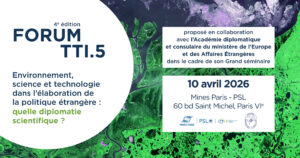
The roundtable “From the Subsurface to Space” embodies this ambition. Moderated by Gépy Koudadje, it explores a technical yet deeply political question: How can we regulate human activities that now span all dimensions of the globe, from mineral resources to space technologies?
Climate urgency has driven rapid evolution in the law. Since the Paris Agreement, a framework of norms, obligations, and incentives has emerged to steer economic actors toward more sustainable paths. Yet this framework remains unstable. Energy crises, security imperatives, and competitiveness concerns frequently challenge it. The tension persists between the desire for global regulation and a fragmenting world, between cooperation and rivalry.
Reading the Future in Past Climates
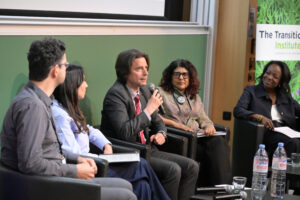
To understand today’s climate challenges, Damien Huyghe takes us back to Earth’s ancient climates. Studying natural archives like fossil shells, he places current transformations in the context of Earth’s climatic history—before human emissions played a role. His insights are illuminating, yet unsettling: yes, Earth has experienced much warmer periods. But never have such changes occurred so rapidly. Where natural variations unfolded over hundreds of thousands of years, today’s warming is unfolding over mere decades.
This shift in temporal scale changes everything. Ecosystems, human societies, and infrastructure lack the time to adapt. However, these archives of the past offer a valuable mirror: they help anticipate potential consequences, such as rising sea levels, changes in river flows, or shifting landscapes.
They also remind us of a fundamental reality: the climate system can find a new equilibrium—but over timescales incommensurate with political or economic horizons.
Geoengineering: Should We Intervene in the Climate?
Faced with this acceleration, some propose direct intervention in the climate. Sofia Kabbej, a researcher at the Institute for Strategic and International Relations (IRIS), explains that “geoengineering” encompasses a wide range of techniques. Some aim to remove carbon dioxide from the atmosphere. Others, more controversial, seek to modify solar radiation to artificially cool the planet.
The latter raise dizzying questions. Altering the climate on a global scale inevitably produces unequal effects across regions. Some areas might benefit, while others suffer. In a world already marked by deep inequalities, such technology could exacerbate tensions.
Worse, it introduces radical uncertainty: how can we attribute a climate event—like a drought or storm—to human intervention or natural variability? This ambiguity could fuel conflicts or even political manipulation.
Resisting the Technological Temptation?
In this context, Aarti Gupta, Professor at Wageningen University, advocates for a strong stance: a moratorium, or even an international agreement to refrain from solar geoengineering.
Her argument rests on three key points. First, these technologies would produce deeply unequal effects, which are hard to justify in an already unequal world. Second, it is unlikely they could be governed equitably on a global scale: who would decide the planet’s “right” temperature? Finally, their very existence might distract from already identified solutions—chief among them, reducing greenhouse gas emissions.
In short, geoengineering might be less a solution than a reckless gamble.
Climate as a New Strategic Issue
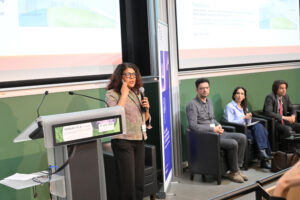
Guillaume Ollagnier, Director General for International Relations and Strategy at the Ministry of the Armed Forces and Veterans, presents a vision of international relations where climate is now part of a logic of conflict. Strategic spaces are no longer limited to land: they extend vertically from the seabed, where communication cables lie, to outer space, where satellites and data circulate.
In this perspective, resources, infrastructure, and even climate technologies become objects of competition. Climate is no longer just an environmental issue—it has become a factor of power.
Inventing Diplomacy for the Challenges Ahead
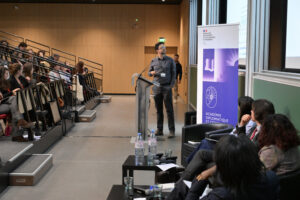
One conviction stands out: no single discipline or actor can address these challenges alone. In his keynote address, Daniel Franks, Director of the Global Centre for Mineral Security at the Sustainable Minerals Institute of the University of Queensland, Australia, reminded attendees that mineral resources—essential for the energy transition—are at the heart of new geopolitical dependencies. This raises a critical question: How can we secure these resources without letting them become an additional source of global inequality and tension?
For Martin Briens, Secretary General of the Ministry for Europe and Foreign Affairs (MEAE), science and technology are redefining international power dynamics. But they must also serve the global commons, such as climate and biodiversity.
This is where scientific diplomacy finds its role. It is not just about exporting knowledge or promoting national interests. It is about building frameworks for cooperation capable of managing global problems in a fragmented world.
Thinking Together, Despite Tensions
These reflections do not offer simple answers. However, they highlight a complex reality: we now have unprecedented scientific knowledge, yet we still lack the political tools to translate it into collective action.
The TTI.5 2026 Forum, by bringing together researchers, diplomats, engineers, and policymakers, outlines a possible path: one of dialogue, confrontation of perspectives, and the gradual construction of a shared culture—all in a world where resources, technologies, and the environment are now deeply interdependent.
For more information:
Photos © Olivier Bolvin-MEAE