Measuring something as complex as creativity?
For more than twenty years, the Program for International Student Assessment (PISA) of the Organization for Economic Cooperation and Development (OECD) has been comparing the performance of 15-year-old students around the world. Long focused on mathematics, reading comprehension, and science, this assessment was expanded in 2022 to include a new domain: creative thinking.
The goal is no longer simply to determine whether a student knows the correct answer, but to assess their ability to generate diverse, original, and relevant ideas when faced with a new situation. This skill has become essential in a world facing challenges as complex as the ecological and digital transitions, industrial transformations, and AI.
Until now, international assessments have relied primarily on quantitative indicators: How many ideas does a student generate? Are they different from one another? Are they rare compared to the responses of other participants? These measures allow for the creation of rankings, but they reveal little about the cognitive mechanisms that lead to these results. Two students may achieve comparable scores while having followed very different lines of reasoning. Conversely, an idea deemed “original” in one country may be quite common in another, making international comparisons particularly challenging.
To overcome these limitations, two international publications released in 2026 propose a shift in perspective: rather than measuring performance alone, they seek to understand how adolescents construct their ideas.
A Design Theory for Mapping Ideas
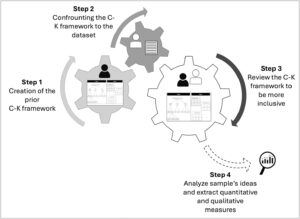
To this end, the researchers drew on Concept-Knowledge theory, better known as C-K theory. Developed at the CGS by Armand Hatchuel, Benoît Weil, Pascal Le Masson, and their colleagues, this theory offers a formal model for accounting for generative processes (creation, invention, innovation, new ideas, etc.). It is now widely used in the fields of design, engineering, and innovation management to collectively facilitate the emergence of truly new and original concepts.
Its principle is seemingly simple. All design activity is based on a constant interaction between two spaces. The first is the space of knowledge (Knowledge), that is, everything we already know: facts, techniques, experiences, or available rules. The second is the space of concepts (Concept), which encompasses proposals that are still undecided—ideas whose feasibility is not yet known, but which open up new possibilities – pipe dreams, utopias, imaginative scenarios, desirable futures…
Designing consists precisely of developing these two spaces simultaneously and in interaction: drawing on existing knowledge to explore concepts that do not yet exist, and conversely, drawing inspiration from concepts to create new knowledge. Innovation arises from this gradual exploration of the unknown.
Cognitive Fixation: The Primary Obstacle to Creativity
This approach, in particular, allows us to observe a phenomenon well known to psychologists: cognitive fixation. When an individual is faced with a problem, their brain spontaneously draws on the most readily available knowledge. These responses are often effective, but they also steer reasoning toward already known solutions and make it more difficult to explore other avenues.
Cognitive fixation is therefore not a lack of creativity. It is a normal cognitive process, essential in many everyday situations. However, when it comes to innovation, it can limit the ability to consider truly new solutions.
Using C-K mapping, researchers can distinguish two complementary patterns. The first corresponds to zones of fixation, where ideas remain close to the most obvious solutions. The second, by contrast, reflects cognitive expansion: students explore categories of solutions further removed from spontaneous reasoning and gradually open up new spaces for design. This distinction offers a much more nuanced understanding of creativity than traditional indicators of fluidity or originality.
A New Interpretation of PISA Results
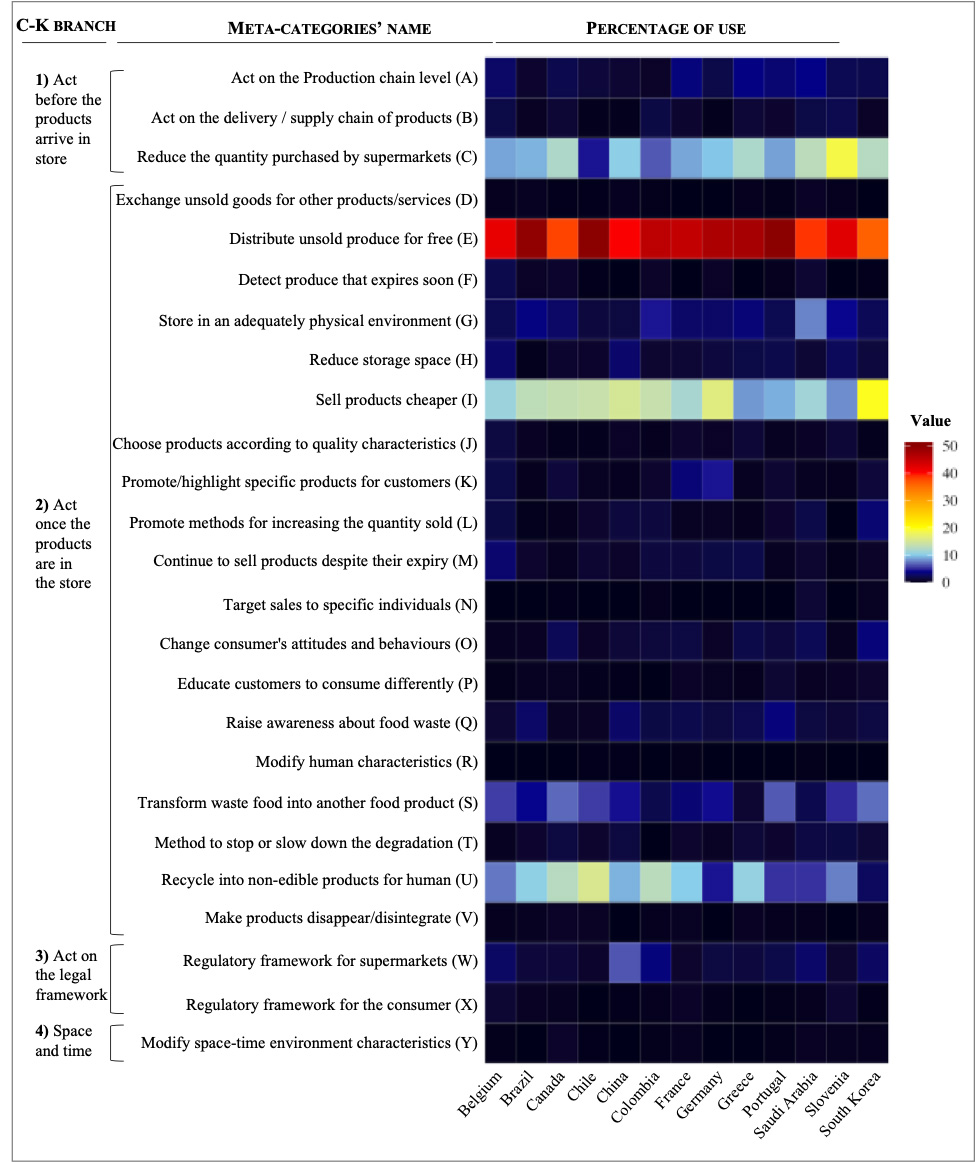
The second publication, Cognitive Flexibility and Rigidity Across Cultures and Genders: Evidence from PISA Creative Problem-Solving, applies this methodology to the responses of tens of thousands of adolescents from thirteen countries who participated in PISA 2022. The problem posed appears deliberately very concrete: how can food waste from unsold products in supermarkets be reduced?
Based on C-K theory, the researchers developed a mapping system comprising 117 response categories, grouped into 25 broad solution families. Each proposal formulated by the students is then positioned within this mapping system, allowing for an analysis not only of the number of ideas generated but, more importantly, of the intellectual directions actually explored.
The first finding is particularly striking. Regardless of the country, teenagers very often propose the same initial solutions: giving away unsold items for free, selling them at a discount, or reducing the quantities ordered by supermarkets. These responses represent widely shared forms of cognitive fixation, revealing common reasoning mechanisms that extend far beyond cultural differences.
However, once students move beyond these initial ideas, their paths diverge. Some groups explore categories of solutions that are further removed from the initial frameworks, while others remain focused on the same families of ideas. The differences observed between countries thus seem to reflect not so much varying creative potential as a greater or lesser ability to move beyond the most immediately accessible cognitive pathways.
In other words, what PISA typically measures as differences in creativity may sometimes primarily reflect differences in the level of cognitive fixation.
(Click to enlarge)
Results That Challenge Preconceived Notions
The study also highlights differences between girls and boys in this specific assessment situation. On average, girls generate more ideas and explore a greater number of solution categories. Boys, on the other hand, generate a proportionally higher number of responses located in the most expansive areas of the map.
The authors, however, stress an essential caveat: these observations should not be interpreted as reflecting “natural” differences in creativity. They describe idea-generation strategies observed in a specific experimental context and may be influenced by numerous educational, cultural, or motivational factors. This caution is fundamental. The aim of this research is not to rank individuals, but to better understand the cognitive mechanisms that foster the exploration of new solutions.
The two studies focused on PISA not only demonstrate that a theory developed at Mines Paris–PSL works in a new field. They show that by studying how ideas emerge, transform, or become fixed, Design Theory now provides tools for understanding industrial innovation processes, the workings of human creativity, the applications of AI, and even educational policies.
C-K Addressing Major Contemporary Challenges
These publications also provide an opportunity to highlight a recent event that just took place at Mines Paris – PSL. Every two years, the Design Computing and Cognition 2026 (DCC’26) brings together researchers from around the world to address a single question: how can we understand the mechanisms of design, creativity, and innovation? Combining design, cognitive science, AI, and engineering, this conference is now one of the leading international events in this field. This year, it took place from July 6 to 11 on the Paris campus of Mines Paris – PSL.
Fostering interdisciplinary exchange to generate new knowledge in the scientific field of design has been what has set this scientific community apart for more than thirty-five years.
The goal is not to set a field of research in stone, but rather to create a community where every participant, regardless of their background or experience, contributes to advancing our understanding of design processes.
John Gero, researcher at Drexel University and founder of Design Computing and Cognition 2026 (DCC’26)
This ambition is reflected above all in a forum for scientific dialogue. By hosting this twelfth edition, Mines Paris – PSL thus reaffirms the central role that Design Theory plays today in its scientific landscape.
The purpose of this conference is to serve as a space for collaboration and the exchange of ideas, where researchers compare their approaches to advance the design sciences together.
Antoine Bordas, postdoctoral researcher at the Centre de Gestion Scientifique (CGS) at Mines Paris – PSL and co-organizer of this Paris edition of DCC’26
Developed over several decades at the CGS, this discipline seeks not only to improve design methods. It focuses on understanding the mechanisms that enable the generation of new knowledge, the exploration of the unknown, and the organization of innovation.
The scientific legacy of Mines Paris – PSL is not focused on the past but serves as a catalyst for shaping the future.
Godefroy Beauvallet, CEO of Mines Paris – PSL
Mines Paris – PSL embraces an open approach to research, where knowledge is built through an ongoing dialogue between scientific heritage and new research questions.
This reflection on the mechanisms of innovation resonated particularly strongly in the inaugural lecture by Mehdi Tayoubi, Vice President of Innovation & Culture at Dassault Systèmes. Through several projects combining heritage, 3D modeling, and scientific collaboration—such as the restoration of Notre-Dame de Paris and the Pyramid of Khufu—he demonstrated that innovation often arises from the intersection of disciplines that do not typically engage in dialogue.
Creating new tools is, above all, about creating new opportunities for collaboration among engineers, researchers, artists, and heritage specialists, so that they can collectively explore unprecedented possibilities.
Mehdi Tayoubi, Vice President of Innovation & Culture at Dassault Systèmes
This same question was a recurring theme in many scientific presentations on AI and Design Theory. Marco Consoloni, a doctoral student at the Università di Pisa, focused on large language models. His work, conducted in partnership between the University of Pisa and Mines Paris – PSL, shows that these systems—trained to predict the most likely answers—can themselves reproduce fixation phenomena by favoring the most conventional solutions. Rather than evaluating only their results, he proposes analyzing the internal generation mechanisms to understand how fixation arises during the very process of reasoning. His work earned him the Best Paper Award at the end of the conference for his article titled Rethinking Design Fixation in LLMs: A Process-Based Perspective Toward Linguistic Fixation, co-authored notably with Pascal Le Masson and Antoine Bordas.
This is a particularly striking illustration of Mines Paris – PSL’s ability to generate fundamental knowledge that bridges disciplines and sheds light on the major scientific and societal challenges of the 21st century.