
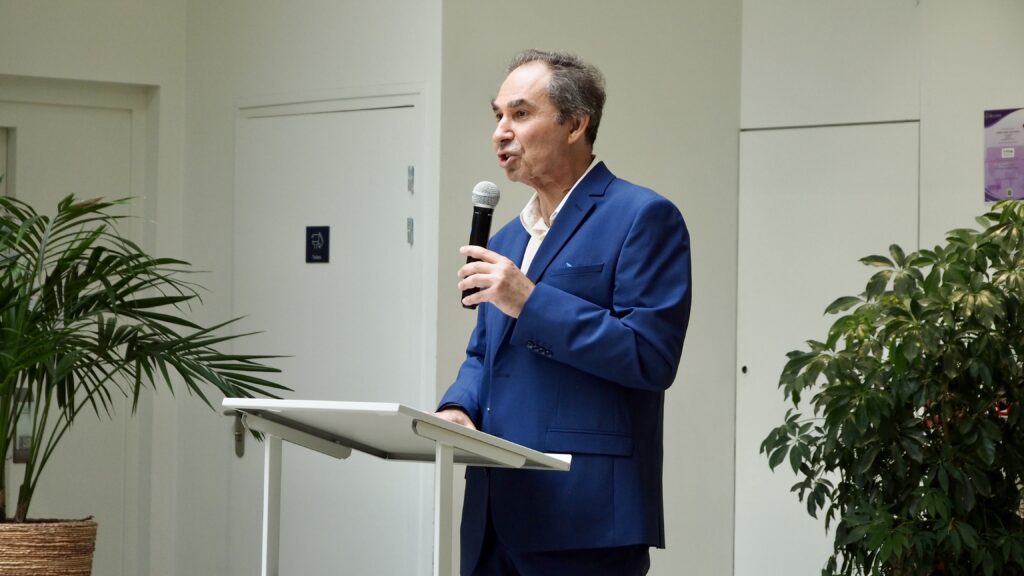
“Training professionals capable of understanding and evaluating the tools of tomorrow”: Olivier Rodot, Director of Academic Programs for the Albert School programs at Mines Paris – PSL
In April 2026, the Master of Science in Data for Business, a joint degree program between Mines Paris – PSL and the Albert School, was officially recognized by the French government as a Master’s degree. In February, the Bachelor’s degree in Business, Data, and AI received official recognition as a Licence. This dual recognition secures and reinforces the value of these degrees, both in France and internationally.
In this interview, Olivier Rodot, Director of Academic Programs for the Albert School programs at Mines Paris – PSL, discusses the challenges of these accreditations, the rigorous stages of the evaluation processes, and the upcoming initiatives to evolve the programs in a context where data and artificial intelligence are profoundly transforming professions and the skills required.
The Master of Science (MSc) in Data for Business, led by Mines Paris – PSL and developed in partnership with the Albert School, has been awarded Master’s degree status by the Ministry of Higher Education and Research. This recognition complements the Bachelor’s degree status granted in February for the Bachelor’s program in Business, Data, and AI.
Olivier, what concrete changes do these accreditations bring for our students?
The awarding of the Bachelor’s and Master’s degrees is first and foremost a process of national academic recognition, which affirms the quality and rigor of the programs we have developed with Albert School. These degrees, issued by the government, certify that our programs meet the highest standards of French higher education, both academically and pedagogically.
Beyond this recognition, the goal was very concrete: to secure and strengthen the value of the degree for our students, both in France and internationally. In an environment where educational paths are becoming increasingly hybrid and international, it is essential that degrees be immediately understandable and recognized by universities, recruiters, and institutions.
For students, the benefits are numerous. First, this guarantees full academic recognition, particularly for continuing studies, entering a doctoral program, or applying to international institutions. Second, it enhances the degree’s credibility in the job market: the Master’s degree, in particular, remains a strong benchmark for employers, both in France and abroad.
Finally, this institutional recognition provides a sense of security and clarity in students’ academic paths: students know that their education is fully aligned with the national and European degree framework (LMD), while preserving the uniqueness of our educational model, at the intersection of data, business, and the sciences.
In summary, these degrees do not change the DNA of our programs (which were already demanding and career-oriented) but they enhance their scope, recognition, and the opportunities offered to our students.
And for Albert School?
For Albert School, obtaining the Bachelor’s and Master’s degrees marks a pivotal milestone by sending a strong signal to all stakeholders: students, families, companies… With degrees now recognized by the state, Albert School can boost its appeal, particularly internationally, and more easily forge key academic partnerships (exchange programs, dual degrees, further studies).
This recognition directly enhances our appeal and, consequently, our selectivity: we are already seeing the effects this year on the Bachelor’s program, with a particularly high number of applications on Parcoursup, even though this is our first year participating.
How did the process of obtaining the Bachelor’s degree unfold? What were the key steps?
The Bachelor’s degree is granted by the Ministry of Higher Education following a rigorous evaluation process conducted by the Commission des titres d’ingénieur (CTI). The CTI accredits engineering programs in France but is also responsible for evaluating Bachelor’s programs offered by engineering schools.
Following a meeting with the CTI’s lead evaluator, who was in charge of our application, the process consisted of three distinct phases.
The first was the preparatory phase. It involved compiling and submitting, on May 16, 2025, a complete application package, including a self-assessment report structured according to the CTI’s guidelines. This self-assessment report was to refer to supporting evidence compiled in a digital file, including a draft RNCP profile (highlighting the targeted competency clusters) and a table of grade criteria demonstrating compliance with the criteria of the decree of January 27, 2020, regarding university grades.
The second phase was the evaluation itself. A team of CTI experts reviewed the dossier and conducted an evaluation visit on July 2, 2026.
In turn, the Director General of Mines Paris-PSL, Godefroy Beauvallet, the Director General of Albert School, Grégoire Genest, and I presented the Bachelor’s program from various perspectives.
The lead evaluator then drafted a mission report, which was sent to the School on October 14, 2026, for comments before being finalized.
The third phase was deliberation and decision-making. The CTI issued a favorable opinion, which was forwarded to the Directorate General for Higher Education and Professional Integration (DGESIP), which then prepared the draft decree, submitted it to the CNESER [National Council for Higher Education and Research], and subsequently published the decree conferring the Bachelor’s degree on February 12, 2026. It may be worth noting that the CTI report identified zero criteria that did not meet all the requirements of the Bachelor’s degree framework. Only one criterion—regarding the ratio of permanent faculty members, which was not yet sufficient—was deemed partially non-compliant.
During these stages, we had to demonstrate, in particular, that our Bachelor’s program was career-oriented, research-based, and managed with a rigorous quality approach.

What about the Master’s degree?
For the MSc, the procedure was different. We did not go through the CTI, but instead followed a so-called “off-cycle” procedure directly with the DGESIP [Directorate General for Higher Education and Professional Integration]. I submitted an accreditation application to the DGESIP on July 17, 2025, which included a document presenting a detailed strategic report, a program description (including the targeted competencies), and an introduction to the teaching team. A second document, called a feasibility report, was intended to demonstrate the added value of this MSc in relation to the socio-economic landscape, the targeted sectors, and jobs… I also drafted and submitted a proposed RNCP profile accompanied by a cross-reference table with the three standards.
Additional materials were requested and submitted in September 2025. I then submitted the complete application to the head of the supervising agency. Two audits preceded the publication of the decree in the Official Journal on April 12, 2026: the first with the CNESER on February 10, 2026 (at the Ministry of Higher Education and Research, formerly the Polytechnique campus until 1975), followed by the CSLMD [Bachelor’s-Master’s-Doctorate Monitoring Committee] on April 3, 2026, in the presence of France Compétences (responsible for evaluating the RNCP profile).
Once these degrees are obtained, is there a follow-up process? What are the next steps, the upcoming projects?
The Bachelor’s and Master’s degrees are awarded to graduates for a limited period, until 2029 and 2032 respectively, at which time I will submit renewal applications.
Four major projects between now and then.
The first is to involve more faculty members from Mines Paris – PSL in the programs, both for math and data courses and for humanities courses. A research-oriented “business deep dive” is also being considered to introduce Bachelor’s students to the world of research.
The second project is a complete overhaul of the Bachelor’s program structure, following the findings from the teaching unit review committees and the pedagogical improvement committees. Within these committees, companies were able to shed light on recruiters’ current expectations regarding data and AI skills and profiles, as well as market trends in the coming months. Furthermore, artificial intelligence is advancing at such a rapid pace that today it has become very easy to generate hundreds, thousands, or even millions of lines of code: therefore, a thorough review must be conducted regarding the teaching of coding and, more generally, all course units.
An overhaul of the MSc program is also underway, particularly with regard to diversifying assessment methods.
The third initiative is the creation of a career outcomes observatory. The CTI framework requires concrete data on graduates’ career paths at 18 and 30 months: employment rates, types of contracts, sectors, salary levels, as well as rates of continued education and success in master’s-level programs. Our first graduating classes are approaching these milestones (the Mines Paris–PSL partnership began in September 2024, so the first MSc class will graduate this year, while the Bachelor’s class will graduate in 2027). We must now establish systematic tracking, with a survey response rate exceeding 75%, as required by the standards.
The final task is the RNCP profiles. Registration in the National Directory of Professional Certifications is a direct consequence of obtaining the degree. I am in direct contact with France Compétences regarding these files. I must keep these profiles up to date and ensure they align with evolving target competencies and market trends.
How can we integrate the rapid advancements in the fields of data and AI into the courses taught at the École Polytechnique?
First and foremost, active pedagogical monitoring by faculty members is essential. Mines Paris – PSL has research teams directly involved in advancements in the field. This proximity to the research community is a real asset for keeping course content up to date. A faculty member who publishes in the field they teach naturally incorporates recent developments into their courses. This is precisely why the CTI framework requires a research-based foundation, as it ensures that the curriculum does not become outdated.
A regular annual review of course outlines is therefore inevitable. Some ECUE courses will be phased out in favor of others. The review and pedagogical development committees, bringing together academic staff, faculty, professionals, and student representatives, will play a leading role in integrating these rapid advancements, particularly in the field of AI: their role is precisely to identify the gaps between the content taught and actual industry practices. If the companies hiring our graduates are making extensive use of LLMs in their data workflows, this reality must be reflected in our curriculum—not as a passing trend, but as a serious subject of study, with its capabilities and limitations.
Finally, an epistemic mindset must be instilled in students. The rapid pace of change in the field makes the ability to learn independently and critically indispensable. This is not an abstract skill: it is acquired by reading research articles, reproducing results, and understanding why a model fails rather than simply noting that it succeeds. The goal is not to train proficient users of today’s tools, but to train professionals capable of understanding and evaluating the tools of tomorrow. Our partner Albert School is perfectly aligned with our motto: Theory and Practice!
A final word?
What strikes me, after nearly a year and a half in this position, is the coherence of the project. Mines Paris – PSL brings academic rigor built on more than two centuries of scientific and technical education. Albert School brings pedagogical agility, an entrepreneurial culture, and close ties to the business world. These two approaches are not at odds; they complement each other, and that is precisely what our students are seeking.
Bachelor’s and Master’s degrees are not the end of this journey. In a way, they are the first external validation of it. The true test will be the test of time: the professional success of our graduates, their ability to adapt to a sector that, in ten years, will bear little resemblance to what it is today.
I am convinced that a solid education grounded in scientific fundamentals is the best protection against obsolescence, provided that these fundamentals are constantly tested through engagement with the business world. This is what the Business Deep Dives, our signature educational approach, embody.

This article is republished fromAlbert Deep Dive. Read theoriginal article (English version).
Learn more
Mines Paris – PSL / Albert School Joint Degrees
These Bachelor’s and Master’s programs are part of a shared ambition: to train professionals capable of bridging science, data, and management to support major technological and economic transformations. Driven by the academic rigor of Mines Paris – PSL and a pedagogical approach closely aligned with the needs of businesses, they provide a structured framework for developing hybrid skills that are immediately applicable and adaptable.