The partnership between Mines Paris – PSL and Albert School was born out of a shared conviction: to train students capable of supporting the major technological, economic, and social transitions of the 21st century. The historic motto of Mines Paris – PSL, “theory and practice,” is embodied in a teaching approach that is resolutely focused on business, data, and innovation. This teaching approach is based on an integrated approach combining real-world projects, mentoring, varied teaching methods, and international outreach.
This approach translates into a demanding alternation between fundamental courses and immersive learning situations, foremost among which are the Business Deep Dives (BDDs), the program’s signature feature.
An immersive teaching approach
Learning by solving real-world challenges
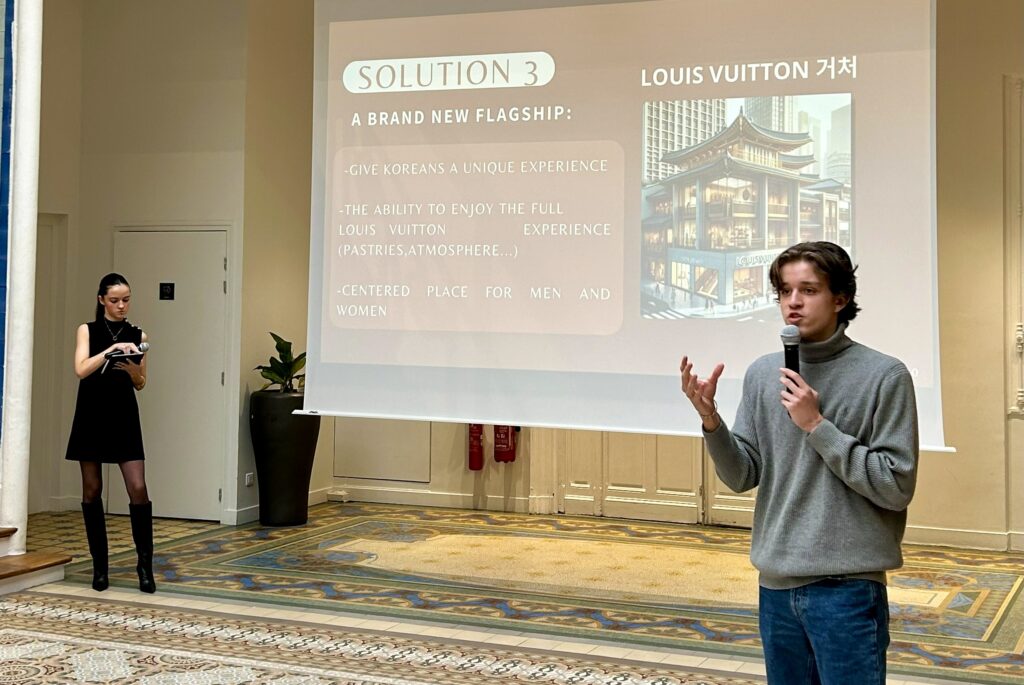
Business Deep Dives are much more than an academic exercise. For three weeks, students immerse themselves in a business issue proposed by a partner company, analyze complex data sets, and present their recommendations to executives. In this way, they experience project-based learning at the very heart of their education, which exposes them to the realities of the professional world from the outset.
André, a student, describes the program: “In short, every three weeks, we are welcomed into a company, where two students interview a few representatives of the company on behalf of the campus. We are introduced, instructed on how the company works, and then given a problem to solve that requires our expertise, data, and creativity. Three weeks later, we return to present our solution. Since this summer, the companies we have worked with are examples: Edmond de Rothschild wanted to see our ability to develop a start-up in a week, the United Nations wanted our feedback and ideas for implementing an application under development. Crédit Agricole Indosuez wanted investment advice and Valrhona wanted strategic advice.

Samuel, an international student, recounts his experience: “Ask most first-year students what they are most looking forward to, and you will always get the same answer: ‘the BDDs’. The experience is always worth the wait. As an international student, walking into the lecture hall without knowing anyone and seeing the other students already chatting—often sharing a similar language, culture, or academic background—was impressive. Every choice I made would shape the rest of my years here. Our mission with the group was to conduct market research for a pet socialization app and prepare a pitch to convince investors to fund it, all under the supervision of the prestigious BCG. As we began to explore the market, we discovered that most pet owners struggled to find time to socialize their companions. We asked for advice, divided up the tasks, and little by little, we shaped a project that none of us could have imagined would be so successful. A few weeks later, that little idea took us to the BCG offices. Even if we didn’t win, I knew I would come away with something much more valuable than a trophy: experience, a new perspective, and a clearer vision of who I was becoming.
For Samuel, as for many international students, the BDDs also provide a first professional immersion in France, reinforcing the cultural openness that characterizes the program.
Hybrid skills for evolving professions
The joint degrees combine mathematics, data science, management, and humanities, responding to growing demand from companies for versatile profiles. Students thus develop dual technical and strategic expertise through a resolutely multidisciplinary education.
Samuel explains: “The first BDD not only taught me things, it gave me a confidence I never thought I would find so early in the year. I felt ready, not only to learn, but also to fail, to start over, to try again, and to keep moving forward. As the courses progressed, the projects became more ambitious. And as the projects grew, so did my responsibilities and curiosity. The BDD with La Poste was one of those turning points. It was more difficult: multiple data sets, Excel dashboards, defining key performance indicators, building a methodology to estimate the cost of an accident in France, and developing strategic recommendations based on all of this. For the first time, I was able to see firsthand how the concepts from our data analytics and business classes came together in a real-world, applied challenge. Working on this case prompted me to ask even more questions in class. Now that I could see how data lessons connected with finance lessons, I was eager to understand the mechanisms behind each part so that I could apply them with confidence. Without even realizing it, I was learning, evolving, and moving forward. “
André emphasizes: ”The program is diverse and complementary. On the one hand, the foundation reinforced by the mathematical standard expected by Mines Paris-PSL gives Albert School its anchor and, in a way, a shared long tradition. On the other hand, there is a vision of innovative business, addressing the next industrial revolution as if it were yesterday. “
This balance between scientific rigor and understanding of business issues is one of the strong points of the joint degree.
A human and formative experience
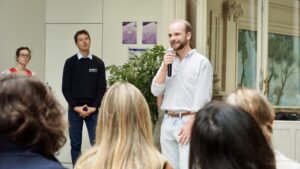
Beyond technical skills, BDDs reinforce team spirit and the ability to adapt. Students, often from diverse backgrounds, learn to collaborate under pressure and to surpass themselves.
Individual mentoring throughout their studies plays a key role here, guiding each student in their academic and professional progress.
Samuel shares: “All this is thanks to the mentors who guide us with honesty. Sometimes they tell you clearly: ‘Your presentation contains the numbers, but it doesn’t tell a story.’ You realize that data alone is never enough. I understood that a good data analyst must also understand the business world. We don’t just collect numbers, we interpret them, connect them, and turn them into decisions. As the databases became more demanding, our skills grew to match them. We started using Python and Pandas more, and strangely enough, things that seemed complex became familiar, even exciting. At La Poste, I never imagined that logistics could be so data-driven until we saw how entire operations rely on real-time analysis. At Carrefour, we discovered how customer behavior analysis shapes business strategy—something I had only read about, but finally saw in action. Today, looking back, I realize how much I accomplished, learned, and grew in such a short time. Each database sets a new, more complex standard—but somehow, in just five minutes, we present a finished piece of work that my team and I have spent weeks refining. Each session teaches us something: how to focus on the essentials, how to express ourselves clearly under pressure, and how to rely on each other to build something bigger than ourselves. “
André concludes: ”The great strength that, in my opinion, makes Albert School unique is the organization and concept of their practical work. […] The mix between intuitive, charismatic, and communicative personalities and thoughtful, rational engineers. This extremely interesting combination allows everyone to challenge themselves in areas where they may not necessarily have had much previous experience, as well as to understand and connect these two normally opposing worlds in a future company. “

Preparation for the major challenges of tomorrow
The programs also have a strong international dimension: exchange semesters, projects carried out with global companies, and diversity of profiles in the classes.
This openness prepares students to evolve in a globalized environment and to understand international economic dynamics.
Graduates of these programs are equipped to support digital and ecological transitions, thanks to training that combines academic excellence and practical experience.
The joint degrees offered by Mines Paris – PSL and Albert School embody a bold vision of higher education: to train individuals capable of linking science and management, theory and practice, to meet the challenges of tomorrow. Through “Business Deep Dives,” students become not only experts in data or management, but also operational professionals upon graduation, capable of innovating, collaborating, and transforming organizations. It is a teaching method that, as André and Samuel say, changes much more than an academic career: it shapes careers and vocations.
Learn more