
Mathematics as a Bridge Between Fields: Olivia Caramello Invited to Mines Paris – PSL
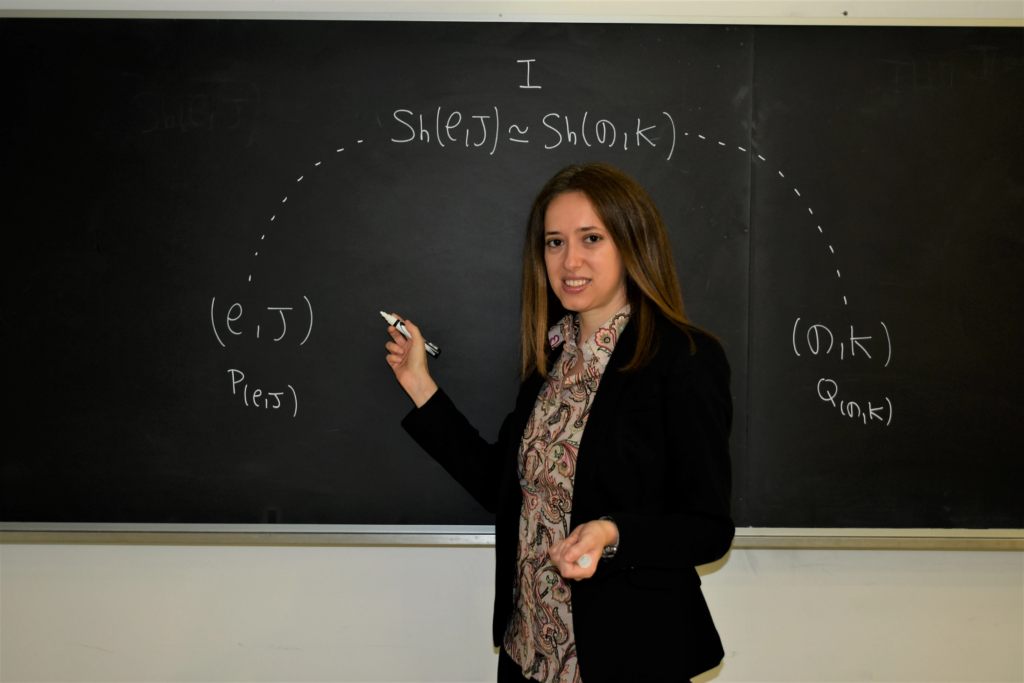
Mines Paris – PSL is welcoming Italian mathematician Olivia Caramello for a research visit focused on applications of topos theory. Her work, which explores the role of “topos-theoretic bridges” in connecting different mathematical theories, is now opening new perspectives well beyond pure mathematics. Olivia Caramello is an associate professor at the University of Insubria, coordinator of the Center for Topos Theory and its Applications at the Grothendieck Institute (which she co-founded), and an affiliated researcher at CentraleSupélec. Through collaborations with the School’s Center for Mathematical Management (CGS) and Center for Computer Science (CRI), this visit aims to investigate the potential of these approaches across fields ranging from formal computer science to management science and contemporary transition challenges.
Building Bridges Between Mathematical Worlds
An internationally recognized Italian mathematician, Olivia Caramello has notably held the Gelfand Chair at the Institut des Hautes Études Scientifiques (IHES) and has led numerous international collaborations in mathematical logic and category theory.
Her research focuses on topos theory, a concept introduced in the 1960s by Alexandre Grothendieck, which provides a framework for describing “mathematical universes” capable of connecting different structures and theories.
For the past fifteen years, Olivia Caramello has developed an original approach: the theory of topos-theoretic bridges. This approach identifies common invariants across different theories, enabling the transfer of results and the emergence of new connections between mathematical domains.
A topos is a space of possibilities: a kaleidoscopic object where different theories fit together by reflecting one another.
.
Connecting Knowledge to Think About Innovation and Transitions
Olivia Caramello’s visit to Mines Paris – PSL aims to explore how these conceptual tools can shed light on questions far beyond pure mathematics. Several of the School’s research centers will be involved in this work.
The CGS has long been interested in formal models of creative reasoning and in studying organizations capable of sustaining collective innovation. In this context, the topos-theoretic approach could help better model the complexity of knowledge structures and design processes.
This work resonates strongly with today’s major transitions, which require both creativity and resource preservation. The topos approach could help formalize these dynamics of “preservative creation,” where innovation is combined with attention to existing systems and environmental or societal constraints.
.
New Connections Between Mathematics, Computer Science, and Engineering
The researcher’s visit will strengthen links between fundamental mathematics and theoretical computer science. At the CRI, Olivia Caramello’s work will be connected with research on formal proofs and proof assistants. Tools such as Dedukti, developed with the French National Institute for Research in Digital Science and Technology (Inria), already enable interoperability between formal systems and the sharing of proof libraries across platforms.
Identifying topos-theoretic invariants could contribute to new methods for translating between logical systems and facilitating interoperability between proof environments. In the longer term, this work may also lead to international conferences, new training initiatives, and the development of research projects within the School.
Three Questions for Olivia Caramello
Your work is based on the notion of “topos-theoretic bridges.” What does this mean, and why is it important for mathematics?
A topos-theoretic bridge is a rigorous correspondence that allows results, methods, or intuitions to be transferred from one theory to another by relying on the invariants they share. These invariants exist in particular at the level of toposes, especially classifying toposes.
Each mathematical theory can be associated with a topos that fully captures its semantic content. This classifying topos makes explicit the full conceptual potential that is implicit in the theory itself. It provides a framework in which one can visualize, organize, and manipulate all possible ways the theory can be realized. By comparing these classifying toposes—and the invariants they share—it becomes possible to identify the conditions under which bridges between theories can be constructed. When a problem is difficult in one theory, it can be translated into another where it becomes more accessible, and the solution can then be transferred back.
This approach is important because it provides a general framework for revealing the deep unity of mathematics. It shows that theories that may appear unrelated can share the same semantic structure, and that by working at the level of toposes, one can uncover new, unexpected, and productive connections.
Your work has so far mainly concerned pure mathematics. What makes its application to other fields, such as computer science or management science, particularly relevant?
What makes these applications relevant is that toposes are not just mathematical objects—they are also frameworks for representing knowledge. They make it possible to model local viewpoints, fragments of information, partial rules, and to understand how these elements can be combined.
In formal computer science, this directly relates to issues of interoperability between logical systems or proof assistants. In management science or the study of innovation, it relates to how organizations combine different perspectives, handle heterogeneous knowledge, and design new solutions under existing constraints.
Classifying toposes, in particular, make it possible to formally capture processes of “preservative creation,” where innovation does not start from scratch but transforms, recombines, or extends existing structures while respecting their core constraints. They make visible the invariants that must be preserved while showing how new configurations can emerge. This opens up applications in modeling innovation processes, analyzing creative organizations, and understanding transitions where the challenge is to innovate without destruction.
In other words, toposes provide a powerful language for thinking about complexity and diversity of perspectives—an issue that extends far beyond mathematics and applies to many domains dealing with rich, distributed, or fragmented systems.
What does this research visit to Mines Paris – PSL represent for you, and what do you hope to develop during it?
For me, this visit is an opportunity to engage with researchers working on questions quite different from my own, but facing similar conceptual challenges: how to structure complex knowledge, how to connect viewpoints, and how to explore possibilities.
I hope these exchanges will help identify new areas where topos-theoretic tools can provide concrete contributions, whether in computer science, innovation process modeling, or the study of transitions. Toposes offer a powerful framework for representing systems where multiple perspectives, heterogeneous constraints, and evolving dynamics coexist.
This capability is particularly relevant in emerging fields such as artificial intelligence. In my recent work, I have shown that relative toposes are especially well suited to modeling the stratification of knowledge: they allow different levels of description, their interactions, and transitions between them to be represented. This hierarchical and flexible structure is essential for designing architectures of artificial general intelligence (AGI) capable of navigating diverse environments, integrating multiple viewpoints, and producing new solutions while preserving structural invariants.
I am also convinced that toposes can play an important role in the social sciences. Their ability to articulate diverse perspectives and make explicit the common structures between seemingly unrelated systems makes them a valuable tool for analyzing human organizations, deliberation processes, and forms of cooperation. They could help imagine more refined and inclusive forms of democracy, capable of integrating heterogeneous information, identifying and leveraging essential invariants of the human condition, and fostering more robust collective decision-making.
This approach extends a vision shaped by my work on toposes: building bridges, opening perspectives, and showing that mathematics can engage with other disciplines to illuminate contemporary challenges.