
TTI.5 Award 2026: Environmental Controversies as a Learning Ground
As environmental crises call for increasingly innovative and collaborative responses, engineering education must integrate a nuanced understanding of the dynamics at play between science, society, and policy. At the TTI.5 Forum – Grand Seminar of the Diplomatic and Consular Academy, held on April 10 on the Paris campus of Mines Paris – PSL under the theme “Environment, science, and technology in shaping foreign policy: what scientific diplomacy?”, the TTI.5 Environmental Controversy Award recognized engineering students’ work on key issues in the ecological transition.
Supported by the course “Describing Controversies,” led by Madeleine Akrich, a researcher at the Center for the Sociology of Innovation (CSI) at Mines Paris – PSL, the award was presented by Matthieu Mazière, Director of Studies for the Civil Engineering program. Understanding the transition also means being able to decipher tensions, confront different forms of knowledge, and cultivate rigorous critical thinking. By recognizing analyses that are both rigorous and thought-provoking, this award embodies a pedagogical approach that places collective intelligence and debate at the core of training future changemakers.
A forum to explore tensions between science, society, and policy
The 2026 Forum of The Transition Institute 1.5 (TTI.5), organized in partnership with the Diplomatic and Consular Academy, explored the connections between environment, science, technology, and foreign policy. This year’s central theme was: “Environment, science, and technology in shaping foreign policy: what scientific diplomacy?” Discussions addressed critical issues such as the governance of mineral resources, the deployment of artificial intelligence, and climate-related challenges linked to space and the subsurface.
Current technological transformations—such as AI, biotechnology, and green technologies—are reshaping geopolitical balances and mechanisms of international cooperation. While promising, these advances raise ethical, economic, and environmental questions. The TTI.5 Forum provided an opportunity to compare perspectives from researchers, institutional stakeholders, and students, to better understand how these issues influence public policy and international strategies.
Active pedagogy to address environmental controversies
Madeleine Akrich, researcher at CSI and head of the “Describing Controversies” course, highlights the importance of this teaching approach:
This course aims to raise students’ awareness of the complexity of environmental issues by immersing them in real-world controversies. The goal is to help them understand that technical solutions alone are not enough: social, political, and economic dimensions must also be taken into account.
Students worked on three projects reflecting current and often polarized debates:
- Net Zero Land Take: a realistic and appropriate objective? by Jolan Guilley and Benjamin Somson
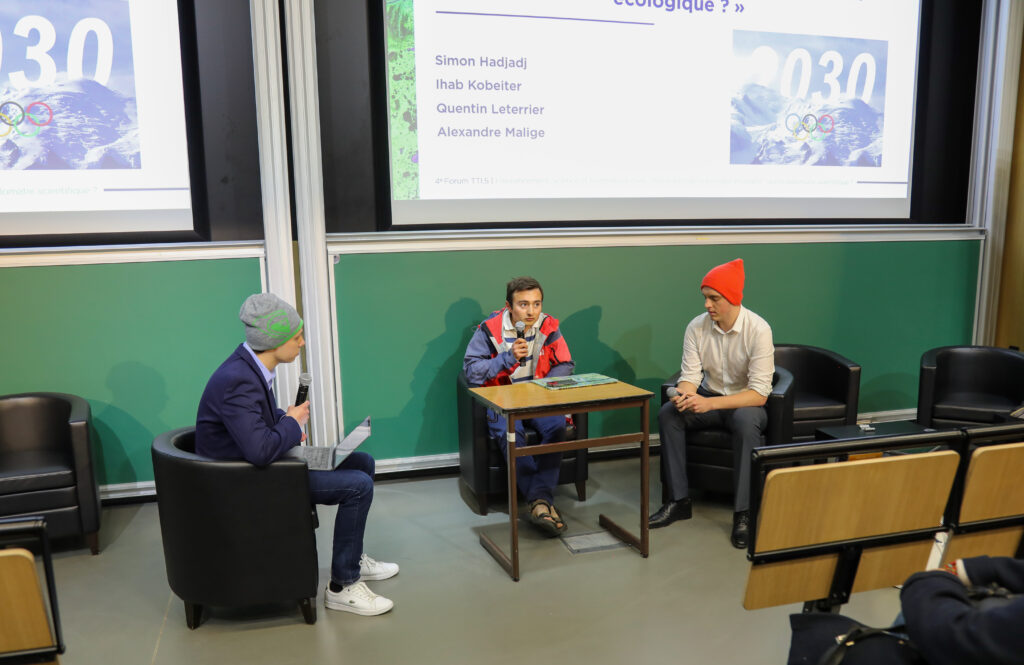
- Winter Olympics in France: an absurdity or an opportunity for the transition? by Simon Hadjadj, Ihab Kobeiter, Quentin Leterrier, and Alexandre Malige
- How should greenhouse gas emissions from livestock be accounted for? by Marie Aubert, Hadrien Do Cao, and Nicolas Rousseau
Madeleine Akrich, researcher at the CSI and head of the course “Describing Controversies.” ©Jean-Marc Dufour – Mines Paris – PSL
Controversies at the heart of ecological challenges
Net Zero Land Take: a realistic and appropriate objective?
The Net Zero Land Take (ZAN) objective aims to reduce the consumption of natural, agricultural, and forest land to reach neutrality by 2050. Students explored the tensions between land protection and the needs of economic and territorial development. Their analysis highlighted implementation challenges, including difficulties in measuring land take, issues related to ecological compensation, and tensions across different territorial scales.
Winter Olympics in France: an absurdity or an opportunity for the transition?
The 2030 Winter Olympics, planned in the French Alps, were at the center of this project. Students analyzed controversies surrounding the environmental impact of the Games, issues of public consultation, and promises of ecological transition. Their work also explored tensions between economic development needs and ecological sobriety goals.
How should greenhouse gas emissions from livestock be accounted for?
This project addressed the complex issue of accounting for greenhouse gas (GHG) emissions related to livestock. Students analyzed different accounting methods, such as Global Warming Potential (GWP) and GWP*, and their implications for emission reduction policies. They also explored tensions between intensive and extensive livestock systems, as well as the challenges of reducing herd sizes.
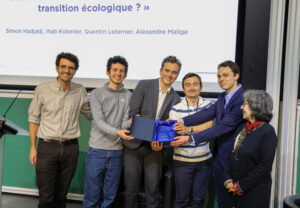
Matthieu Mazière and Madeleine Akrich present the Environmental Controversy Award to Simon Hadjadj, Ihab Kobeiter, Quentin Leterrier, and Alexandre Malige for their work on the topic “Winter Olympics in France: an absurdity or an opportunity for the transition?” ©Jean-Marc Dufour – Mines Paris – PSL
Thinking about the ecological transition in all its complexity
The 2026 Environmental Controversy Award was presented to Simon Hadjadj, Ihab Kobeiter, Quentin Leterrier, and Alexandre Malige for their original treatment of the topic “Winter Olympics in France: an absurdity or an opportunity for the transition?” Through these projects, students highlighted often-overlooked dimensions: power relations, conflicts of interest, the plurality of expertise, and the collective imaginaries that shape environmental choices. By rewarding such analyses, the award encourages thinking about the transition not merely as a technical challenge, but as a societal issue.
Matthieu Mazière, Director of Studies for the Civil Engineering program, emphasizes the importance of this subject:
This course is a true lesson in nuance. Students learn to confront divergent viewpoints, analyze complex controversies, and propose informed solutions. It is a unique resource for training engineers capable of addressing tomorrow’s challenges.
By showcasing the richness of controversies, this award promotes an active pedagogy based on inquiry, the confrontation of arguments, and critical examination—an illustration of Mines Paris – PSL students’ commitment to developing genuinely informed solutions.
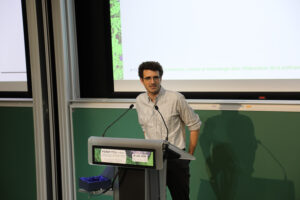
Matthieu Mazière, Director of Studies for the Civil Engineering program (IC). ©Jean-Marc Dufour – Mines Paris – PSL