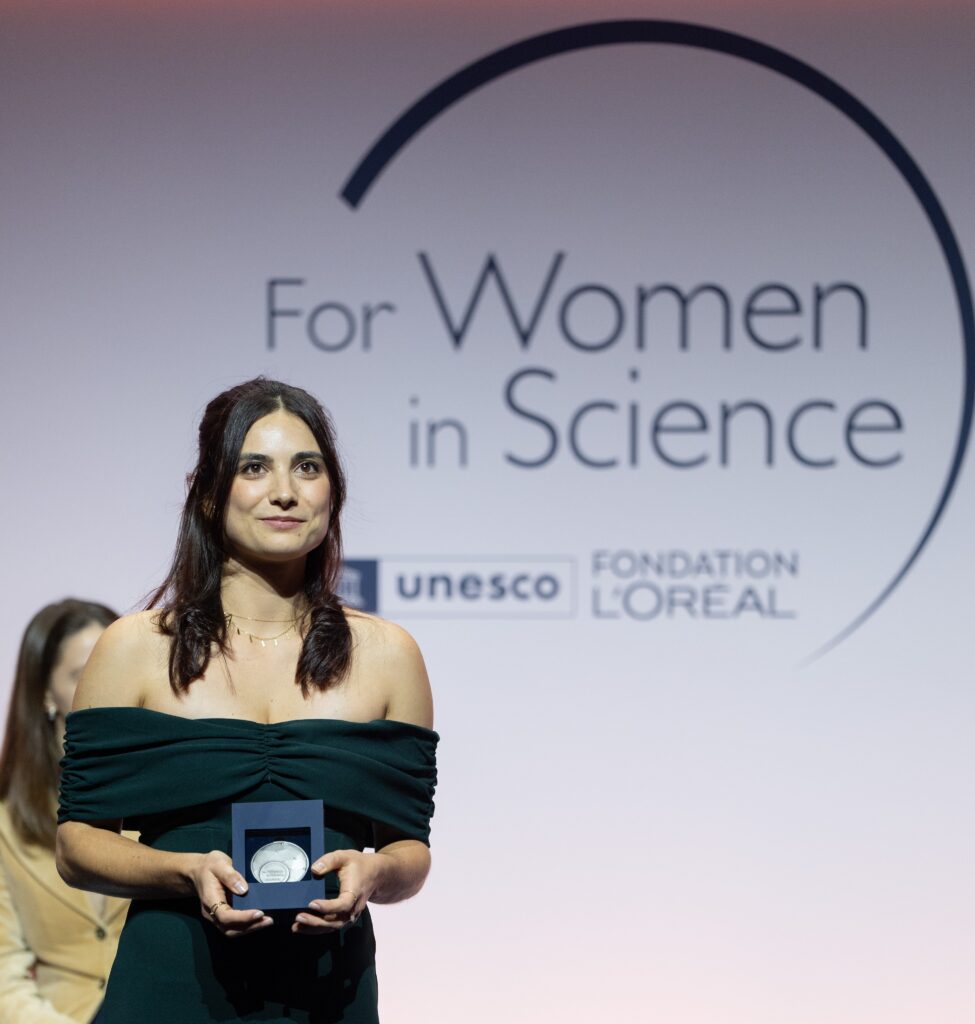
The L’Oréal-UNESCO For Women in Science Young Talents Award
Created in 2007, this award is part of the international “For Women in Science” program launched by the L’Oréal Foundation and UNESCO in 1998. Each year, it rewards promising doctoral and post-doctoral students in France at a pivotal moment in their careers, enabling them to join an international community of more than 4,700 women scientists from over 140 countries.
The winners receive a financial grant and a leadership training program to boost their confidence, visibility, and ability to take on scientific responsibilities. Their commitment helps to remove the barriers that still exist in women’s scientific careers and to inspire future generations of female researchers.
Crédit Fondation l’Oréal
Transforming textile waste into sustainable materials of the future
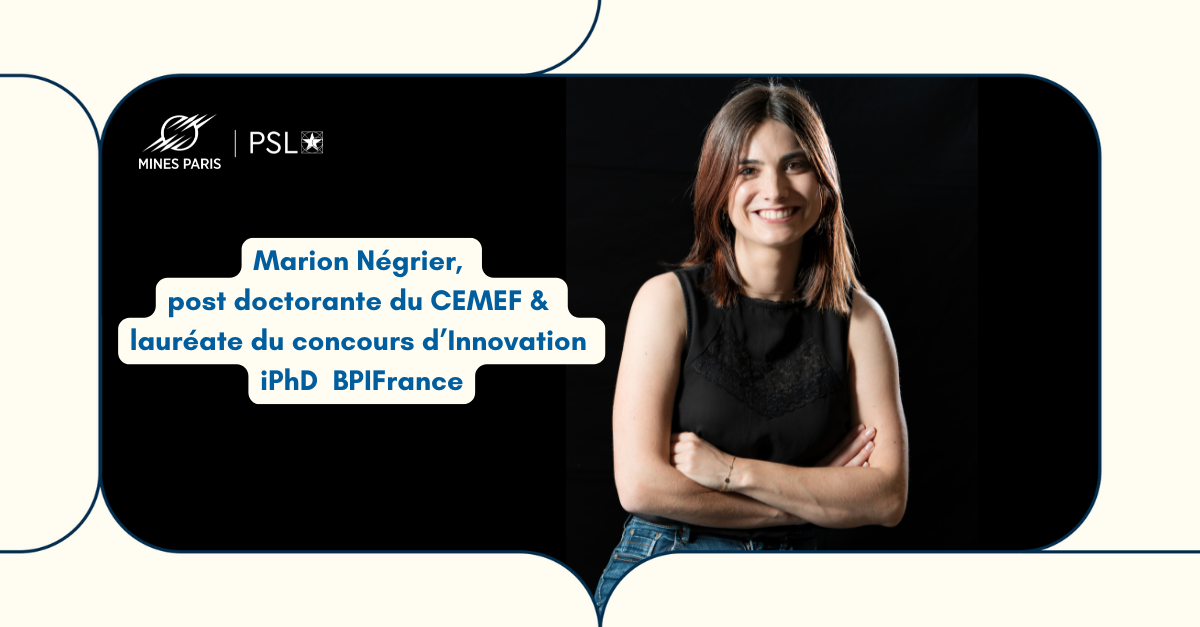
Winner in the “Innovating for a Sustainable Future” category, Marion Négrier is currently devoting her postdoctoral research to developing a chemical recycling process with low environmental and economic impact. This process separates synthetic fibers (polyester, polyamide) from plant-based fibers (cotton, viscose) in order to transform the latter into versatile biomaterials that are 100% recycled and recyclable.
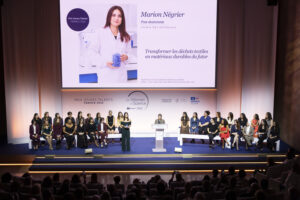
These materials, designed as genuine alternatives to fossil-based plastics such as polystyrene and polypropylene, have applications in a variety of sectors, from decoration to packaging and furniture. The aim of this postdoctoral program is to create a start-up from Mines Paris – PSL in 2026, dedicated to the production of these sustainable and innovative materials.
Working on a topic related to resource recovery is a no-brainer, and when I discovered the world of the textile industry and its many issues during my thesis, I knew I wanted to devote my future work to it. My scientific approach is part of a desire to respond to real and urgent issues. It aims to continuously improve existing processes while developing new ones.
Prior to this project, Marion Négrier devoted her thesis, carried out at CEMEF under the supervision of Tatiana Budtova, Elise El Ahmar, and Romain Sescousse, to the recovery of cellulosic textile waste through the development of cellulose aerogels, porous materials with high added value. Her work explored different processes (prilling, additive manufacturing, 3D printing) to create lightweight, modular materials with a high specific surface area. Faced with environmental challenges and the need to rethink our modes of production and consumption, her research combines technological innovation, sustainability, and social responsibility.
Her scientific rigor and expertise in polymer chemistry and shaping processes have already earned her several awards, including the i-PhD 2024 competition, as well as high-level publications and a patent currently pending.
Marion perfectly embodies the values that this program seeks to promote: scientific excellence, innovation, and social commitment. Her research on the chemical recycling of cellulosic textiles into new sustainable materials is fully in line with current environmental issues, offering innovative solutions that can be applied on an industrial scale to combat textile pollution. She stands out for her creativity, independence, and ability to bring people together. Her dynamism and perseverance enable her to overcome the challenges inherent in her field of research and provide concrete solutions to major environmental and industrial issues.
Elie Hachem, Director of CEMEF
A researcher committed to accessible science
Beyond her research, Marion is actively involved in popularizing science and sharing knowledge, particularly with young audiences, in order to make science more accessible, inclusive, and inspiring.
Her career path illustrates Mines Paris – PSL’s commitment to training researchers who combine scientific excellence, creativity, and social engagement.
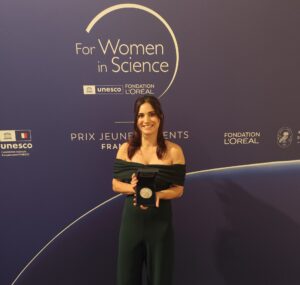
3 questions for Marion
Your research focuses on recycling textiles into sustainable materials. Can you explain how this is an innovative response to current environmental challenges?
“Today, only 7% of textile waste is recycled, only 1% is reprocessed into yarn, and the amount discarded continues to increase, currently reaching 100 million tons per year worldwide (roughly equivalent to 15 pyramids of compressed textiles). The problem? Fiber mixtures, contamination, and the poor quality of certain materials. New methods of recycling this unused waste with high potential are needed to drastically reduce the environmental impact of the textile industry. My postdoctoral research consists of developing a green process for chemically recycling cellulosic textiles, whether pure, contaminated, or mixed with synthetic fibers, into new versatile materials capable of replacing everyday plastics. Yes, cotton-based imitation plastic is possible! In this sense, challenging the collective imagination and encouraging new generations, especially young women, to turn to science and invent the technologies of tomorrow.
What motivated you to devote yourself to this research topic and what meaning do you give to your scientific approach?
I have always had an appetite for environmental issues, particularly those relating to the transformation of materials. Working on a topic related to resource recovery was an obvious choice, and when I discovered the world of the textile industry and its many challenges during my thesis, I was determined to devote my future work to it. My scientific approach is part of a desire to respond to real and urgent issues. It aims to continuously improve existing processes while developing new ones. It is my tool and my way of actively participating in major environmental challenges, putting science at the service of sustainable solutions. “
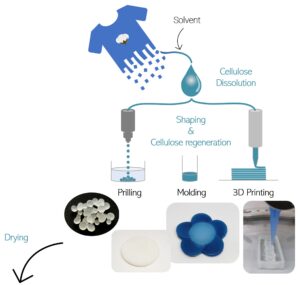
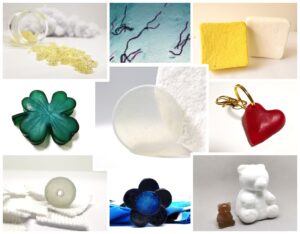 Process for transforming cellulosic textiles into new materials – examples of “plastic-like” creations made from plant-based textile materials
You are involved in popularizing science and mentoring young people. How do you hope to inspire future generations of women scientists through your career?
“I have participated and continue to participate in numerous initiatives set up by various organizations, and I love sharing my educational background and anecdotes with students. I show them that it is possible to explore different paths before finally finding a career that suits us… and that it is also possible to change careers! I try to pass on my passion for research and innovation and inspire them in this way. Science is a huge playground to explore and share with others, and it’s not just for men! I encourage them to have confidence in themselves, to be bold and to follow their ideas.“
To go further: