
Energy-efficient water and air management: STEM, a startup from Mines Paris – PSL, at VivaTech 2026
How can we reduce energy consumption in industrial processes? And how can we treat industrial wastewater while minimizing water withdrawal? In response to these two major challenges of the ecological transition, STEM offers a solution based on innovative membrane technology developed through research conducted at Mines Paris – PSL. A spin-off of the School founded in 2020 and led by Assaad Zoughaib, professor at the Center for Energy, Environment, and Processes (CEEP), STEM develops solutions capable of reducing energy requirements for industrial dehumidification by up to 75% and recovering up to 80% of industrial wastewater. Presented at VivaTech 2026, this innovation illustrates Mines Paris – PSL’s commitment to deep-tech entrepreneurship in support of environmental transitions.
Two Industrial Challenges, One Technology
Today, industry faces three major, mutually reinforcing challenges: rising energy costs, decreasing availability of fresh water, and increasingly stringent environmental standards regarding discharges and resource consumption. In this context, two technical challenges frequently arise: first, controlling the humidity of the air in industrial process environments, and second, treating industrial effluents—wastewater loaded with pollutants from industrial processes (metals, solvents, organic compounds, etc.).
These issues affect a wide range of sectors that are highly dependent on controlled production conditions: the food industry, pharmaceuticals, electronics, chemicals, and even gigafactories, where air must be controlled to ensure product quality and worker safety. In many cases, the solutions currently in use rely on proven but energy-intensive processes, which significantly increase their cost and environmental impact.
To address these limitations, STEM, a startup spun out of Mines Paris – PSL, has developed an approach that tackles both of these challenges. It relies on water vapor membrane exchange, a process that uses hydrophobic membranes that allow only water vapor to pass through while retaining liquid, combined with the use of low-temperature waste heat—thermal energy typically lost by industrial facilities and reused here to power the process at very low energy cost.
Membranes for effective dehumidification
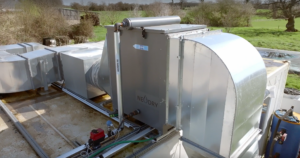
The first product developed by STEM, NEODRY aims to rethink how industry controls air humidity in its facilities. This control of industrial dehumidification is essential in many environments: pharmaceutical cleanrooms, where the air must be extremely dry and clean; food-freezing units; and lithium-ion battery manufacturing sites, where the presence of moisture can degrade material performance.
Today, most systems rely on desiccant wheels: devices containing materials capable of adsorbing water from the air. To be reused, these materials must then be “regenerated,” meaning heated to release the water they have captured. This heating step requires high temperatures and therefore accounts for a significant portion of the system’s overall energy consumption.
The technology developed by STEM offers a different approach. It relies on polymer membranes porous to water vapor, forming a liquid-tight framework. Moisture is thus absorbed by a concentrated saline solution circulating within the frameworks. This solution is then regenerated: it is concentrated in salt again, but this time at a low temperature (between 30 and 40 °C) using waste heat.
This approach reduces energy consumption by up to 75% compared to conventional systems, with a return on investment generally ranging from three to five years.
Turning Effluents into Resources
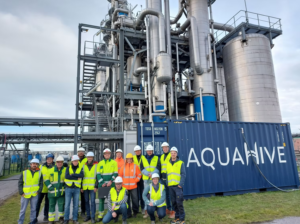
STEM also applies its membrane-based approach to industrial water treatment with its second process, AQUAHIVE. This process is designed to treat industrial effluents—specifically wastewater generated by manufacturing processes—which often contain substances that are difficult to treat, such as heavy metals, solvents, organic compounds, and PFAS.
Today, these effluents are generally treated using processes such as evaporation-concentration—which involves evaporating the water to concentrate the pollutants—or advanced filtration techniques. These solutions are effective but often costly, as they consume significant amounts of energy and require several upstream treatment steps to prevent damage to the facilities.
AQUAHIVE offers a different approach based on a hydrophobic membrane, a material that acts as a very thin barrier: only water vapor can pass through it, while pollutants remain on the effluent side. The water vapor is then recovered and condensed back into liquid water, achieved with a very high level of purity, allowing it to be directly reused in industrial processes, such as for steam production or cleaning.
This technology allows for the concentration of up to 80% of pollutants in a reduced volume of water, while recovering reusable water. The entire system operates with low energy consumption, as the process utilizes low-temperature waste heat.
Innovation Driving Industrial Transition
Beyond technical performance, the solutions developed by STEM are part of a broader approach to the evolution of industrial models.
How can we reduce processes’ energy dependence? How can we make better use of the resources already available at production sites? How can we limit water withdrawal and environmental discharges?
By harnessing waste heat—an energy source often lost—and promoting water recycling, STEM offers concrete solutions to these challenges.
The company aims to become a leading player in industrial greentech, balancing economic performance with a reduced environmental footprint.
From Mines Paris – PSL research to industrial innovation
Founded in 2020, STEM is a spin-off from Mines Paris – PSL. Its innovations stem from research conducted at the Center for Energy, Environment, and Processes (CEEP) at the School.
Assaad Zoughaib, STEM’s scientific director and head of the Systems Thermodynamics research group at CEEP, is the originator of NEODRY technology. Working alongside him, Rasha Mustapha, a PhD graduate of Mines Paris – PSL and co-founder of the company, leads the startup’s research and development activities.
This continuity between academic research and industrial development illustrates Mines Paris – PSL’s ability to foster scientific innovations that address society’s concrete needs.
VivaTech, an international showcase for research and entrepreneurial innovation
VivaTech has established itself as the global gathering for startups, companies, and research stakeholders shaping the technologies of tomorrow. For its first participation in the event, PSL University, of which Mines Paris – PSL is a member institution, will present some twenty projects from its member institutions, in collaboration with the University Innovation Hub (PUI) and the University’s entrepreneurial ecosystem.
STEM’s presence at VivaTech 2026 highlights the role played by Mines Paris – PSL in transforming scientific knowledge into concrete innovations capable of supporting the energy and environmental transitions.
This collective presence reflects a strong ambition: to support the entire innovation journey, from the emergence of ideas in laboratories to the creation of deeptech companies addressing major industrial and societal challenges.
Visit the PSL University booth
- June 17–19, 2026 – Paris Expo Porte de Versailles
- Hall 7 • Zone B • Booth 2C01
- The full program
Mines Paris – PSL, a breeding ground for impactful deep tech
By supporting initiatives like STEM, Mines Paris – PSL affirms its commitment to research that is open to the socio-economic world. The School supports its researchers and entrepreneurs through the various stages of their projects’ development: technological development, industrial partnerships, knowledge transfer, and business creation.
STEM exemplifies this dynamic. Built on high-level scientific expertise in energy and process engineering, the startup develops technologies that reconcile industrial competitiveness with resource efficiency.
At VivaTech, it will thus showcase a vision of innovation deeply rooted in the missions of Mines Paris – PSL: putting science to work to address the major challenges of our time and helping to build a more sustainable industry.