An innovative format to bring science and society closer together
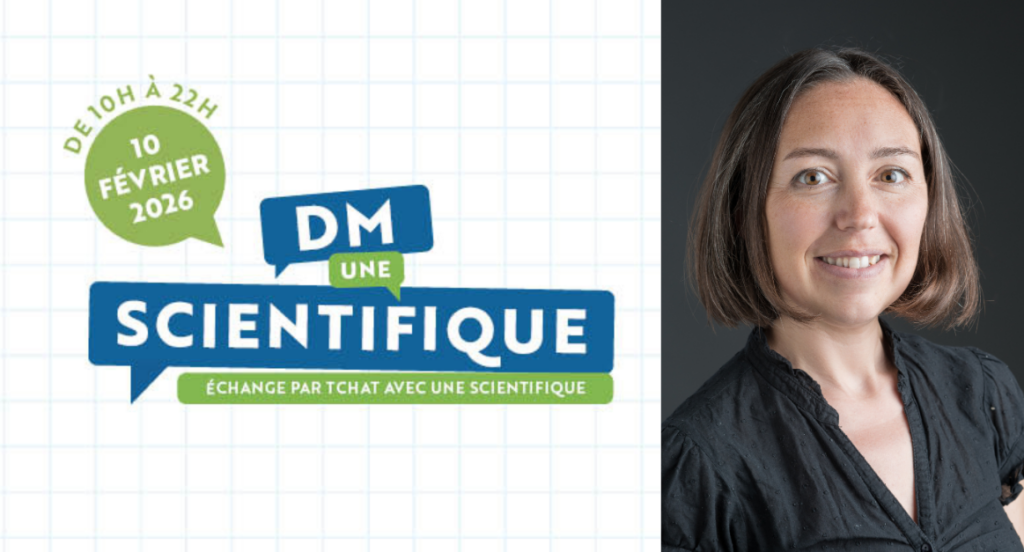
Organized as part of the SCIENCE AZUR project, certified Science With and For Society (SAPS) by the Ministry of Higher Education, Research, and Space, the “DM une scientifique” event was held on February 10, 2026, in the form of an online chat accessible to the general public and schoolchildren.
For several hours, nearly fifty women scientists (doctoral students, engineers, technicians, and researchers) from various disciplines answered questions from participants live. This format of exchange, inspired by social media, allowed for spontaneous and direct discussions about scientific professions, career paths, and current research topics.
At Mines Paris – PSL, this dynamic resulted in the involvement of several scientists with complementary profiles, engaged in both fundamental research and the analysis of major contemporary societal issues.
The aim of the initiative was to make science more accessible, to deconstruct certain representations still associated with scientific careers, and to encourage the emergence of vocations, particularly among young people.
A collective mobilization at Mines Paris – PSL around various disciplines
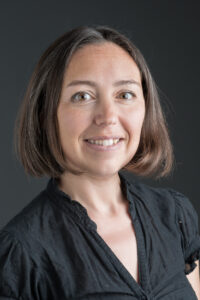
Among the scientists involved, Sandrine Selosse, director of research at the Center for Applied Mathematics (CMA) at Mines Paris – PSL in Sophia Antipolis, participated in discussions in the field of low-carbon technologies and public policy.
With a PhD in Science and Innovation Economics from GREDEG (CNRS – Université Côte d’Azur), she conducts research on international climate policies and energy transition, which she approaches through prospective models of the energy system. Her work also focuses on incentives for individual behavioral change, an essential lever for reducing energy consumption and supporting the societal transformations necessary to address climate challenges.
Her participation in “DM une scientifique” is part of an approach to knowledge sharing and scientific mediation, showcasing research closely linked to major contemporary challenges. Sandrine thus demonstrates her commitment to strengthening dialogue between science and society, promoting scientific careers, and disseminating knowledge to all audiences.
Alongside Sandrine Selosse, two other colleagues from Mines Paris – PSL took part in the “DM une scientifique” initiative.
Rachel Pierre-Léandre, a doctoral student at the Center for Applied Mathematics (CMA), conducts research in prospective modeling and structural inequalities. Her work focuses on energy transition trajectories in Martinique, analyzing how colonial and post-colonial legacies continue to shape economic, energy, and social inequalities. From a post-growth and decolonial perspective, her research aims to rethink energy-climate models so that social, distributive, and political goals guide the construction of transition trajectories.
Talking with young people forced me to simplify my profession in order to inspire them to explore these topics, and it also made me rethink what it means to be a researcher and our place in society. It was extremely rewarding to share my passion for research, even at the beginning of my career.
Rachel Pierre-Léandre
Séverine A.E. Boyer, a CNRS researcher at Mines Paris – PSL, conducts fundamental and applied research on the mechanisms of multi-scale polymorphogenesis in organic-based, functional hybrid structural materials under severe or complex environmental conditions. Her work, illustrated in particular by the phenomena of crystallization, solidification, gelation, and foaming, is part of the challenge of disruptive innovation, with applications in various sectors such as luxury and beauty, transportation, new energies, recycling, and bio-resources.
This diversity of research fields reflects Mines Paris – PSL’s commitment to open science, rooted in the environmental, social, and industrial challenges of the future.
This commitment echoes Mines Paris – PSL’s desire to actively contribute to a more open and inclusive science that is in tune with the challenges of our time.