Hydrogen to Decarbonize the Oceans
Shipping accounts for nearly 90% of global trade. But it also accounts for about 3% of global greenhouse gas emissions—a share that is set to grow without a fundamental transformation of propulsion technologies. Faced with new European regulations, notably FuelEU Maritime and the integration of the sector into the European carbon market, the industry must now accelerate its transition to low-carbon solutions.
Among the various avenues being explored, hydrogen-powered fuel cells are among the most promising. Unlike an internal combustion engine, they directly generate electricity from hydrogen and oxygen, without combustion and with water as their only byproduct. This technology is already used in certain land vehicles, such as cars, but adapting it to the maritime sector requires a complete change of scale.
This is the goal of the European MARINER project, coordinated by the Norwegian Research Center (NORCE) and funded by the Horizon Europe program to the tune of nearly 7 million euros. Its objective is to develop a modular 1 MW fuel cell system capable of being scaled up to 10 MW to power increasingly powerful ships. The consortium brings together fourteen international industrial and academic partners covering the entire value chain, from fuel cell design to their integration aboard ships.
Scaling Up from a Car to a Ship
At first glance, it might seem sufficient to simply assemble several existing fuel cells to achieve one megawatt of power. In reality, scaling up faces physical limitations. The fuel cells currently used in industrial applications deliver a few hundred kilowatts. Scaling up to the megawatt level is therefore not simply a matter of “adding” fuel cells: certain mechanical, thermal, or fluid-flow-related phenomena take on new significance and require a complete rethinking of the system’s architecture.
To understand this challenge, we must examine how a fuel cell works. Its principle is based on two reactions that take place on electrodes located on either side of a membrane, within electrochemical cells—the basic building blocks of the fuel cell: an oxidation reaction of hydrogen (H2), which breaks the molecule down into protons and electrons, and a reduction reaction of oxygen (O2), which reacts with the protons and electrons to produce water. The gas-tight, electrically insulating membrane allows only protons to pass through. The electrons travel through an external circuit that connects the two electrodes: the electric current thus generated can be used to power equipment, such as an electric motor.
However, a single cell produces only a low voltage (around 0.6 V during operation) and a current limited by the surface area of the electrodes. To obtain more power, several hundred cells are stacked on top of one another, forming a “stack.” But as the number of cells increases, so do the constraints—particularly mechanical ones—related to variations in membrane thickness during operation. It also becomes increasingly difficult to maintain uniform operating conditions throughout the entire stack. Beyond a certain size, these constraints ultimately limit the system’s performance and lifespan.
The MARINER project proposes a modular architecture. Rather than building a single giant one-megawatt stack, several modules of approximately 200 to 300 kW will be combined to achieve the desired power output. Each of these modules serves as a building block that can then be replicated to eventually design systems up to 10 MW. This approach helps maintain performance, facilitates maintenance, and makes the industrialization of these future fuel cells more feasible.
A Balance Between Temperature, Humidity, and Performance
Generating electricity is only part of the challenge. To function properly, a fuel cell must be maintained under highly controlled conditions. An imbalance can reduce its performance, accelerate its aging, or even damage it.
The first challenge relates to temperature. The overall reaction generates a great deal of heat. About half of the energy contained in hydrogen is converted into electricity, while the other half is released as heat. However, the membranes used cannot withstand excessively high temperatures: above about 90 °C, they degrade rapidly. It is therefore essential to continuously circulate a coolant to dissipate this heat. On a ship, this thermal energy can then be recovered, significantly improving the system’s overall efficiency.
But temperature is not the only parameter that must be controlled; the level of gas humidification is also critical. The membranes must remain well-moistened. If they dry out, they no longer allow protons to flow properly, blocking the electrochemical reactions. Conversely, the presence of liquid water in the electrodes blocks the flow of hydrogen and oxygen, which reduces the fuel cell’s performance.
The system must therefore constantly strike the right balance among numerous parameters: gas pressure, cooling circuit flow rate, temperature, humidity, and power distribution among the various modules. All these settings change continuously depending on the ship’s energy demand and must be coordinated with great precision.
The Mathematics Behind Fuel Cell Operation
A fuel cell is a system whose performance constantly depends on operating conditions: hydrogen supply, humidity, thermodynamic conditions, and more. It is in this complex interplay that the CAS teams come into play. Using numerical models and advanced control strategies, they develop tools capable of controlling these fuel cells in real time to ensure they remain efficient, safe, and durable.
Researchers are developing digital twins that replicate the fuel cell’s behavior in order to anticipate its aging, optimize its operation, and detect early signs of failure before they become critical. These models are also used to estimate, in real time, internal parameters that cannot be measured directly—such as membrane humidity—which is essential for effectively controlling the fuel cell.
The project also calls for the development of new control strategies to distribute power among the fuel cell’s various modules. If one of them begins to age more rapidly, the system will be able to automatically adapt its operation to preserve the entire system while ensuring the power required by the ship.
This intelligent monitoring system is one of MARINER’s most significant innovations. It will not only extend the equipment’s service life but also reduce operating and maintenance costs—two essential conditions for the industrial adoption of this technology.
Viewing the Fuel Cell as a Complete Energy System
The service life of a fuel cell is difficult to estimate under real operating conditions, as it is linked to several degradation phenomena occurring in parallel, the severity of which depends heavily on how the fuel cell is operated (start-ups/shutdowns, operating temperature, power levels, etc.).
These degradation phenomena become significant and observable after hundreds of hours of operation. Understanding them requires targeted testing in which extreme operating conditions are applied to accelerate specific degradation phenomena or those representative of normal operation. However, these accelerated aging tests (Accelerated Stress Tests) are very costly in terms of time and resources.
The use of simple numerical models, calibrated against experimental data obtained in the laboratory on scaled-down systems (a few kilowatts), makes it possible to extrapolate the degradation phenomena observed experimentally, estimate the lifespan of high-power systems, and develop control strategies to extend that lifespan. However, accounting for various degradation phenomena in numerical models remains an active area of research. The PERSEE Center is involved in developing these models, notably through an open-source platform for modeling PEMFC fuel cells.
As part of the MARINER project, researchers at the PERSEE Center are tasked with characterizing the performance and degradation of the fuel cells used in the laboratory and providing calibrated numerical models to support the development of the 1 MW system and the definition of test conditions representative of the actual system. In addition, the numerical models developed will be integrated into existing open-source tools, and the PERSEE Center will develop a two-day training course on fuel cell modeling to promote the dissemination of the project’s results and developments.
Collaborative, Transdisciplinary Research to Support the Energy Transition
Before it can be installed on commercial vessels, the system developed by MARINER will need to demonstrate its reliability under conditions that closely resemble actual operating conditions. The project therefore calls for more than 1,000 hours of testing on a 1 MW demonstrator, supplemented by accelerated aging protocols to estimate its behavior over the equivalent of 40,000 hours of operation. These tests will inform the numerical models, control strategies, and predictive maintenance tools developed by CAS and the PERSÉE Center.
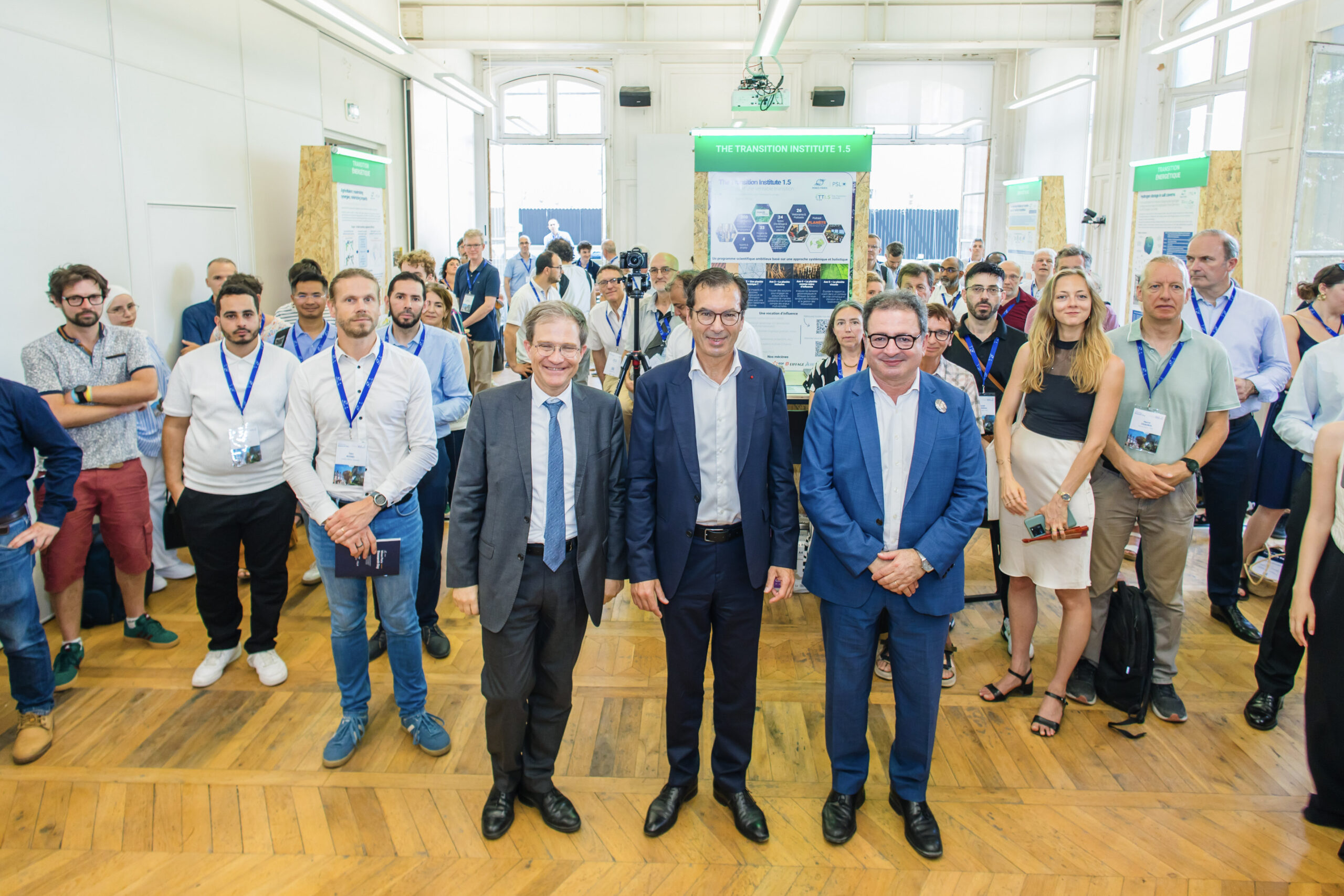
Presented at the Mines Paris Research Day 2026, this project illustrates the mission of the collaborative research led by Mines Paris – PSL: to foster dialogue between transdisciplinary basic research, engineering, and industry on an international scale, in order to accelerate the transfer of innovations into practical applications. Organized around four major scientific and industrial challenges, the event brought together more than 450 researchers, companies, and institutional partners to discuss over fifty research projects, demonstrating the School’s role in supporting major contemporary transitions.
With MARINER, this ambition takes the form of a challenge that is as much scientific as it is industrial: transforming an emerging technology into a solution robust, reliable, and high-performing enough to support the decarbonization of maritime transport on a large scale.