A historic and formative scientific project
STIM is part of the School’s scientific history, which began in the 1950s with Georges Matheron and Jean
Serra, founders of geostatistics and mathematical morphology at Mines Paris-PSL, two disciplines which, although distinct, shared a passion for spatial data analysis. For decades, these two communities evolved side by side, sometimes collaborating. Today, the convergence of approaches, accelerated by the rise of AI, makes the merger of the Center for Mathematical Morphology (CMM) and the geostatistics team at the Center for Geosciences both natural and necessary to enable Mines Paris-PSL to remain competitive and innovate in a rapidly evolving field.
The STIM center will be composed of 13 faculty members, one administrative staff member, and 40 doctoral students (half of whom are co-supervised with other centers at the School) to develop high-level methodological research combining artificial intelligence, geostatistics, mathematical morphology, and probabilistic and physical modeling.
AI is approached as a tool, integrated into knowledge-informed models, with a particular focus on interpretability, uncertainty estimation, and methodological restraint. The center’s strength lies in its ability to combine AI with its historical expertise in a hybrid approach.
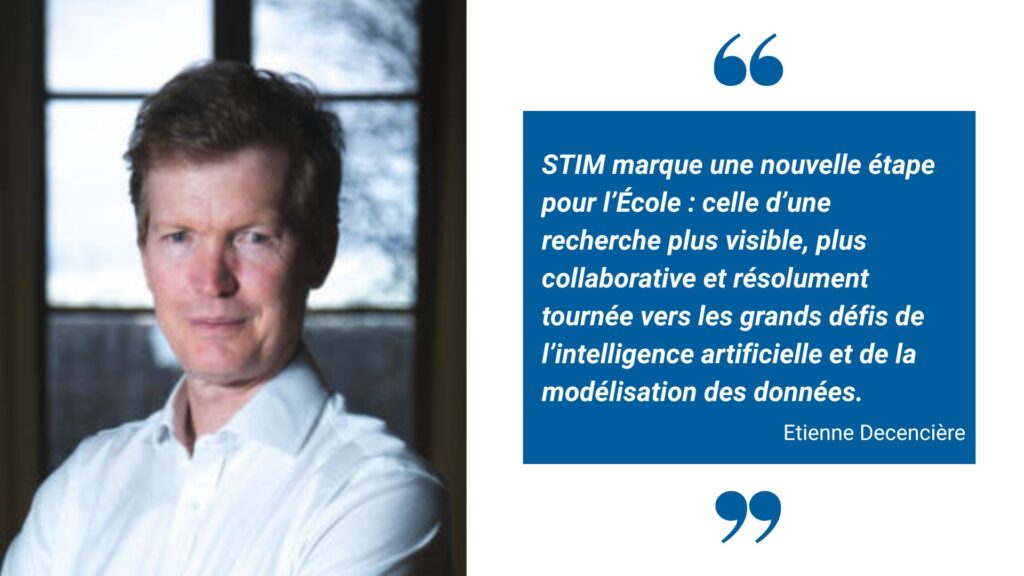
STIM marks a new stage for the School: one of more visible, more collaborative research that is resolutely focused on the major challenges of artificial intelligence and data modeling. Designed as an open and connected center, STIM also aims to strengthen its ties with the socio-economic world: working alongside companies, developing sustainable partnerships, and promoting the expertise of Mines Paris – PSL. This dynamic does not erase historical collaborations: the teams will continue to work closely with the Geoscience Center, considered an essential ally in this new organization.
Étienne Decencière, Director of the new STIM center.
STIM was created to continue and strengthen the role of Mines Paris – PSL at the forefront of research in artificial intelligence and digital transformations, applied to the major scientific and technological challenges of the decarbonization – resources – materials continuum.
Paolo Stringari, Director of Research at Mines Paris – PSL
An open and collaborative center
STIM is designed to be an open, connected center based on partnerships, thanks to existing collaborations within the School, but also to links with the socio-economic world. The center relies on solid industrial partnerships, particularly in the fields of geosciences, materials, the environment, biomedicine, and industrial vision.
Several structural projects are underway, including the PRIOR consortium on generative AI for the subsurface, the work of the chair “Equipping companies with AI for biodiversity issues” in collaboration with ISIGE and the Geosciences Center, and the renewal of the Geolearning chair.
A coherent teaching component
STIM aims to play a central role in the training offered by Mines Paris – PSL, ensuring the thoughtful organization of AI-related options and working to make the courses more accessible to engineering students and specialized training programs in conjunction with the Teaching Department. The Center will be entirely responsible for the redesigned Geostatistics and Applied Probability option and will be jointly responsible for the MAREVA, IDSC, and Geosciences options. It will also be involved in the development of the core curriculum (probability, signal processing, integral calculus, differential calculus, data science).
MAREVA, IDSC, and Geosciences options. It will also be involved in developing the core curriculum (probability, signal processing, integral calculus, differential calculus, data science) as well as several specialized courses (Geostatistics, Physics and Mechanics of Random Media, Deep Learning for Image Analysis, Extreme Values Statistics, Machine learning for physics and engineering, Image analysis: from theory to practice, Inverse problems).
To understand the origins, ambitions, and prospects of this project, we met with Étienne Decencière, Director of the Center for Mathematical Morphology and one of the main architects of this merger.
This merger between the CMM and the geostatistics team seems almost obvious today. However, it was not always a priority. How did this idea emerge, and what made it inevitable?
The history of this merger actually goes back much further than one might think. In the 1960s, Georges Matheron and Jean Serra laid the foundations for geostatistics and mathematical morphology, two disciplines that, although distinct, shared a common passion for spatial data analysis. For decades, these two communities evolved side by side, sometimes collaborating, often working in parallel. However, with the emergence of artificial intelligence, something changed.
Both teams embraced AI with enthusiasm and success. We realized that our methods were converging: whether analyzing images, generating subsurface models, modeling materials, or studying environmental phenomena, we were using increasingly similar approaches. The idea of merging our strengths was born from this observation. Nicolas DESASSIS, Head of the Geostatistics Team, was the first to formalize it, proposing the creation of a single center that would bring together our expertise. It quickly became clear that this merger was not only an opportunity, but a necessity in order to remain competitive and innovative in a rapidly evolving field.
What convinced the teams was the prospect of creating something greater than the sum of our parts. We already had a common scientific culture, shared tools, and a desire to gain autonomy and visibility. Paolo Stringari played a key role in challenging us: “Build a common scientific project that brings you together.” We took up the challenge, and after rich and constructive discussions, the merger was unanimously approved. Today, we are ready to write a new page in our history, together.
You talk about STIM as a center “at the heart of AI.” Yet you also insist that AI is just one tool among many. How do you reconcile these two visions?
When we say that STIM is “at the heart of AI,” that doesn’t mean we limit ourselves to it. Quite the contrary. For us, AI is a powerful tool, but it must not overshadow the methods we have developed over decades in geostatistics and mathematical morphology. One of our strengths lies in our ability to combine AI with our historical expertise, whether to generate data, analyze uncertainties, or solve complex problems.
Our approach is deeply hybrid. We are not abandoning our roots: we are enriching them with contemporary tools. For example, we are working on generative models that integrate physical or geometric knowledge, making them more robust and explainable. We also address crucial issues such as the energy efficiency of algorithms and their interpretability, questions that are often overlooked in a field where performance takes precedence over everything else.
A good example of this philosophy is the PRIOR consortium project led by Hervé CHAURIS, which combines physical approaches and AI to generate images of the subsurface and estimate the associated uncertainties. We are also developing, with ISIGE and the Center for Geosciences, a sponsored chair dedicated to the development of tools to enable companies to assess their impact on biodiversity, a subject where our multidisciplinary approaches can bring real added value. Our goal is to have a double impact: to strengthen our academic credibility by publishing in the best journals and participating in the most attractive conferences, while responding to the concrete needs of our industrial partners.
The Center for Statistics and Imaging will continue its structural collaborations with the Center for Geosciences and the Center for Materials, and more broadly will seek to strengthen existing collaborations within the school and forge new ones.
The training of engineering students is part of STIM. What is your educational offering?
Artificial intelligence now occupies an important place at Mines Paris – PSL, both in the civil engineering program and in other courses. We are jointly responsible for several options related to AI, and this merger is also an opportunity to reflect on their organization. Our goal is to make these courses clearer and more coherent for students. We are therefore working on reorganizing the options, with a proposal currently being reviewed by the Teaching Department.
STIM relies on strong industrial and academic partnerships. Can you give us a concrete example of collaboration and explain how these partnerships enrich your research?
Our partnerships are one of the pillars of STIM. We capitalize on the complementarity of our networks to broaden our scope of action. Our long-standing partners, such as Thales, are already very involved in this adventure. For example, we co-organized a workshop with them on Geometry-Informed Deep Learning, which was a great success.
The chair on biodiversity, which we are currently setting up, is another example of this dynamic. It allows us to forge new contacts and address major societal issues, such as the impact of human activities on ecosystems.
Our strategy is simple: communicate more about what we do. We are already more visible on platforms such as LinkedIn, and we are receiving more and more unsolicited applications for theses. This visibility attracts talent, and talent attracts projects. It is a virtuous circle that we want to amplify in the coming years.