

Reliable, sober, and explainable AI: studying its mathematical foundations at the CMA

Behind the spectacular performance of artificial intelligence (AI) lies a fundamental question: can we understand, control, and ensure the reliability of these models, often referred to as “black boxes”? At the Center for Applied Mathematics (CMA) at Mines Paris – PSL, researchers are developing another approach: AI based on rigorous mathematical frameworks capable of integrating geometry, physical constraints, and data uncertainty.
Led by Nadia Maïzi, the CMA is developing work combining deep learning, mathematical optimization, optimal transport, and geometric data processing, in an international context that promotes AI for the benefit of people, the planet, and progress, as exemplified by the India AI Impact Summit 2026 to be held in New Delhi from February 16 to 20. Presented at the AI Workshop organized at Mines Paris – PSL on December 10, 2025, this research illustrates the center’s concrete impact on areas related to ecological and digital transitions, including energy optimization, computer vision, and spatial data analysis.
AI constrained and informed by nonlinear mathematics
The research conducted at CMA is based on a strong conviction: AI cannot be limited to the accumulation of data and parameters. To be reliable, interpretable, and truly useful, it must be based on explicit mathematical models.
This is the spirit behind one of the PR[AI]RIE-PSAI (PaRis Artificial Intelligence Research InstitutE – Paris School of IA) chairs held by Jesus G. Angulo at the CMA. Created in 2019 by our PSL University, the CNRS, Inria, the Institut Pasteur, Université Paris Cité, and a group of industrial partners, PR[AI]RIE is one of four interdisciplinary AI research institutes set up as part of the national AI strategy announced by the President of the Republic in 2018. PR[AI]RIE-PSAI aims to become a world leader in AI research and higher education, with a real impact on the economy and society.
Within J. G. Angulo’s PR[AI]RIE-PSAI chair, mathematical morphology provides a common language for describing complex shapes, structures, and spatial relationships. It allows concepts such as data geometry, topology, and variability to be formalized where purely statistical approaches reach their limits.
The context and objective of the chair is to combine the power of neural networks (convolutional or transformers) with rigorous mathematical methods of image/data processing. Working on a common non-linear theoretical basis derived from mathematical morphology, certain paradigms are integrated into neural networks:
- Topological data analysis: this consists of studying the overall shape of the data (its groupings, gaps, and connections) rather than its precise values, in order to identify hidden structures that conventional methods cannot see.
- Stochastic geometry: this is a way of describing data or phenomena by taking into account both their geometry (their shape) and randomness, for example to model noisy images or uncertain measurements.
- Tropical geometry: this is a geometry based on simplified calculation rules (based on maximums and minimums) that allows complex shapes to be represented and analyzed in a more stable and faster way for algorithms.
- Algebra and operator representation theory: these tools are used to mathematically describe the transformations applied to data (e.g., filtering an image or extracting a feature) in order to better understand and control the internal workings of neural networks.
- Semi-groups and partial differential equations (PDEs): these enable the gradual evolution of a phenomenon (such as heat diffusion or image smoothing) to be modeled and are used to link neural networks to physical laws or well-understood continuous processes.
Model hybridization
AI interacts with physics and real-world constraints
Another major focus at CMA concerns the hybridization of machine learning and mathematical optimization. This research, led in particular by Sophie Demassey, has applications in many industrial systems, including drinking water networks, energy management, and storage. In these fields, decisions must comply with strict constraints: physical capacities, safety rules, and energy costs. However, while deep learning models are effective at predicting behavior based on historical data, they do not guarantee the feasibility or optimality of the proposed decisions.
The solution developed at the CMA consists of combining prediction and optimization. In the case of energy management for water networks, a neural network learns to predict plausible storage profiles based on past data. These predictions are then used as the starting point for a combinatorial optimization algorithm, which is responsible for correcting and certifying the right solution.
- Result: quick, energy-efficient decisions that are, above all, mathematically guaranteed.
- Concrete impact: better control of critical systems, with measurable energy savings and increased explainability of the choices made.
Summarize, compare, and learn from complex distributions
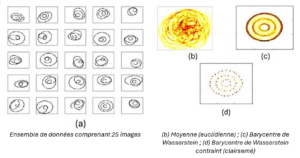
Another central challenge of modern AI is the management of complex data such as images, point clouds, and probability distributions. Welington de Oliveira is working on a key concept for these issues: optimal transport. Each piece of data is like a pile of sand. Instead of simply comparing two piles, optimal transport measures the minimum effort required to transform one pile into another, as if the sand were being moved in an optimal way.
To quantify this effort, we use the Wasserstein distance, which assesses how close or far apart two data sets are, even if they are very complex. If you have several photos of cats, optimal transport allows you to calculate an average image that best represents all of these photos. This average image, called the Wasserstein barycenter, is a kind of “composite sketch” of the cats photographed.
Thanks to the work of the CMA, it is now possible to integrate additional rules when calculating this average. For example, we can impose that only the most important information be retained (sparsity), or force the result to respect a certain structure so that it remains realistic. Thanks to powerful optimization methods, these calculations become possible even for very large data sets.
These advances make it possible to develop more robust algorithms capable of synthesizing and analyzing complex data with great precision. There are many applications: improved image processing, automatic object classification, and analysis of rare or incomplete data, such as medical images or scientific records. In short, this work helps AI to better understand the complexity of the real world, for more reliable and useful results in our daily lives.
Measuring dissimilarity differently by learning with little data
In certain fields, such as the study of rare diseases, the recognition of unique objects, or ecology, the available data is often very limited. However, traditional AI methods struggle to function effectively in these conditions, which is where Few-Shot Learning comes in, a field that involves learning from very few examples.
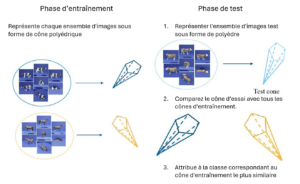
Valentina Sessa and her colleagues have developed an original approach to overcome this problem. Instead of representing sets of images as conventional linear spaces, they model them as convex cones, geometric structures that are better suited to capturing the diversity and variations in the data. To compare these sets, they have developed a new measure of dissimilarity based on the maximum and minimum angles between these cones.
This measure is linked to a mathematical distance called the Pompeiu-Hausdorff distance, which allows for a more refined assessment of the differences between groups of images. This method relies on non-convex optimization algorithms, designed to ensure reliable calculations even in complex situations. Thanks to this innovation, it becomes possible to better distinguish between different categories even with very few examples available.
The impact is significant: this approach improves AI performance in contexts where data is scarce, difficult or costly to obtain, such as the diagnosis of rare diseases or the identification of animal species from a few observations. It thus paves the way for more accurate and robust applications, even when the available information is limited.
The AI Workshop: fostering dialogue within a research ecosystem
This work was highlighted during the AI Workshop held in December 2025 at Mines Paris – PSL. Designed as an opportunity for internal exchange, the event allowed faculty, doctoral students, and engineers to present their projects, tools, and platforms through oral presentations and posters.
Beyond the diversity of topics, the workshop highlighted a common dynamic: building AI that is grounded in reality, capable of interacting with humans and integrating into complex systems.
Towards more sober, explainable, and responsible AI
Beyond technical results, CMA’s AI research shares a common ambition: to develop more reasonable artificial intelligence, in terms of the relationship between means and needs.
Faced with the race for ever larger and more energy-intensive models, mathematics offers an alternative:
- Less data
- Less computation
- More interpretability
- Better integration of physical laws and environmental constraints
This approach is fully in line with a policy of digital sobriety and responsible design, in tune with the challenges of ecological and industrial transition.
At CMA, AI is not just a technology: it is a scientific subject in its own right. By anchoring it in solid mathematical frameworks, the center’s researchers are helping to design a more reliable, understandable, and sustainable AI, an AI designed to meet the real challenges of our society.
To go further
- Valentin Penaud–Polge, Santiago Velasco-Forero, Jesus Angulo. Group Equivariant Morphological Networks. SIAM Journal on Imaging Sciences, 2025, 18 (4), pp.2236-2276. ⟨10.1137/24M1685766⟩. ⟨hal-05422798⟩
- Angulo, G.J. (2026). A Mathematical Morphology View of the Universal Representation of Scattering Networks. In: Wilkinson, M.H.F., Kosinka, J. (eds) Discrete Geometry and Mathematical Morphology. DGMM 2025. Lecture Notes in Computer Science, vol 16296. Springer, Cham.
- Jesus Angulo. Group Morphology Fixed Points on Homogenous Spaces for Deep Learning Equivariant Networks. GSI 2025, Oct 2025, Saint Malo (FR), France. ⟨hal-05319499⟩ Mimouni, P Malisani, J. Zhu, W. de Oliveira. Computing Wasserstein Barycenter via operator splitting: the method of averaged marginals. 2023. ⟨hal-04160009v4⟩
- Daniel Mimouni, Welington de Oliveira, Gregorio M Sempere. On the Computation of Constrained Wasserstein Barycenters. 2025. ⟨hal-05216990⟩ de Oliveira, V. Sessa, D. Sossa. Measuring dissimilarity between convex cones by means of max-min angles. ArXiv, 2025.