
Civil engineering degree : the second year
The second year of the Civil Engineering Program offers students a high degree of flexibility to explore different fields, delve deeper into their areas of interest, and gradually develop their career plans. Through academic, international, scientific, or entrepreneurial experiences, each student can tailor their academic path while continuing to acquire the fundamental skills of a general engineer.

Shaping Your Career Path: Mobility and Experiences
A modular approach to international mobility, within PSL, in engineering, research, or entrepreneurship
The second year is a key milestone in shaping each engineering student’s academic path. Thanks to its modular structure, it offers students the opportunity to explore new academic fields and gain a wide range of experiences, including international study abroad, research immersion, entrepreneurship, dual degrees, or in-depth scientific study.
This flexibility in course selection is in line with the Civil Engineering Program’s mission: to train generalist engineers capable of understanding complex environments, developing expertise, and adapting to changes in the industrial, scientific, and societal spheres.
Three Program Options for the Second Year
The Academic Affairs Office at Mines Paris – PSL supports each engineering student in designing their educational path and making academic choices. For students who wish to complete their second year in a single academic year, three program options are available:
| Semester 3 (30 ECTS) | Semester 4 (30 ECTS) |
|---|---|
| At Mines Paris – PSL | At Mines Paris – PSL |
| International | At Mines Paris – PSL |
| At Mines Paris – PSL | International |
Two Options for Pursuing a Dual Degree or a Gap Year
For students wishing to pursue a dual degree in France or abroad, or a gap year, the second year can be structured over two academic years to allow them to carry out their plans.
Students can choose between semesters at Mines Paris – PSL and either a gap year or a dual degree:
| YEAR N | YEAR N+1 | |
| Semester 3 | Semester 4 | Gap year or double degree |
| YEAR N | YEAR N+1 | ||
| Semester 3 | Gap year or double degree | Semester 4 | |
Learning Through Experience
Projects, Research, and International Outreach
The broad-based nature of the Civil Engineering program is reflected in a pedagogical approach grounded in a variety of experiences: engineering projects, immersion in research, international exposure, and exploration of new disciplines. These various dimensions enable each engineering student to develop a comprehensive understanding of the challenges they will face in their future careers.
Structure of the Second Year
During the two semesters of the second year, each engineering student tailors their academic path through a variety of complementary experiences:
| Teaching Unit | Description | Credits |
|---|---|---|
| UE31/41 | 2 Engineering Terms | 2 × 9 ECTS |
| UE32/42 R or 32/42 E | 1 Research Term or 1 Entrepreneurship Term | 15 ECTS |
| UE33/43 | At least 4 specialized courses | 4 × 2 ECTS |
| UE45 | Engineering Internship in a Company or Abroad | 15 ECTS |
| UE26 | Professional and Scientific English | 2 ECTS |
| UE26 | Second Foreign Language | 2 ECTS |

Spotlight on the Engineering Quarter
8 projects to choose from
MOVIE
Virtual Worlds: Technology and Society Issues
Prepare students for the challenges of interactive, immersive, real-time 3D virtual environments—or VR & AR (Virtual Reality and Augmented Reality)—by designing a real-time interactive 3D application. Learn more about the project
MECATRO
Mechatronics
To provide students with an understanding of the challenges associated with the design and implementation of technical systems that integrate mechanics, electronics, and industrial computing in a balanced manner.
MOLONARI
Local Monitoring of Groundwater-River Exchange
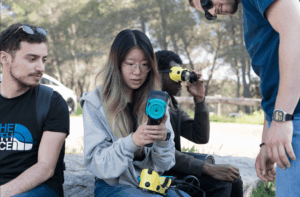
Guide students in developing a data acquisition system—from the sensor to the control station—to monitor the exchange between a watercourse and a groundwater aquifer.
MobApp
Mobile App Development
To enable students to explore the mobile app environment, taking into account both technical and marketing aspects.
MECAERO
Design of Aerodynamic Structures
To train students in the use of modern design and optimization tools in the fields of materials and structural mechanics and aerodynamics.
IDS
Intelligent and Digital Systems
Guide students in building a cyber-physical system. These are increasingly complex embedded systems, often interconnected via a network and linked to physical interfaces.
Underwater
Work with students to design underwater equipment for ocean conservation.
Undersolar
Encourage students to undertake low-tech engineering projects involving solar thermal or thermodynamic concentration.
Our news about these courses
Engineering Projects


Research & Entrepreneurship Quarter


Stabilizing the unstable: the science of dynamic systems control with the Research Quarter
Find out more
From engineering to the clinic: synergies between science and health with the R_SANTÉ Research Quarter (Engineering and Health Research)
Find out more