
Specialized Master Expert in Environment & Sustainable Development, International Track in Environmental Management (EEDD-ENVIM)
Built on 18 years of experience working with international and European partners (both academic institutions and companies), the EnvIM Specialized Master’s program at Mines Paris – PSL trains the future leaders of the ecological transition.
The Specialized Master’s program, registered with the RNCP under No. 39578, is available through apprenticeship and professional training contracts.
A High-Level Program
For International Environmental Management
For the past 18 years, Mines Paris – PSL has been collaborating with international and European partners—both academic institutions and companies—to offer the EEDD-EnvIM Specialized Master’s program, a top-tier program for future professionals in the ecological transition.
This 100% English-language program is designed for students and young professionals seeking to acquire the key skills needed for a career in environmental management. It combines theoretical foundations with learning by doing through real-world case studies and collaborative projects developed in partnership with experts and professionals.
Environmental challenges, which are multifaceted and occur on multiple scales (from local to global), require a systems-based approach to identify levers for action, appropriate policies, and the stakeholders to be engaged. Our innovative and pragmatic teaching approach enables students to acquire:
- A 360° perspective on socio-environmental challenges,
- analytical and decision-making tools (data management, environmental assessment, multi-criteria analysis),
- The ability to anticipate and collaboratively build sustainable futures.
Our goal: to develop responsible leaders who are capable of balancing economic performance with positive impact in a changing world.
An Environment of Excellence
For 240 years, Mines Paris – PSL has been training engineers and generating cutting-edge knowledge to help companies meet their challenges, particularly those related to the ecological transition and digital transformation. As a founding member of the PSL University, ranked among the world’s best universities, the school draws on a dynamic ecosystem of research and innovation, combining academic excellence with close ties to the socio-economic world.
At ISIGE, research and expertise play a central role in supporting the ecological transition and societal transformations. Through a multidisciplinary approach, researchers and experts explore a variety of topics, such as the circular economy, resource management, and adaptation to climate change.
Building a Sustainable Future
The Specialized Master’s Program in Leading the Ecological Transition
EEDD-EnvIM prepares professionals to tackle complex environmental challenges through a scientific, systemic, and strategic approach. Students develop:
- Analytical skills to understand global issues,
- Operational leadership to design sustainable solutions,
- The ability to link global goals with local actions.
Why Choose EEDD-EnvIM?
- Give meaning to your career by actively contributing to a sustainable future
- Benefit from a year of professional training in international environmental management
- Join a network of experts (consulting firms, startups, companies, NGOs, public institutions)
Who is this for?
- Graduates with a master’s degree (or equivalent) in natural sciences, engineering, economics, political science, social sciences, or environmental studies.
- Young professionals looking to change careers and enter the environmental sector.
- Bachelor’s degree holders with at least 3 years of professional experience in an environment-related field.
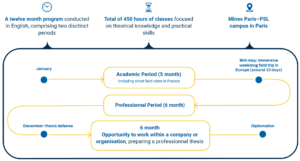
A 12-month program
- 100% in English
- Work-study option available (apprenticeship contract) or as initial training
- Active learning: project-based learning, real-world case studies, collaborative projects
A training program to learn how to
- Analyze the challenges of the ecological transition at various scales
- Design sustainable development strategies tailored to international contexts
- Implement innovative tools to evaluate and manage environmental projects
- Manage the transition by involving all stakeholders
- Anticipate emerging trends to develop resilient, low-carbon solutions
Educational Program
An intensive and immersive training program
5 Key Modules
1.
Major Environmental Challenges
Acquire and understand the fundamental scientific knowledge related to the ecological transition. Analyze the major socio-environmental challenges facing societies and organizations today, taking into account their multidimensional nature, the various scales at which they manifest, and the need for a systemic approach that provides a comprehensive, 360° perspective.
2.
Regulatory Frameworks and Sustainable, Resilient Strategies
Organizations must integrate sustainable innovation into their strategies in order to remain competitive while meeting evolving societal and regulatory expectations. This module explores the challenges associated with global transformations and new uncertainties, as well as the resulting new responsibilities.
The goal is to design and adapt a CSR and sustainable development strategy to address these new challenges.
3.
Tools and Methods for Sustainable Innovation
From a sustainable strategy perspective, this module presents the tools and methods for designing solutions that are more robust, resilient, and eco-designed. From data collection and analysis to the implementation of multi-criteria approaches based on the principles of life cycle assessment, students learn to develop action plans and strategies tailored to new transition pathways.
4.
Project Development in an International Context
Acquire the management skills needed to address the complex challenges of the ecological transition, while taking environmental and social impacts into account. It also aims to strengthen coordination capabilities among project teams, stakeholders, and different levels of decision-making within organizations, in order to promote consultation, cooperation, and the joint development of sustainable transition strategies.
5.
Foresight and Pathways for the Ecological Transition
This module explores transition pathways for business ecosystems and regions, and addresses disruptive innovations and the emergence of new economic models from an inclusive perspective. The goal is to analyze and identify emerging trends and to develop sustainable and resilient pathways that respect the needs of living systems.
Innovative Teaching Methods
The program relies heavily on innovative teaching methods that combine academic instruction, case studies, and applied projects. Students work on selected international case studies as well as real-world projects developed in collaboration with experts, companies, consulting firms, or NGOs.
These case studies provide an integrated approach to the five major dimensions of environmental impacts—climate, biodiversity, pollution, and natural resources—while also taking social issues into account and incorporating the expectations of numerous stakeholders.
The Fundamentals of the EEDD-EnvIM Program
- Learning by Doing: real-world case studies, collaborative projects with companies, NGOs, or local governments.
- Interdisciplinarity: integrating scientific, economic, and social approaches.
- International focus: addressing global challenges with partners from around the world.
Topics covered:
Climate, biodiversity, pollution, resources, sustainable value chains, new business models and the circular economy, social impacts, and transition management within companies and regions.
Professional Assignment
The professional assignment undertaken following the academic program allows students to apply the knowledge and skills acquired during the weeks of instruction. Its objective is to explore and analyze a strategic issue related to environmental challenges, and to formulate innovative proposals and recommendations in response to that issue. This experience provides students with an opportunity to build on their prior experience while applying the knowledge and skills acquired during the Specialized Master’s program in a professional context that is often international and multicultural.
This program is supported by personalized guidance from the ISIGE teaching staff.
Two possible tracks
Work-Study Program
For students on an apprenticeship contract, the professional placement takes place at the host organization following the academic term.
Starting in June at a company or local government agency.
Compensation and coverage of training costs.
During the initial training phase
5- to 6-month internship (June through December) at a company, institution, or NGO.
Professional assignment proposed by the host organization, focusing on a specific topic related to the environment or the ecological transition.
Professional Thesis
At the end of this professional internship, students must write a professional thesis presenting their work, analysis, and recommendations, and then defend it before a committee.
This project allows students to:
- Validate the skills they have acquired,
- Apply their knowledge to a real-world case,
- Receive personalized guidance from the ISIGE faculty.
Career Path
The Specialized Master’s in EEDD-EnvIM International Track, prepares students for a wide variety of careers related to the environment and sustainable development. Career opportunities naturally depend on each student’s academic track, skills, and career goals.
Thanks to its multidisciplinary approach, the program enables graduates to pursue roles at the intersection of environmental issues, sustainable development strategies, and organizational transformation.
Sectors
- CSR and Sustainable Development
- Water, Waste, and Energy Management
- Circular Economy
- Urban and Regional Planning
Career Paths
- Environmental Manager (in an international context)
- Sustainable Development Consultant
- Resilient Supply Chain Expert
- Climate Risk Analyst
- Ecological Transition Project Manager
- CSR (Corporate Social Responsibility) Program Manager
- Circular Economy Project Manager
- Ecological and Territorial Transition Consultant
Admission
Requirements
- Minimum Master’s 2 degree (engineering school, business school, science programs, political science, law, economics, etc.)
- Or Master’s 1 degree with at least 3 years of professional experience
- Good command of English (TOEFL or TOEIC, or a degree from an English-speaking university)
Step 1: Application Review
- Application package with supporting documents
- 3 letters of recommendation (academic and professional)
- If the application is accepted, candidates at this stage will be invited to an interview
Step 2: Interview and Eligibility
- An individual interview with a panel, designed to assess the candidate’s motivation, their ability to develop a strategic vision based on scientific knowledge, and the coherence and relevance of their career plan (April for the first session).
Cost of the program
14,000 € (+ 800 € registration fee)
The study trip is included in the tuition.
Funding Options
- Work-Study Program: Costs covered by the company.
- Personal Funding: Student loans are available (a guarantor residing in France is generally required).
- Paid Internship: Students receive compensation during the 6-month internship period.
- Scholarship: Students should contact Campus France in their home country.
Training Location
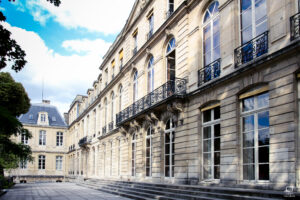
60 Boulevard Saint-Michel – Paris 6th
Located in the Latin Quarter, near the Panthéon and the Luxembourg Gardens, the Paris campus blends historical heritage with scientific activity, offering spaces for education, research, and student life that are integrated into a vibrant academic and intellectual community
Words from Graduates
Zhao L.
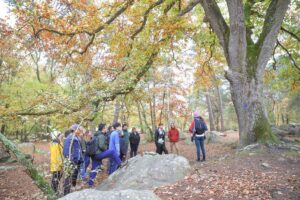
“EnvIM gave me a systemic perspective on sustainability issues through real-world case studies (the Fontainebleau Forest, a project in Turin) and a collaborative teaching approach. My internship at Crédit Agricole Assurances, working on a climate project, led to my thesis, which served as a bridge between research and the field. Today, I put these skills into practice every day.”
Xingci C.
“The program combines scientific rigor with a pragmatic approach. The immersive workshops and group projects helped me understand the complexities of the ecological transition. My internship at LVMH gave me the opportunity to apply life cycle assessments to real-world projects. It was an unforgettable personal and professional experience.”
The Specialized Master’s Program bearing the
Specialized Master’s Quality Label
The Specialized Master’s Program bears the Specialized Master’s Quality Label, a collective trademark registered and filed with the INPI and owned by the Conférence des grandes écoles. This label is awarded to a 12-month program leading to an institutional degree at the post-master’s level (Bac+6).

Contact