
What happens to industrial waste beneath our feet?
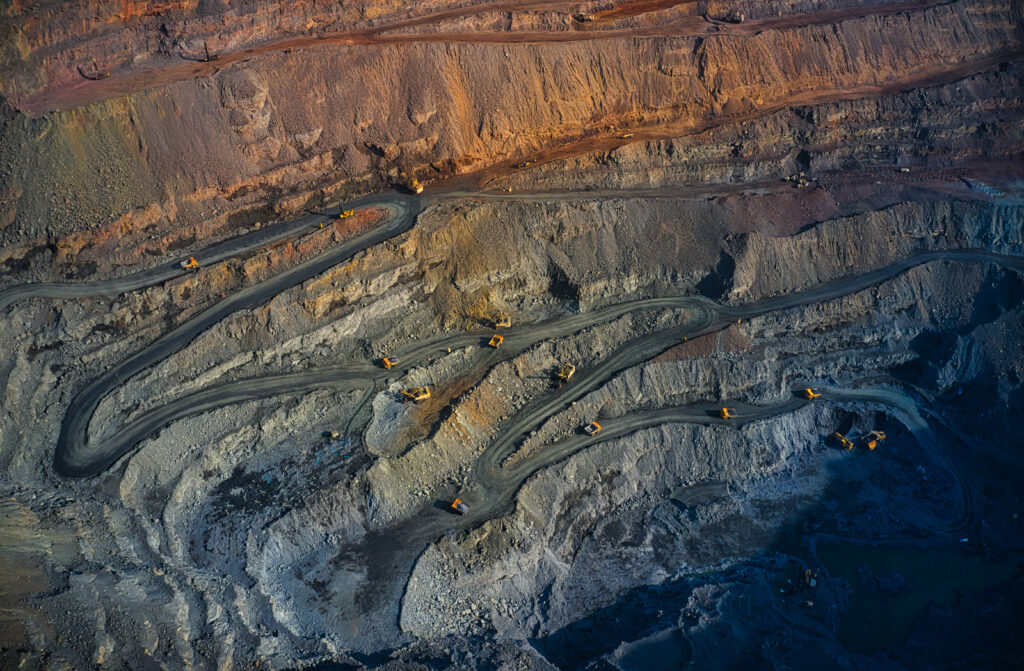
For centuries, we have drawn from the Earth’s depths the resources needed for industrial development. Today, those same subsurface layers also hold the waste generated by these economic activities. But what is really happening several hundred—or even thousands—of meters beneath our feet? In Sous le sol, published on October 8, 2026, by Premier Parallèle, Lisa Claussmann, a postdoctoral researcher at the Center for the Sociology of Innovation (CSI) at Mines Paris – PSL, takes us deep underground in France and Norway to explore the solutions being considered to address environmental challenges.
From the Mines of Yesterday to Today’s Underground Landfills
Coal, salt, metals, hydrocarbons… Since the Industrial Revolution, the subsurface has been viewed primarily as a reservoir of raw materials. Their extraction has shaped our landscapes, fueled our factories, and driven the development of our societies. But this story did not end with the closure of many French mines at the end of the 20th century.
As industrial activities expanded, they also produced growing quantities of waste, some of which contains particularly toxic substances that are difficult to treat. One solution to the problem of this accumulating waste has been to bury it in deep geological formations.
It is this shift in the use of the subsurface that Lisa Claussmann explores in her book. Once exploited for what it could provide, the subsurface has now also become a sought-after space for what it might contain. This transformation reveals a paradox: the Earth’s depths, which were the driving force behind part of our industrial development, are now being used to house the externalities of that development—whose consequences are the most dangerous to human health and the environment.
550 meters underground: a mine turned into a landfill
To understand this transformation, the researcher takes us to Alsace, specifically to the StocaMine site in Wittelsheim. This former potash mine—potash is a mineral used primarily to manufacture fertilizers—was converted in the late 1990s into a storage facility for hazardous industrial waste.
Between 1999 and 2002, nearly 44,000 metric tons of waste were lowered there, to a depth of about 550 meters underground. Incineration residues, contaminated soil, substances containing mercury or arsenic, and hazardous chemical compounds: all of these materials were buried to minimize risks to the public and the environment.
But in 2002, a fire brought storage operations to a permanent halt. After some of the waste was removed between 2014 and 2017, nearly 42,000 metric tons remain in the underground tunnels. Their permanent containment is the subject of controversy, particularly due to the risk of pollutants seeping into the Alsace aquifer, a major underground water reserve.
Through several descents into the tunnels, Lisa Claussmann chronicles the transformations of this industrial space. She describes the machinery, the storage blocks, the containment work, and the men and women who continue to work there. Some are former miners whose skills have been repurposed for waste management.
This immersive exploration reveals what technical descriptions and expert reports sometimes struggle to convey: an underground space that is neither empty nor static, but a place of work, geological constraints, and human decisions. The tunnels evolve, the rock shifts, the facilities require monitoring, and the waste remains present, even when it becomes inaccessible.
Landfilling, therefore, does not mark the disappearance of waste. It ushers in a new phase in its history, the consequences of which may extend far beyond the lifespan of the infrastructure and the people who designed it.
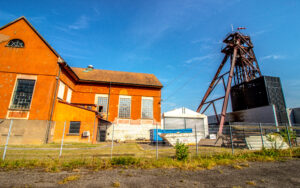
StocaMine site in Wittelsheim
Storing CO₂ to Combat Global Warming?
Research continues in Norway, where another use for the subsurface is gaining ground: the geological storage of carbon dioxide (CO₂).
Unlike solid industrial waste, CO₂ is a greenhouse gas whose accumulation in the atmosphere contributes to global warming. To limit emissions from certain industrial activities, particularly cement production, carbon capture and storage technologies are currently being developed.
The process involves capturing CO₂ before it is released into the atmosphere, transporting it, and then injecting it into deep rock formations capable of trapping it for long periods. The goal is to prevent some of these emissions from contributing to global warming.
Lisa Claussmann is particularly interested in the Northern Lights project on Norway’s west coast. This facility receives CO₂ transported by ship, stores it temporarily, and then transports it via an underwater pipeline to an injection site located approximately 2,600 meters below sea level.
While this technology is based on geological knowledge and industrial processes that have been proven in various contexts, its large-scale deployment raises many questions. How can the containment of CO₂ be guaranteed over very long periods? How should its transport between emitting facilities and storage sites be organized? What are the costs, energy requirements, and necessary infrastructure?
The study also shows that these new projects rely heavily on expertise from the oil and gas industry. The skills developed to extract hydrocarbons are now being applied to reinject carbon deep into the Earth.
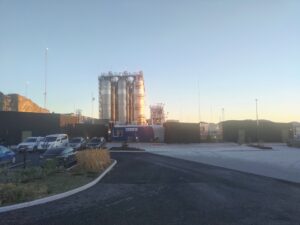
Carbon dioxide storage tanks for the Northern Lights project.
Does burying pollution really make it go away?
Burying hazardous waste or storing CO₂ can help meet specific environmental goals. But these operations do not necessarily eliminate the substances in question. They merely shift their location and, at times, the responsibilities associated with managing them over time.
In the case of StocaMine, the key issues include the behavior of the waste and geological formations, the risks of contamination, and the passing on of a potentially hazardous industrial legacy to future generations. For CO₂ storage, it is also a matter of determining what role these technologies can play in decarbonization strategies, without losing sight of the need to reduce emissions at the source.
These choices are therefore not solely a matter of geology or engineering. They also raise economic, social, and political questions: Who decides how the subsurface is used? Which regions host these facilities? Who oversees them? And how can we collectively debate decisions whose effects could last for decades, or even centuries?
This is where the perspective of the sociology of science and technology takes on its full significance. By examining infrastructure, workers, scientific knowledge, and controversies, Lisa Claussmann demonstrates that technical solutions cannot be separated from the societies that design and implement them.
Bringing to Light What Lies Beneath Our Feet
In Sous le sol, Lisa Claussmann presents a scientific investigation that also draws on narrative techniques. From former mines in Alsace to Norwegian carbon storage facilities, she takes readers on a journey through places usually inaccessible to the public, giving center stage to those who know them, operate them, or challenge their use.
This approach is part of the research conducted at the Center for the Sociology of Innovation (CSI) at Mines Paris – PSL, where the humanities and social sciences enable the study of the relationships between technological innovations, industrial activities, the environment, and society. The study was conducted in part with funding from Mines Paris–PSL as part of the ANR SESAME project (Support for Scientific Equipment and the Acquisition of Experimental Resources: Sociotechnical Trajectories for Onshore Geological Storage in France), which is part of the PEPR SPLEEN research program (Priority Research Program and Equipment “Supporting Innovation to Develop New, Largely Decarbonized Industrial Processes”) dedicated to the decarbonization of industry.
By shedding light on these underground worlds, the book ultimately invites us to broaden our thinking about so-called environmental policies. Understanding what we choose to bury underground also means questioning what we produce on the surface—and the responsibilities we wish to pass on to future generations.
Further Reading
- Beneath the Ground: In the Depths of an Earth Turned into an Industrial Landfill, Lisa Claussmann, published by Premier Parallèle, Carnets parallèles series, 180 pages, released on October 8, 2026.
- Radio France broadcast on Tuesday, October 13, 2026 Asbestos, Pesticides: When Our Subsoil Becomes an Industrial Landfill