
Mines Paris for the Ocean: Engineering in the Service of Marine Conservation and Exploration
The ocean, the beating heart of our planet, is a vital environment that must be protected and understood. Mines Paris – PSL, drawing on its long-standing expertise in engineering and resource management, is firmly committed to addressing the maritime challenges of tomorrow. Through innovative projects, strategic partnerships, and an action-oriented educational approach, the School harnesses science and technology to preserve marine ecosystems, ensure safety at sea, and promote sustainable exploration of the seabed.
From underwater robotics to underwater archaeology, including the training of tomorrow’s engineers and risk modeling, Mines Paris – PSL is helping to shape a future where technical progress goes hand in hand with respect for life.
To mark World Oceans Day on June 8, 2026, the School is sharing the content of the special issue “Mines Paris for the Ocean,” published in Carnets de Correspondances #17, a publication of the Pierre Laffitte Campus of Mines Paris – PSL.
Mines Paris for the Ocean
A Message from Franck Guarnieri
Director of the Center for Research on Risks and Crises (CRC) at Mines Paris – PSL and Faculty Member, co-founder of the course “Mines Paris for the Ocean”
The ocean is the beating heart of our planet. It produces half of the oxygen we breathe, regulates the climate, is home to priceless biodiversity, and connects people across continents. A source of life and inspiration, it also fuels our dreams of distant horizons. But it has become a mirror of our excesses: global warming, pollution, overexploitation, the disappearance of fragile ecosystems… All these are signs reminding us of the urgent need to rethink our relationship with the world.
In this context, our School naturally finds its place. For over two centuries, it has been dedicated to understanding the Earth’s resources and promoting their responsible use. In the past, it supported the great industrial revolutions by training engineers capable of transforming the Earth’s underground resources. Today, its expertise must contribute to a new balance that recognizes the Ocean as a vital space and the shared heritage of humanity and all living beings.
Our School fulfills this role by combining scientific rigor with social responsibility. Our researchers explore, model, and innovate. They design resource-efficient technologies, optimize material and energy flows, and devise solutions to limit the impact of human activities. Our engineering students, for their part, learn to bridge engineering, science, and action; to combine innovation with awareness; and to build a future where technical progress and respect for life go hand in hand.
The task is immense: developing sustainable maritime industries, establishing tools for monitoring and protecting the seabed, supporting the energy transition while preserving marine ecosystems, and informing public policy. It is precisely this ambition that gives meaning to our commitment.
Protecting the ocean means protecting life. It means leaving future generations a world that is still livable, beautiful, and bountiful. It means understanding that the ocean is not just a resource, but a horizon we must preserve. Our school must rise to this challenge!
Underwater Engineering Project
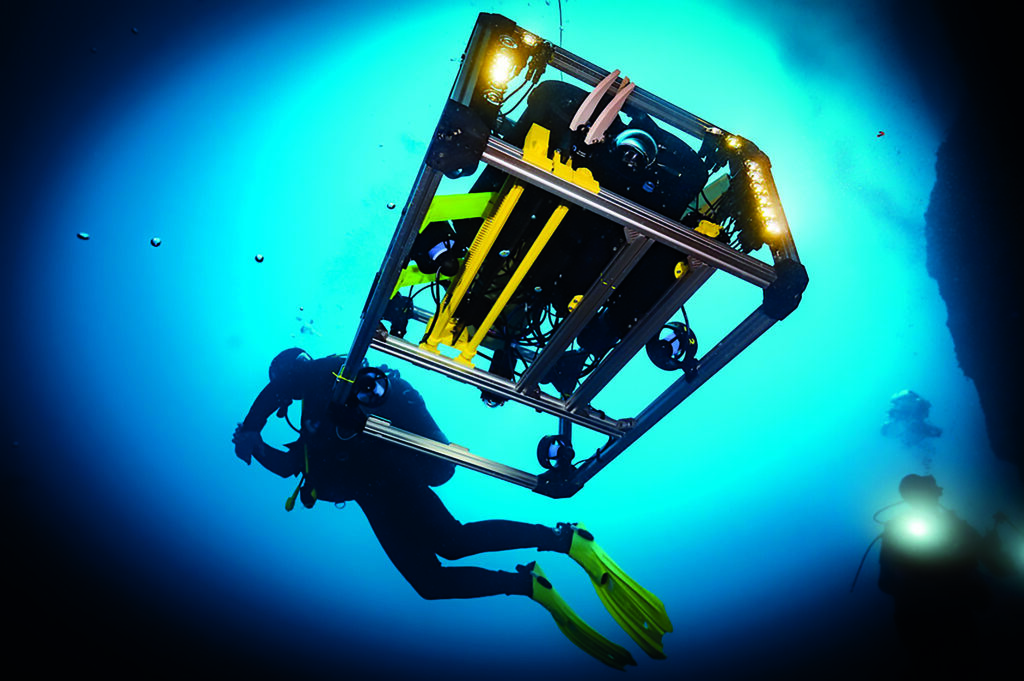
Underwater robotics is a true feat of technological craftsmanship.
In an environment characterized by extreme pressure, darkness, and corrosion, every detail matters: the choice of materials, the precision of the sensors, the reliability of the propulsion and power systems, and the sophistication of the control algorithms.
It is thanks to this millimeter-level precision and these absolute standards that engineering has the power to open up the ocean to exploration, protection, and preservation.
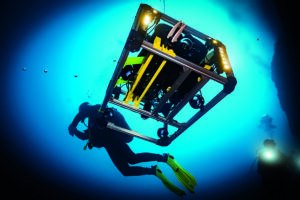
Photo credit: Pierre VADAM
The Underwater Engineering Project took place from March to May 2024 in Sophia Antipolis on the Pierre Laffite campus of Mines Paris – PSL, involving second-year civil engineering students.
Their challenge? To assess the role of underwater robotics in the preservation of shipwrecks. To do so, their goal was to design and develop two underwater robots operated remotely from the surface. Each robot was equipped with a payload capable of capturing images for the reconstruction of scenes in 2D and 3D.
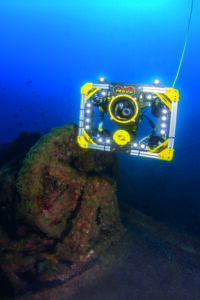
The two ROVs (Remotely Operated Vehicles), capable of reaching depths of 100 meters, explored the wreck of the Robuste II, a steamship sunk by a mine in 1943, in the Gulf of Juan-les-Pins (06).
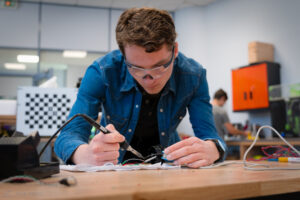
Research, Engineering & Training
The ocean holds more mysteries than we will ever know.
Yet, thanks to the passion of visionary researchers, its secrets are gradually being revealed.
Some model marine dynamics, while others use imagery to reveal unexpected landscapes. As engineers, they design robots capable of withstanding the pressure of the deep, serving as technological scouts in the darkness of the ocean floor. And to make sense of this wealth of data, AI becomes their ally, transforming numbers and images into understanding.
Training the marine engineers of tomorrow
A program of excellence in marine and underwater robotics, combining scientific rigor, technological innovation, and hands-on experience with real-world projects.
The Center for Research on Risks and Crises (CRC) offers a specialized track in marine and underwater robotics, which is part of the civil engineering program at Mines Paris – PSL and is taught on the Pierre Laffitte campus in Sophia Antipolis.
This three-year program combines foundational knowledge, technical specialization, and practical application. In the first year, a three-week intensive module, limited to 16 students, introduces engineering in underwater robotics, with an emphasis on computer science and the simulation of robotic systems.
The second year offers twelve weeks of courses for 30 to 40 students, dedicated to the design of marine and underwater systems, whether autonomous or remotely operated. The curriculum covers mechatronics, sensors, and actuators, as well as control software, communication, and project management.
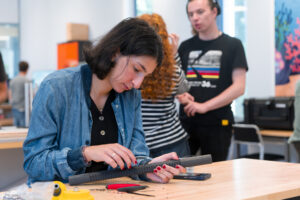
In their third year, students complete research or capstone internships at the CRC or with its partners. These applied projects focus on underwater investigation, maritime safety, environmental monitoring, defense, and exploration in extreme environments, allowing students to apply all the skills they have acquired.
A hands-on, multidisciplinary learning environment
By Samuel Olampi, Research Engineer
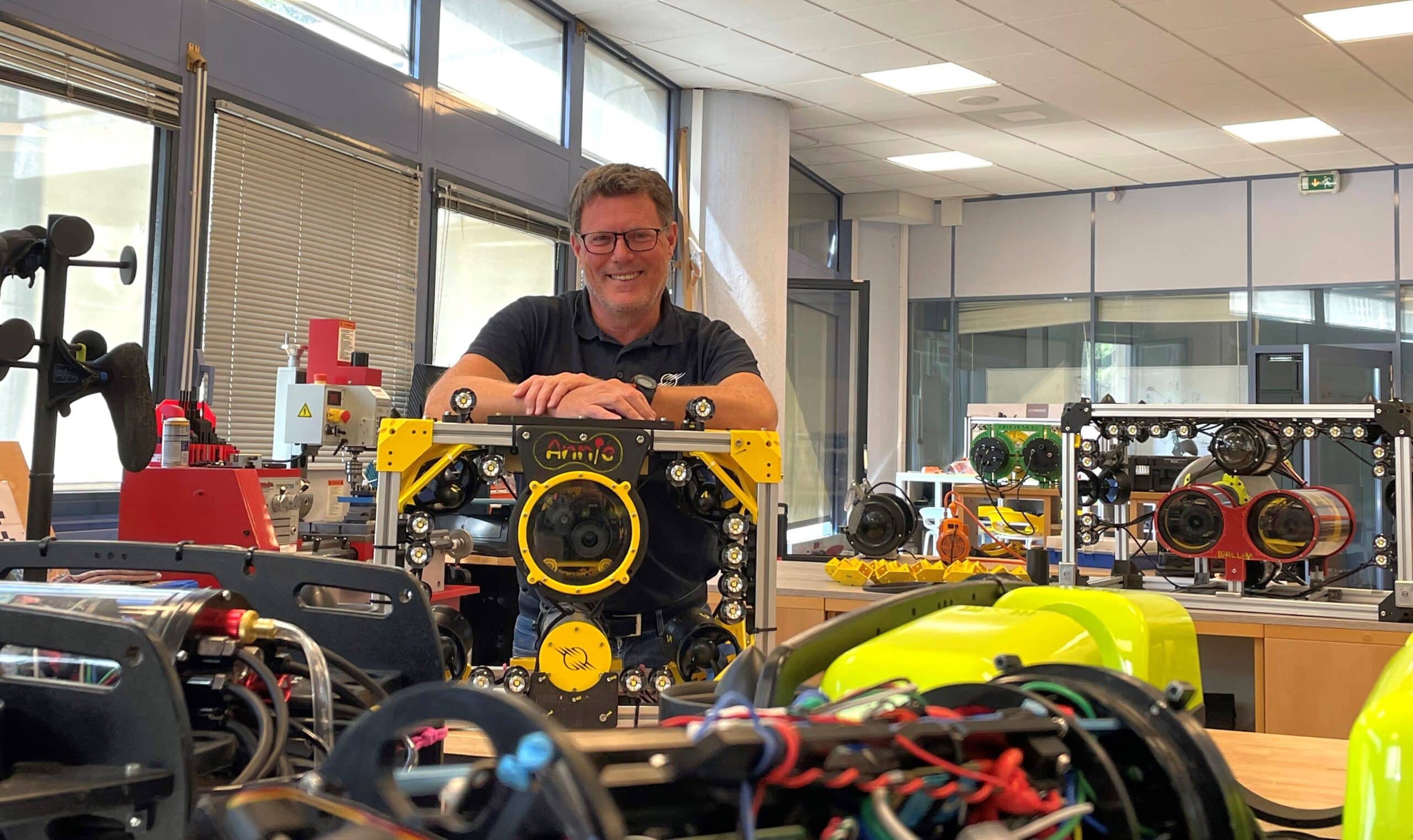
Our workshop was designed as a space for learning through experimentation. Here, students learn by doing. They tackle concrete, complex, and meaningful projects. Designing an underwater drone is no small feat: it requires integrating skills in mechanics, materials, electronics, embedded computing, hydrodynamics, and even acoustic communication.
We are equipped for this: 3D printers, laser cutters, milling machines, welding stations, computer-aided design workstations, and, most importantly, a test tank that allows students to quickly test their prototypes in real-world aquatic conditions.
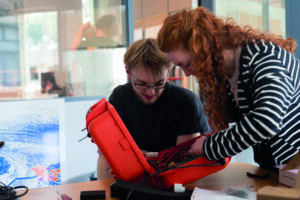
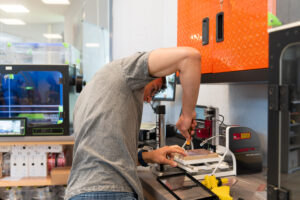
Our workshop—or rather, our “fabrique,” as we like to call it—is a space where we design, build, and test machines built to operate in one of the most demanding environments: the underwater world.
A workshop of ideas, commitment, and passion
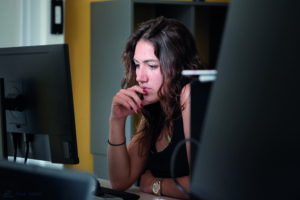
Leading this workshop means supporting the curiosity, inventiveness, and commitment of brilliant young minds every day. It means watching them marvel when their drone dives for the first time, or when a sensor sends back its first data. It also means teaching them that engineering isn’t just about technology, but a response to the challenges of our time. And that, ultimately, is our most beautiful mission.
Diving with the National Gendarmerie
A critical operational need, a tailor-made technological solution
By Franck Guarnieri, Director of the CRC
The elite divers of the CNING, recognized since 1965 for their operations in extreme environments, face technical limitations as soon as depths exceed 50 meters: safety constraints, low visibility, and limited human endurance.
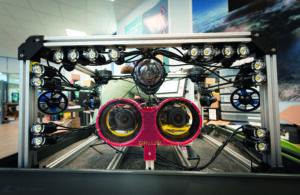
Our goal is to provide a concrete solution to these challenges by developing an underwater drone operated remotely from the surface, specifically designed to assist investigators while ensuring the integrity of the chain of evidence.
From the very first discussions, a principle was established as the foundation of the project: the goal is not to adapt existing technology, but rather to create a tool entirely designed for the specific needs of underwater forensic science.
An ROV designed for underwater forensic investigations
The specifications, developed in close collaboration with the CNING, are based on three key pillars:
- an ultra-high-definition camera, paired with sonar, to locate and document underwater scenes with millimeter precision;
- a compact, robust structure capable of withstanding great depths, easily deployable in real-world conditions and equipped with a powerful lighting system;
- an ergonomic software interface, facilitating rapid familiarization by gendarmerie operators.
The challenge goes beyond mere technological prowess: it is also judicial, human, and institutional. The goal is to equip the gendarmerie with the means to intervene effectively where very few actors can operate.
In 2024, a pivotal meeting with the investigative divers of the Gendarmerie’s National Nautical Training Center (CNING), led by Commander David Veyrunes in Antibes, paved the way for an unprecedented collaboration: combining our respective expertise to design an underwater drone entirely dedicated to deep-sea forensic investigation. This is how the DIVER project was born.
A rigorous and collaborative project approach
The DIVER project spans 18 months, divided into five major phases: requirements analysis, design, prototyping, field testing, and operational integration. Tests are conducted both in our test tank at the Sophia Antipolis laboratory and in the field alongside CNING divers in their training area in Antibes/Golfe-Juan.
This constant proximity to end-users is one of the project’s key drivers: it enables the co-development of a relevant, agile system that can potentially be adapted for other stakeholders, such as water rescue teams or the French Navy.
Innovation in the Service of Public Service
This partnership with the CNING fully illustrates our commitment at Mines Paris to putting science and engineering at the service of critical public missions. Working alongside professionals in the field, who can provide precise feedback under real operational conditions, is a rare asset in the realm of technological innovation. With DIVER, we are seizing the opportunity not only to advance underwater robotics but also to actively contribute to the modernization of tools for justice and public safety, in a spirit of strong social responsibility.
Drones & Underwater Archaeology
The Contribution of Drones to Underwater Archaeology
By Franck Guarnieri, Director of the CRC
Crédit photo : Jean-Michel Mille
In recent years, underwater drones, or remotely operated vehicles (ROVs), have revolutionized the practice of underwater archaeology. While human dives are limited by depth, bottom time, or environmental conditions, these machines offer unprecedented freedom of action. Capable of operating at depths of several hundred meters, transmitting live high-definition images, detecting structures using their onboard sensors, and performing tasks with extreme precision, they have become the archaeologist’s true robotic extensions.
The recent mission in June 2025, led by Anne Joncheray, is a striking demonstration of this. A renowned archaeologist and director of the Saint-Raphaël Archaeological Museum, she had identified a deep-water sonar anomaly off the coast of Île d’Or (near Hyères) as early as 2016. Due to a lack of suitable equipment, the nature of this structure remained undetermined. Our intervention, as part of the Underwater 2025 engineering project, led to the deployment of two underwater drones remotely operated from the surface.
At a depth of 107 meters, we uncovered a metal barge approximately 15 meters long. While this is far from an archaeological treasure, this wreck undoubtedly has a story to tell.
Thus, its exploration revealed an engine, a folding crane, a plastic dinghy, and a fender dating from after 1975—signs of a utilitarian and recent construction. The absence of any visible pollution and the presence of abundant marine life—lobsters, corals, sponges—attested to the wreck’s gradual transformation into an artificial reef.
This project marks the emergence of a new approach to archaeology. It is no longer defined solely by physical diving, but by an interdisciplinary approach that integrates archaeology, engineering, history, and biology. Drones are expanding the range of tools available to archaeologists; they accompany them into areas that were previously inaccessible, extending their vision and their reach.
Thanks to them, exploration has become safer, more precise, and, above all, more respectful of fragile environments. The past—sometimes hidden, often buried—can thus be better understood, better protected, and shared with as many people as possible.
Underwater archaeology remains one of the last great frontiers of historical exploration. While the collective imagination continues to associate this discipline with the adventures of divers discovering sunken treasures, the reality is quite different. It is a demanding field, based on rigorous methods and a strict scientific framework. In France, this mission is coordinated by the Department of Underwater and Submarine Archaeological Research (DRASSM), a division of the Ministry of Culture.
Establishment of the College of Naval Sciences
A joint laboratory in marine and underwater robotics
By Franck Guarnieri, Director of the CRC, and Sébastien Travadel, Faculty Member and Researcher
The establishment of the College of Naval Sciences (CSN), made official on June 24, 2025, marks a major milestone in the alliance between scientific excellence and industrial sovereignty. This project, initiated and championed with conviction by our research center and the school’s administration, in partnership with the Training Division of the Union of Metallurgy Industries and Trades (UIMM), is part of a clear ambition: to make Toulon and its metropolitan area a national and European hub for innovation in the field of marine and underwater robotics.
This choice is no accident. Toulon boasts an exceptional concentration of civilian and military stakeholders: France’s main naval base, a historic presence of the French Navy, a high-tech industrial base, and a pool of expertise in mechanics, materials, electronics, and computer science… The Toulon Provence Méditerranée metropolitan area and the South – Provence-Alpes-Côte d’Azur region have for several years made these issues a central focus of their economic and geopolitical strategy. It is in this context that this joint laboratory takes on its full significance.
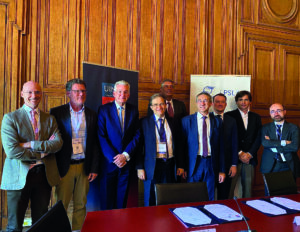
The College of Naval Sciences will be a new kind of research and training center. It will bring together faculty members, engineers, doctoral students, and undergraduates to address the major transformations associated with the widespread use of drones in civil and military navies. We had the honor of designing and developing this project in collaboration with the École Des Industries Avancées (EDEIA), the new engineering school of the UIMM Sud Training Cluster.
Mines Paris – PSL will play a central role in this initiative. We will assume the scientific leadership of the College and ensure its academic affiliation with PSL University. Our faculty members, gradually joined by those from EDEIA, will lead projects there as part of a five-year roadmap.
The CSN is also designed to harness the full range of expertise from Mines Paris – PSL’s research centers, whether in materials science, artificial intelligence, energy, automation, robotics, or even industrial economics and the social sciences. We will also actively participate in training future EDEIA engineers by sharing our educational expertise, particularly our “MINES Paris for the Ocean” initiative, which emphasizes project-based learning, interdisciplinarity, and hands-on fieldwork.
With this in mind, our goal is to establish strategic partnerships with Ifremer and the Naval Academy in the coming months.
The objective is clear: to create scientific and educational synergies at the regional and national levels, pool expertise, and foster the growth of a true Mediterranean ecosystem for maritime innovation.
These collaborations will enrich the research conducted at the College of Naval Sciences, open up opportunities for engineering students and doctoral candidates, and support a strategy to expand the college’s international scientific reach. With its dual locations in Toulon and Sophia Antipolis, the CSN embodies what the future of French research should be: rooted in local communities, open to societal challenges, and connected to the concrete needs of strategic sectors.
Virtual Reality in Underwater Robotics Training
By Sébastien Travadel, Lecturer and Researcher
Whereas traditional video game engines simplify physics and struggle to accurately represent drag or Archimedes’ thrust, our simulator relies on a specialized calculation engine capable of reproducing the forces at work underwater that determine the robot’s equilibrium.
Learners can thus decide on a set of shapes, a distribution of masses, and propulsion forces to achieve a given performance objective (maneuverability, speed, etc.).
An initial experiment was conducted with twenty-six engineering students from Mines Paris – PSL. Equipped with virtual reality headsets, they gradually discovered the fundamental principles by observing the behavior of a submarine, before tackling more complex design challenges and participating in a competition on underwater circuits. This step-by-step approach fostered not only an understanding of the concepts but also motivation and a desire to excel.
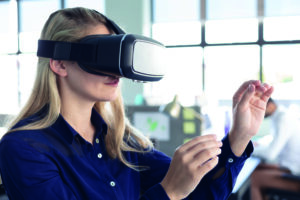
Feedback collected through standardized questionnaires confirmed the relevance of the experience by assessing psychological immersion, ergonomics, and the perceived value of the tool.
The results are very encouraging: the more intuitive and enjoyable the application is deemed to be, the more students achieve a state of concentration and enjoyment (“flow”) that enhances their learning. This sense of immersion reinforces the perception of usefulness and enrichment, and reflects the role that virtual reality can play in the active acquisition of complex knowledge.
The study also demonstrated the importance of taking individual learning profiles into account when evaluating this sense of immersion and the overall perception of the learning experience. This leads to recommendations regarding the design and use of such applications, particularly for engineering training related to environments far removed from everyday experience, such as the underwater environment.
Admittedly, the experiment remains modest in scale and has not yet been compared to traditional methods. Nevertheless, these limitations in no way diminish the significance of the results obtained. On the contrary, they open up exciting prospects for future research and educational applications on a larger scale.
Learning about the physics of water and the forces acting on an underwater drone is a challenge, even for engineering students. Sea trials offer a fun opportunity to learn, but come with prohibitive costs.
To make these concepts more accessible and engaging, we have developed a virtual reality application in collaboration with Andrei Stanescu, a doctoral student. Its goal is simple: to give engineering students the opportunity to easily design submarines using simple shapes, materials of varying densities, and engines, and then to test their virtual designs in a realistic, immersive environment.
SEABOTS
An Introduction to Underwater Robotics for Middle and High School Students
By Tom Gournay and Franck Guarnieri, Director of the CRC
Mines Paris pour l’Océan is developing the SEABOTS project, an innovative educational initiative that offers middle and high school students a hands-on immersion in the fascinating world of underwater robotics.
Built using simple, reliable, and inexpensive components (PVC pipes, motors, onboard electronics, 3D-printed parts, etc.), SEABOTS wire-guided drones serve as a unique educational tool, engaging a wide range of skills and promoting active, hands-on learning.
Middle and high school students are invited to design, program, and test their own underwater drone over a period of one to two weeks. The activity can, of course, be organized over a longer period depending on the projects led by the teaching teams.
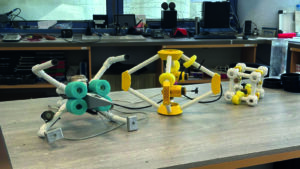
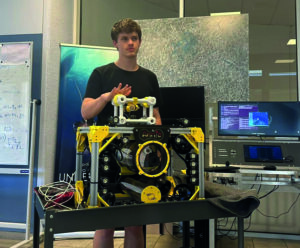
SEABOTS is based on an interdisciplinary educational approach inspired by the STEAM model (Science, Technology, Engineering, Arts, and Mathematics). This approach combines scientific rigor with creativity by integrating artistic, aesthetic, and societal dimensions into classroom projects.
It develops essential cross-disciplinary skills: curiosity, critical thinking, independence, observational skills, and cooperation.
The project’s expansion relies on a strategic partnership with the Ministry of National Education, as well as support from the UIMM (Union of Metalworking Industries and Trades) in the South Region. In this context, active collaborations are underway with the school districts of Nice, Aix-Marseille, and Toulon to enable a growing number of schools to access this program.
Pilot trials have already been successfully conducted in several high schools, notably in Antibes and Valbonne, where students designed, assembled, and launched a first series of SEABOTS.
Building on this momentum, the SEABOTS line will soon expand with the development of surface marine drones, opening up new educational opportunities related to the exploration of the marine environment. The gradual integration of onboard sensors—cameras, temperature probes, pH sensors, etc.—will enrich the educational experience by providing students with tools for observing and analyzing the aquatic environment, thereby strengthening the link between technology and environmental issues.
Through SEABOTS, Mines Paris for the Ocean reaffirms its commitment to a modern, inclusive science education that addresses the major challenges of the 21st century. By bringing together stakeholders from education, research, and industry, the project aims to inspire new generations and prepare them for the scientific and technological careers of tomorrow, dedicated to the preservation and protection of the ocean.
Imaginary Scenarios of Maritime Emergencies
By Aurélien Portelli, Research Fellow
I had the pleasure of editing, together with my colleagues Nebiha Guiga and Henning Trüper—both researchers at the Leibniz Centre in Berlin—a special issue of the Canadian journal *Histoire sociale / Social History* devoted to “Social Imaginaries of Maritime Emergencies since 1800.” This theme resonates with my research on the imaginaries of risk and crisis, which I have been conducting at the CRC since 2012.
Drawing on diverse approaches and fields of research, the contributors to this special issue examine the imaginaries of maritime emergencies in light of the transformations that have taken place in European societies since the late 18th century.
Thus, is there a specifically modern imagination of maritime emergencies, and if so, how did it emerge and how has it evolved?
While numerous studies have already addressed maritime imaginaries, most of them do not place a central focus on emergencies.
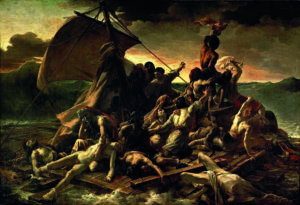
Oil on canvas, The Raft of the Medusa (1819)
Théodore Géricault
In our article, we show how modern representations of lifesaving fit into the founding narrative of the RNLI—a key source of legitimacy and meaning—while broadening its scope through a process of adaptation to the present day.
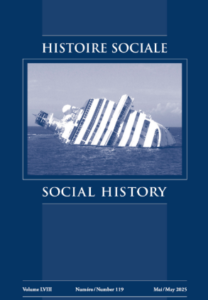
This issue aims to fill that gap by highlighting the moral dimension of rescue, based on an analysis of representations found primarily in literature, the press, and television series. The issue consists of seven contributions, including an article I co-authored with Nebiha Guiga, which proposes to investigate, from a historical perspective, the imaginaries of danger and heroism in the documentary series *Saving Lives at Sea*. This series, broadcast on the BBC, follows volunteers from the Royal National Lifeboat Institution (RNLI), founded in 1824 and tasked with saving lives at sea in the United Kingdom and Ireland.
Publication date of the special issue: Fall 2025
Predicting the Location of Ships
Using Deep Learning & Environmental Data
By Ambroise Renaud, Ph.D. Candidate, supervised by Aldo Napoli, Research Professor, and Clément Iphar (University of Western Brittany)
Rather than modeling radio wave propagation using classical physical equations (such as the ITU-R model), I explored an approach based on graphs and deep learning, specifically graph neural networks (GNNs), a machine learning architecture that is well-suited and innovative for this problem.
An inductive approach, for better generalization
My model learns from real-world data: millions of AIS messages acquired by the receiving device at the Pierre Laffitte Campus (Sophia Antipolis), enriched with meteorological data (wind, pressure, humidity) and topographical data (altitude). The model constructs spatial graphs every hour and analyzes them using algorithms inspired by neural networks (GraphSAGE, LSTM, among others). It is able to accurately predict which ships will or will not be detected by our AIS acquisition system.
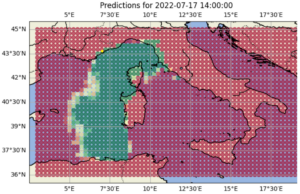
The figure on the left shows a typical example of a prediction generated by the model. It is a map depicting the reception area of our AIS acquisition device in Sophia Antipolis (yellow dot), under very favorable propagation conditions, where each cell is colored according to the probability of receiving a message transmitted from that location (from red for the lowest probability to green for the highest).
Ships at sea and in ports continuously exchange information via the AIS (Automatic Identification System), a system based on messages broadcast on two VHF channels that transmit their position, course, or speed. However, the reception of these signals is highly dependent on geographical and meteorological conditions: rugged terrain or atmospheric phenomena can affect the signal’s range.
Performance and Prospects
Compared to conventional methods or traditional machine learning algorithms such as XGBoost, my approach achieves better results, particularly for long-distance propagation. It thus demonstrates that a model based on graphs and environmental data can accurately predict AIS reception zones, capturing complex phenomena that physical or statistical approaches struggle to reproduce.
The model was trained and evaluated primarily in the Sophia Antipolis area (Ligurian Sea, Tyrrhenian Sea), raising the question of its generalizability to other maritime environments. These findings open up avenues for future work: validating the model at other coastal sites, enriching it with satellite data, or moving from classification (reception/non-reception) to regression (received power level). Ultimately, such an approach could contribute to adaptive and scalable modeling of maritime radio coverage, with direct implications for navigation safety and surveillance.
JASON Project
By Aldo Napoli, Professor and Researcher, for Maritime Safety
JASON aims to build on scientific research, technological advances, and the results of previous projects in the areas of environmental protection and maritime safety within the geographical cooperation area covered by the Interreg Maritime program. In light of this work, Jason will focus on three specific issues with a particular impact on the environment, as well as a key regulatory topic and a source of demand for new operational capabilities, such as alternative energy sources (propulsive and non-propulsive), autonomous ships, and maritime and port cybersecurity, all with a 2050 horizon.
- Project coordinated by the Liguria Region
- Total budget: €4,693,331
- ERDF funding: €3,754,665
- Project duration: 42 months
- 14 partners
The CRC and JASON
Eric Rigaud, Justin Larouzée, and Aldo Napoli, researchers at the Center for Research on Risks and Crises (CRC), will be involved in the JASON project to:
1.
Contribute to the development of forward-looking scenarios for the year 2050.
These scenarios will focus on the deployment of alternative fuels and autonomous vessels in the Franco-Italian maritime area, taking into account, among other things, various policy options.
2.
Conduct a System-Theoretic Process Analysis (STPA), a forward-looking method derived from STAMP (Systems-Theoretic Accident Model and Processes).
The objective: to map and structure knowledge related to risks—including emerging risks—associated with the integration of new technologies in the area of interest.
3.
Utilize the EBIOS Risk Manager IT risk analysis method, developed by ANSSI (the French National Cybersecurity Agency).
This is to assess the vulnerability of the current (AIS—Automatic Identification System) and future (VDES—VHF Data Exchange System) automated message exchange systems (location, characteristics, etc.) between ships, including autonomous ships, and shore-based centers in the face of cyber threats.
The CRC aims to develop, with the assistance of project partners, training and certification programs for stakeholders in the maritime transport and port sectors. These training programs, which could follow the course model established by the International Maritime Organization (IMO), will focus on the implementation of the AM, STPA, and EBIOS RM methods and will present their findings compiled into a body of knowledge. They can be adapted for public and private training institutions as well as for the target audience (seafarers, controllers, port operators, etc.). These training programs may be proposed to the IMO to enrich its catalog of courses related to maritime safety.
About this content
This content is taken from the special issue Mines Paris for the Ocean, published in Carnets de Correspondances #17, a Mines Paris – PSL (Pierre Laffitte campus) publication.
This issue explores the challenges of underwater robotics, underwater archaeology, the training of tomorrow’s engineers, and technological innovations dedicated to ocean conservation.
Authors:
- Franck Guarnieri – Director of the CRC
- Samuel Olampi – Research Engineer
- Aurélien Portelli – Research Fellow
- Ambroise Renaud – Ph.D. Candidate
- Sébastien Travadel – Faculty Member and Researcher
- Aldo Napoli – Faculty Member and Researcher
- Tom Gournay – Ph.D. Candidate
Pour aller plus loin
- Underwater 2025: 33 engineering students from Mines Paris – PSL are designing an underwater system for a scientific mission in the Mediterranean
- Interview with Franck Guarnieri: blue engineering at the heart of teaching with Mines Paris pour l’Océan
- Underwater Engineering Project: heading for the abyss