
MEDUSA: When Engineering Takes Center Stage in an Underwater Ballet
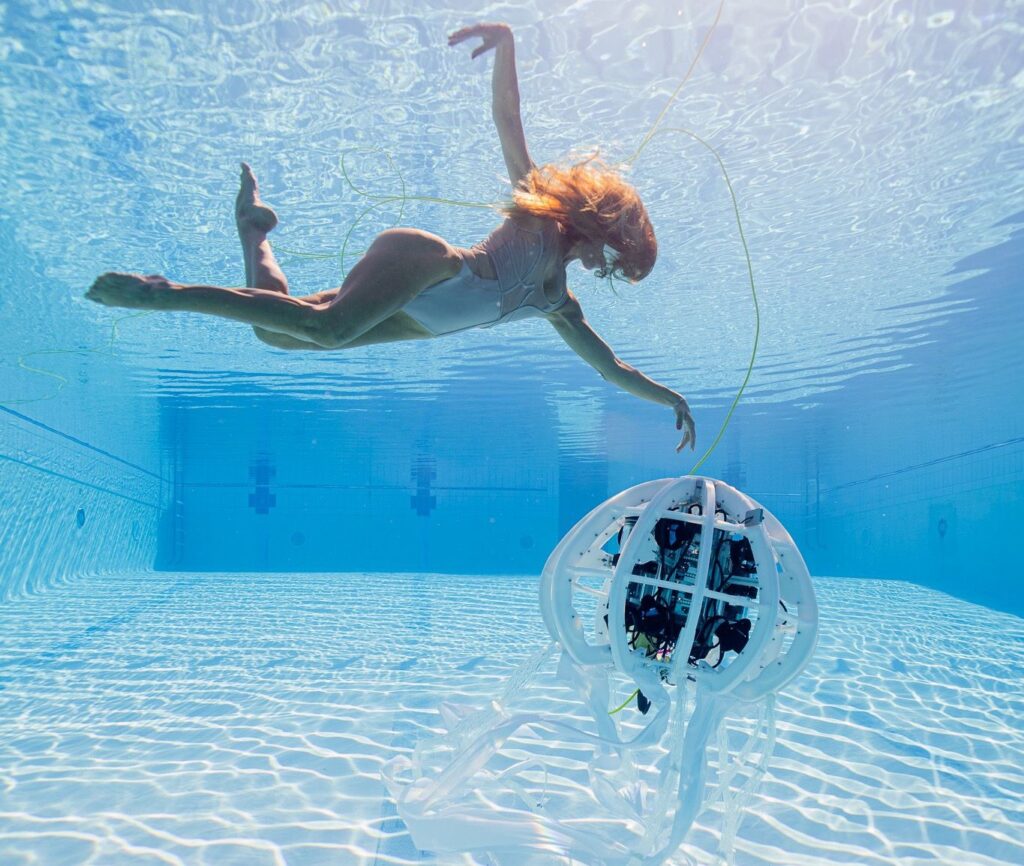
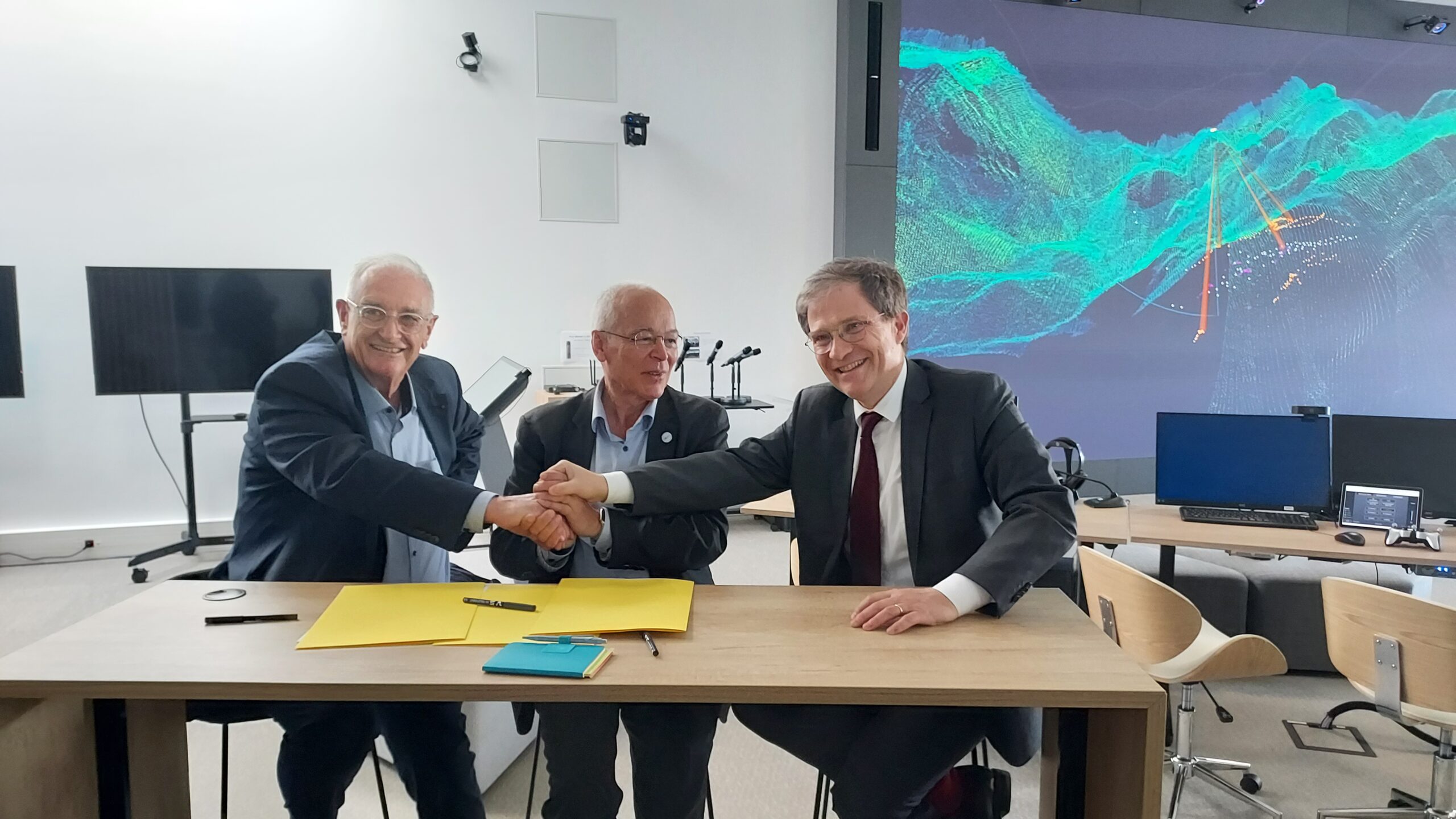
At the intersection of art, robotics, and underwater exploration, the MEDUSA project brought together, on May 30 in Les Sables-d’Olonne, a unique choreographic creation and an engineering challenge. Designed by the team at the Collège des Sciences Navales (CSN), an interdisciplinary research and innovation center born from a partnership between the École des Industries Avancées (EDEIA) of theUIMM and the Centre de recherche sur les Risques et les Crises (CRC) at Mines Paris – PSL, with the support of the Mines Paris Foundation, a jellyfish robot accompanied artist Bastien Soleil and his team Le premier souffle in an underwater ballet where technology became a stage partner. A unique encounter between artistic creation and innovation, as 2025–2026 is the Year of Engineering, bringing together the worlds of education, research, business, and the general public to highlight the professions as well as the scientific and technological knowledge that shape our future.
Dance, freediving, and underwater robotics
Beneath the surface, our bearings shift. Bodies slow down, movements hang in the air, and breath becomes dramatic matter. It is in this silent universe that MEDUSA unfolded, a new kind of live performance conceived by contemporary artist Bastien Soleil, at the crossroads of dance, freediving, imagery, and visual poetry.
Presented on May 30, 2026, as part of the Les Sables-d’Olonne Dance Biennale, MEDUSA offered a rare immersive experience: five professional dancers performing while freediving in a five-meter-deep pool, without respiratory assistance. Led by Bastien Soleil, his team Le premier souffle—comprising notably Marion Crampe, Rose Molina Barrios, Aurélie Coze, Dimitrii Staev, and Oliver Gregory—brought to life a choreographic language shaped by water, slowness, the resistance of the aquatic environment, and breath control.
But MEDUSA is not merely an aquatic work. It is also a testing ground for engineering. At the heart of the production, a jellyfish robot designed by the team at the Collège des Sciences Navales has become a full-fledged participant in the creation. Inspired by living organisms and designed to move through the water with precision and expressiveness, it extended the dancers’ movements and introduced a unique dialogue between the human body and a poetic machine into the scene.
A machine designed to evoke emotion
The jellyfish robot is based on technologies developed by Blue Robotics, a company specializing in underwater robotic solutions. Building on these technological building blocks, the team at the Collège des Sciences Navales (CSN) worked to adapt, integrate, and master a system capable of meeting the very specific demands of an underwater setting: stability, trajectories, safety, fluidity of movement, clarity of motion, and interaction with the performers.
In MEDUSA, the technology does not seek to impress through performance alone. It is put at the service of an emotion. The robot is neither a mere prop nor a technical demonstration: it becomes a presence, a partner, a floating figure. Its trajectory, behavior, and rhythm contribute to the choreography. Engineering is conceived here as a language, capable of resonating with dance, light, music, and water.
Bastien Soleil, water as stage and as breath
An international artist, Bastien Soleil has for several years been developing a unique practice that blends underwater performance, freediving, photography, and film. His works are built around a radical constraint: creating in a single breath, without assistance, in an environment where every gesture must be anticipated, mastered, and embodied.
With MEDUSA, he takes a new step forward. His world, until now often captured through images, becomes a live performance shared with the audience. Water is no longer merely a backdrop: it becomes a stage, a partner, a space of transformation. The dancers in his troupe develop a distinct physicality within it—at once constrained and liberated—where balance, slowness, and suspension form a choreographic vocabulary unique to the underwater world.
The presence of the jellyfish robot amplifies this artistic exploration. It introduces a new form of stage relationship: no longer just between dancers, but between humans, machines, and the aquatic environment. In this encounter, technical movement merges with artistic expression.
This approach illustrates a strong conviction: innovation is not limited to laboratories or industrial applications. It can also open up new imaginaries, transform our view of living things, and invent unprecedented artistic forms.
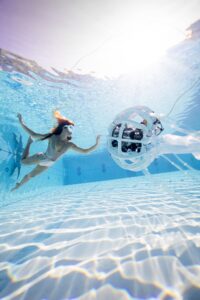
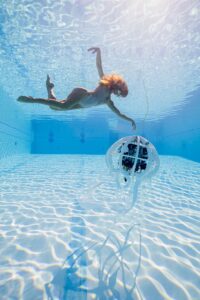
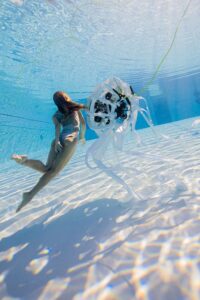
Credit: Bastien Soleil. Photos taken during rehearsals. Dancer: Rose Molina Barrios
Art, engineering, and ecology: a single movement
MEDUSA explores our relationship with water, the sea, and marine ecosystems. The figure of the jellyfish, both fascinating and ambivalent, evokes the fragile beauty of the underwater world but also the ecological imbalances that permeate it. The performance thus invites us to feel, rather than merely understand, the urgency of reconnecting with aquatic environments.
In this context, engineering plays an essential role. It makes the invisible visible, creates the conditions for an immersive experience, and gives shape to an encounter between science, art, and ecological awareness. MEDUSA becomes an underwater laboratory where robotics, physical performance, visual creation, and environmental awareness intersect.
The project has received support from the Fondation Mines Paris, which is thus backing an initiative that is at once artistic, technological, and educational. For the students, engineering students, and supervisors involved, MEDUSA serves as a practical learning ground: designing for a constrained environment, working with artists, integrating safety considerations, experimenting with trajectories, and adapting the machine to a theatrical vision.
A special resonance in 2026, the Year of Engineering
The year 2026 puts engineering in the spotlight. In this context, MEDUSA offers a particularly poignant illustration of what engineering can be today: a discipline of design, experimentation, and responsibility, but also a force of imagination.
By bringing together an underwater ballet, a robot inspired by living organisms, and a reflection on our relationship with the ocean, the project demonstrates that engineering can engage with art to reach new audiences. It becomes a means of storytelling, of transmission, and of inquiry. It does not merely solve problems: it helps invent experiences capable of shifting perceptions.
At a time when ecological, technological, and cultural transitions call for new forms of cooperation, MEDUSA reminds us that engineers and artists share the same imperative: to give form to what does not yet exist.
A premiere that opens new horizons
During its premiere in Les Sables-d’Olonne, MEDUSA offered two ways to experience the performance: part of the audience was able to follow the performance from the water, equipped with masks and snorkels, while the other spectators watched the live broadcast on a large screen. This dual approach—experiencing the work from the water or observing it through cinematic imagery—reflects the project’s ambition: to forge a new connection between the audience, moving bodies, the machine, and the marine environment.
With MEDUSA, Mines Paris – PSL is embarking on an adventure where engineering becomes an art of connection: a connection between disciplines, between humans and machines, between research and creation, between technology and life. Underwater, the robotic jellyfish did more than simply accompany Bastien Soleil and his team. It offered a glimpse of another way to imagine the future: sensitive, responsible, and deeply interdisciplinary.