Innovative pedagogy
At the service of critical thinking
The course “Imaginer les crises” (Imagine the Crises) offers interdisciplinary learning. Students work on complex issues for five half-days, mobilizing not only the knowledge and techniques of engineers, but also understanding social and human dynamics, articulating collective work, and constructing coherent narratives.
The course is supervised by Aurélien Portelli and Justin Larouzée, teachers at the Center for Research on Risks and Crises (CRC), as well as a committee of experts from various fields: crisis management and resilience, industrial processes, geopolitics and defense, narration, and staging. This close supervision allows students to benefit from multiple points of view and to deepen their reflections on the technical, organizational, and human aspects of crises.
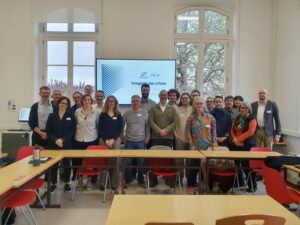
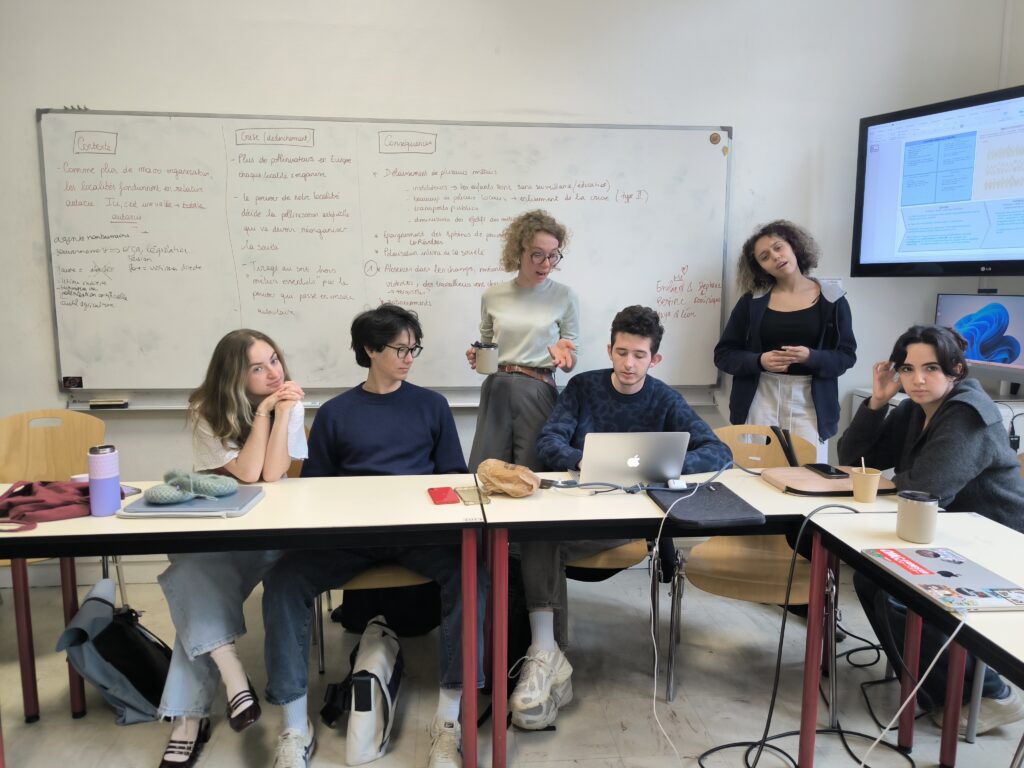
Course “Imaginer les crises” (2026) team
Through the method of thought experiments, students are invited to design crisis scenarios. The exercise consists of imagining their genesis and immediate effects in a plausible world, and then analyzing how these crises spread and impact sociotechnical systems (human and non-human agents).
This original approach allows us to develop analytical and reflective skills in future engineers, while emphasizing creativity and the ability to consider disruptive scenarios.
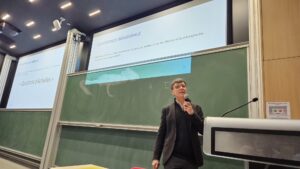
Olivier Rey, a mathematician and philosopher at the CNRS, introduced the notion of scale in his inaugural conference, which is essential for investigating the theme chosen for the 2026 edition of the course.
The 2026 edition:
“What crises in a localized world where macro-organizations have disappeared?”
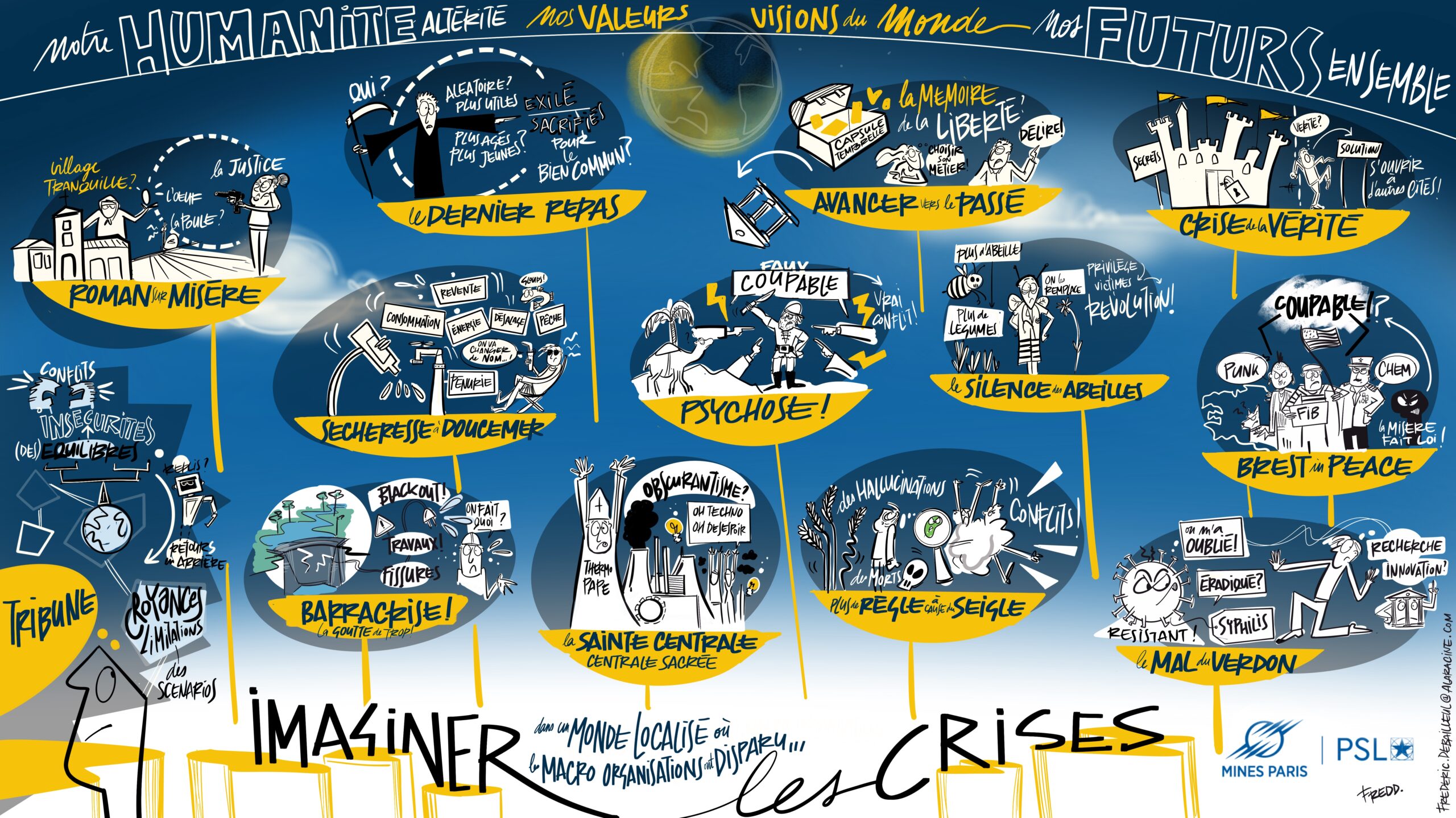
For this edition, students had to design plausible and realistic scenarios in a world where large political, economic, and social organizations had disappeared, leaving room for more or less autonomous local units. Using the thought experiment method, they explored crisis situations, questioning the limits of security models and the ability of actors to adapt to the unexpected.
Each group produced a unique, structured, and plausible scenario, combining available scientific data with a reflection on the social, economic, and political consequences.
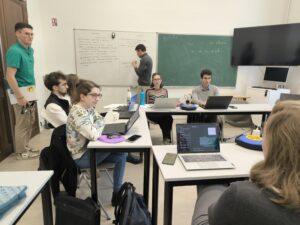
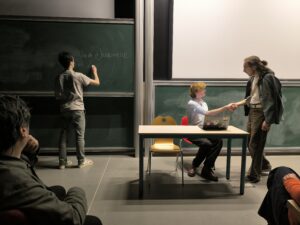
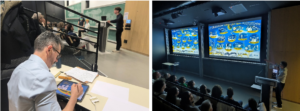
Workshop of a group of students
The mentors Aurélien Portelli and Justin Larouzée share: “The current era is characterized by an increasingly radical critique of major governance and production systems, and the promotion of local initiatives in terms of organization. Les élèves du cycle Ingénieur Civil de Mines Paris – PSL ne sont pas étrangers à ces réflexions. Without questioning the merits of these proposals, it is possible to identify a utopian bias consisting of believing that a return to a small scale would be a panacea that would exempt individuals from the problems of living together, managing resources, interacting with the environment, as well as incidents, accidents, and crises. We therefore wanted to invite our students to question the specific logics that govern small groups, the importance of thresholds, and the effects of bifurcation or rupture due to their crossing.”
These are scenarios where technology and humanity meet.
The scenarios imagined by the students go beyond the scope of technical analysis. They incorporate infrastructures, networks, and complex systems, as well as the interactions between technology and society, while taking into account the reactions of local communities to unprecedented crises. The exercise requires maintaining coherence with the imagined world, respecting the laws of physics and the criteria of plausibility, which requires a delicate balance between scientific rigor and narrative inventiveness.
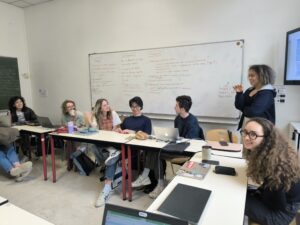
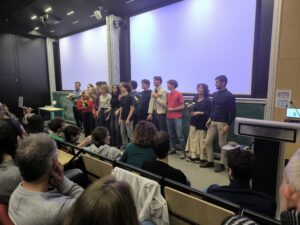
Workshop of a group of students
Focus on a thought exercise
A crisis scenario triggered by a nuclear winter, depriving the Earth of sunlight and disrupting energy and social balances.
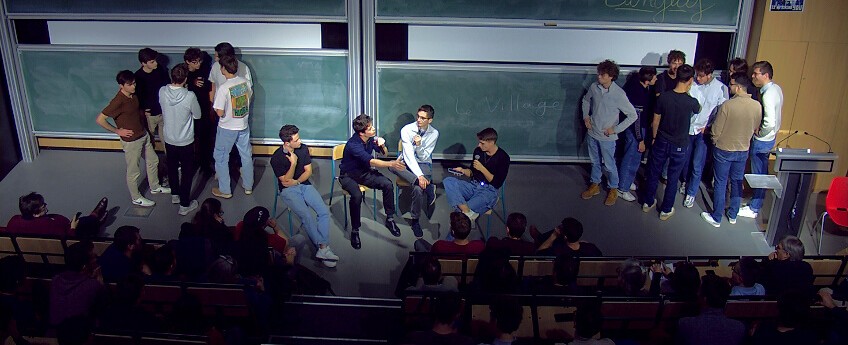
In this video, Malo and Thomas’s group revisits one of the scenarios developed. They demonstrate how they used the thought experiment method to develop a structured reasoning from a plausible situation.
In this scenario, the students imagined a community that survives around a coal-fired power plant that has become vital, giving rise to a hierarchical society where technical knowledge and religious power intertwine. The progressive degradation of knowledge ultimately leads to a major technical failure, revealing the fragility of the system and causing a global crisis.
They also present their work process and the contributions of the exercise, especially for understanding the interdependencies between systems and anticipating complex situations.