
Building a Community to Reflect on Risk and Crisis
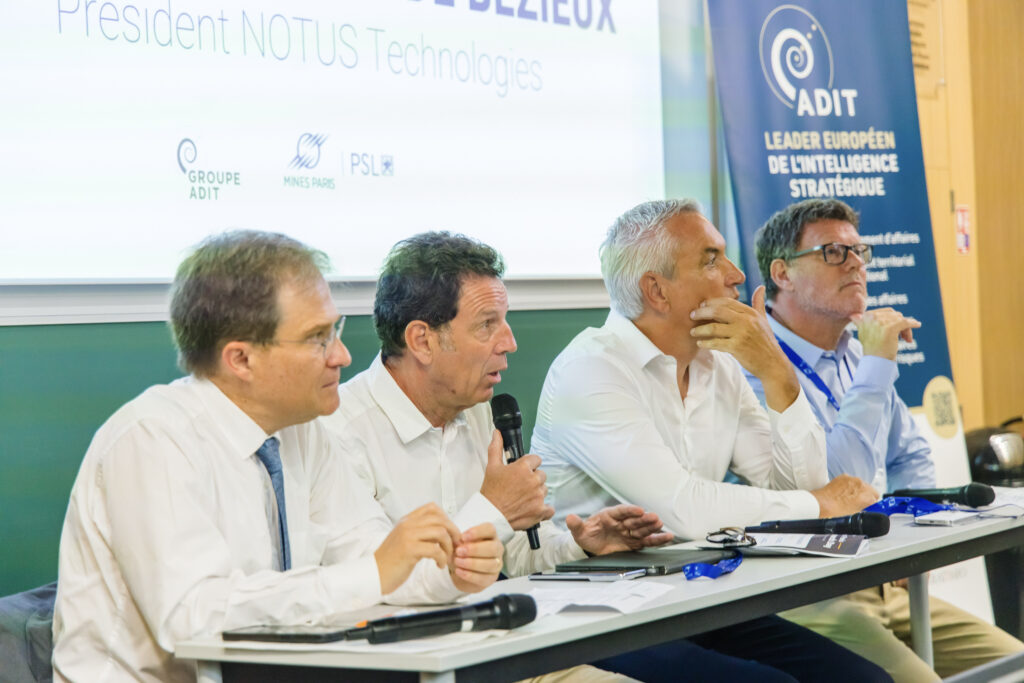
Crises no longer occur in isolation: they follow one another in rapid succession, reinforce one another, and transcend the boundaries between sectors, disciplines, and institutions. In such a context, how can we develop a common understanding of risks and strengthen our collective ability to anticipate crises? This was the focus of the roundtable discussion “Toward a French Risk Community? ,” held on June 23 as part of the Mines Paris Research Day 2026. Godefroy Beauvallet, CEO of Mines Paris – PSL, Philippe Caduc, Chairman and CEO of the ADIT Group, Franck Guarnieri, Director of the Center for Research on Risks and Crises (CRC) at Mines Paris – PSL, and Geoffroy Roux de Bézieux, President of Notus Technologies and Honorary President of MEDEF, exchanged their perspectives to outline the contours of a new risk culture—one that is more cross-functional and action-oriented—notably through the signing of a strategic partnership between Mines Paris – PSL and the ADIT Group, which will lead to the creation of a Risk Institute.
Risks and crises that transcend disciplinary boundaries
Cyberattacks, geopolitical tensions, climate change, technological dependencies, and disinformation—the consensus is clear: contemporary risks can no longer be analyzed on a sector-by-sector basis. They intersect, produce cascading effects, and make organizations more vulnerable.
Bringing together more than 450 researchers, industry professionals, entrepreneurs, and institutional partners to address major contemporary scientific and industrial challenges, the Mines Paris Research Day is an annual highlight of collaborative research at Mines Paris – PSL. The roundtable discussion “Toward a French Risk Community?”, moderated by Cédric Prunier, Director of Development, Partnerships, Entrepreneurship, and Commercialization (DPEV) at Mines Paris–PSL, highlighted an issue that has become central: in the face of risks that are now systemic, no single area of expertise can claim to act alone.
For Geoffroy Roux de Bézieux, President of Notus Technologies and Honorary President of MEDEF, this shift is profoundly transforming the way companies must integrate risk into their strategy.
Geopolitics has made a strong entry onto corporate boards. Geopolitical risk has become a business factor.
Geoffroy Roux de Bézieux, president of Notus Technologies and honorary president of MEDEF
In his report on corporate economic security submitted to the President of the Republic in September 2024, Geoffroy Roux de Bézieux highlights, in particular, the rise of risks linked to foreign interference, economic espionage, and cyberattacks, which now extend far beyond the defense sector alone.
This development calls for an unprecedented collaboration between businesses, government agencies, and the academic community to better share information and build a true “French national team” for economic security.
Speakers from left to right: Cédric Prunier, Director of Development, Partnerships, Entrepreneurship, and Commercialization (DPEV) at Mines Paris – PSL (moderator), Godefroy Beauvallet, CEO of Mines Paris – PSL, Geoffroy Roux de Bézieux, President of Notus Technologies and Honorary President of MEDEF, Philippe Caduc, Chairman and CEO of ADIT Group, Franck Guarnieri, Director of the Center for Research on Risks and Crises (CRC) at Mines Paris – PSL.
Building a Common Language of Risk
Researchers, industry professionals, safety specialists, crisis managers, and insurers each develop their own methods and tools, without always having shared spaces for dialogue and collaboration. For Franck Guarnieri, Director of the Center for Research on Risks and Crises (CRC), the difficulty lies not in a lack of expertise, but in its fragmentation. An interdisciplinary approach combining engineering, the social sciences, the humanities, modeling, and organizational analysis is essential.
Risk communities already exist, but they have been built around highly specialized fields that still engage in too little dialogue with one another: industrial safety, cybersecurity, natural disasters, risk insurance, operational safety… In the face of risks that are now systemic, this fragmentation has become a limiting factor.
Modeling—whether qualitative and/or quantitative—should serve as a common language that enables these different communities to share information and data and to build solutions together.
Franck Guarnieri, Director of the Center for Research on Risks and Crises (CRC) at Mines Paris – PSL
Research conducted at the CRC explores this ability to break down barriers between approaches. It focuses as much on technical phenomena as on the interactions between infrastructure, organizations, human behavior, and public policy decisions. Understanding contemporary crises thus requires developing shared frameworks capable of linking complementary areas of expertise rather than simply juxtaposing them.
Training engineers capable of thinking through uncertainty
The issue of risk has been at the heart of the School’s identity since its founding in 1783, when the goal was already to train engineers capable of ensuring the safety of mining operations while supporting industrial development.
For Godefroy Beauvallet, Director General of Mines Paris – PSL, it is no longer just a matter of developing cutting-edge expertise, but also of training engineers capable of bridging disciplines, engaging with stakeholders from different cultural backgrounds, and navigating situations marked by uncertainty.
When we don’t know how to conceptualize something, when we lack the concepts to discuss it, we end up in denial or in hyper-specialization.
Godefroy Beauvallet, Director General of Mines Paris – PSL
This ambition drives both the research activities and the educational programs at Mines Paris – PSL. Through courses such as Imagining Crises, students are guided to develop forward-looking scenarios that draw on engineering, geopolitics, the humanities, and narrative analysis to foster a comprehensive understanding of complex phenomena.
By placing interdisciplinary dialogue, collaborative research, and foresight at the heart of its strategy, Mines Paris – PSL affirms its role as a scientific leader addressing major contemporary transformations. Training engineers capable of understanding complexity, assessing risks, and informing decision-making is now one of the essential prerequisites for addressing industrial, environmental, and societal challenges.
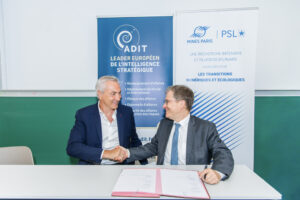
Signing of the strategic partnership between the Center for Research on Risks and Crises (CRC) at Mines Paris – PSL and the ADIT Group, establishing the creation of a Risk Institute. From left to right: Philippe Caduc, Chairman and CEO of the ADIT Group, Godefroy Beauvallet, President and CEO of Mines Paris – PSL.
A Partnership to Build a French Risk Community
This roundtable also marked an important milestone with the announcement of a strategic partnership between Mines Paris–PSL and the ADIT Group. This collaboration reflects a shared goal: to build lasting bridges between academia, businesses, and public policymakers in order to develop a shared culture of risk.
Philippe Caduc, Chairman and CEO of the ADIT Group, outlined this initiative, which aims to bring together expertise that is currently still scattered and to develop new tools for understanding contemporary risks.
We want to create a collective culture of risk and a true tool for intellectual sovereignty.
Philippe Caduc, Chairman and CEO of the ADIT Group
This partnership will take shape, in particular, through the creation of an Executive Master’s program in “Strategic Risk Intelligence,” designed to train a new generation of public and private decision-makers capable of navigating an environment marked by uncertainty.
More broadly, it is part of a project to create a Risk Institute, designed as a meeting place for researchers, industry representatives, field experts, and institutional stakeholders. The goal is to foster the sharing of experiences, develop new analytical frameworks, and help build a genuine French risk community capable of anticipating crises rather than merely enduring them.
Making Research a Catalyst for Collective Action
This roundtable fully illustrates the mission of the Mines Paris Research Day: to build bridges between research, industry, and public policy in order to provide concrete responses to major contemporary transformations. This ambition is fully aligned with the collaborative research led by Mines Paris – PSL, which aims to create new tools for analysis and anticipation.
As risks become increasingly systemic, understanding them is no longer the sole domain of scientific expertise or operational management. It also requires building common frameworks, fostering interdisciplinary dialogue, and developing a shared culture of foresight. Through this initiative and the partnership established with the ADIT Group, Mines Paris – PSL reaffirms its role as a center for research, education, and cooperation dedicated to addressing the major challenges of sovereignty and resilience.