
AI, a “runaway horse” to be tamed to transform the economy
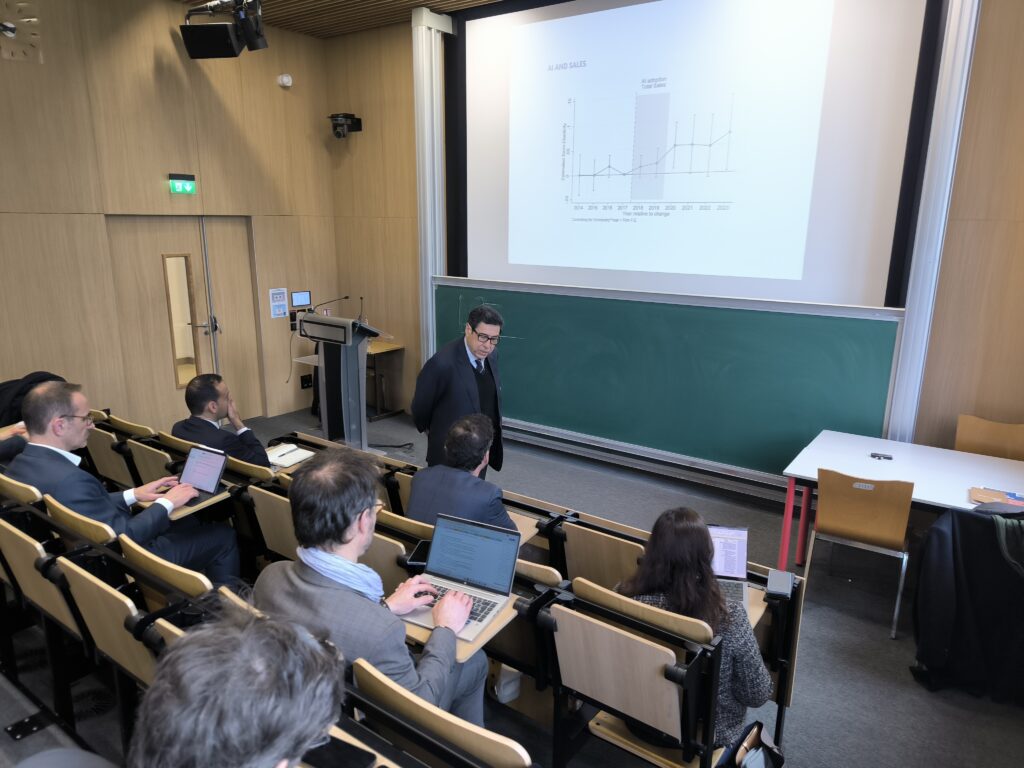
Should we fear artificial intelligence or welcome it? Between promises of growth, disruptions to work, and environmental challenges, the issue divides and raises concern. This question lies at the heart of the conference series “Major Economic and International Issues”, led by Mines Paris – PSL Executive Education in partnership with the French Treasury. Economist Philippe Aghion, Professor at the Collège de France and recipient of the 2025 Nobel Prize in Economics, was invited for the occasion. He shed light on the debate with a nuanced message: AI is neither inevitable nor a panacea—it is a powerful lever whose impact will depend above all on our collective choices.
A space for dialogue
A space for dialogue
In a context shaped by rapid digital, climate, and geopolitical transformations, the “Major Economic and International Issues” conference series is designed as a forum for reflection and knowledge-sharing. By combining the academic excellence of Mines Paris – PSL, through its Executive Education programs, with the strategic expertise of the French Treasury, the series aims to bridge scientific knowledge and decision-making challenges.
Inviting leading researchers such as Philippe Aghion is part of this approach: helping audiences understand ongoing transformations, drawing on rigorous yet accessible research.
AI
A revolution shaped by innovation
While artificial intelligence entered everyday life in 2022, its roots go back to the 1950s with the pioneering work of Alan Turing. Only recently, however, has it experienced a dramatic acceleration, driven by the combination of massive datasets and computing power. For Philippe Aghion, this marks a decisive turning point: humans now oversee systems that learn to identify statistical relationships within data. In other words, machines no longer simply execute tasks—they learn, adapt, and fundamentally transform production processes.
Beyond technological progress, AI is already having a significant impact on economic growth. Early observations are striking: in some firms, the introduction of generative AI leads to rapid and substantial productivity gains. But for Aghion, the key point lies elsewhere. AI does not just automate tasks—it also automates the production of ideas.
By enabling the recombination of knowledge, AI sustainably accelerates innovation, with potential comparable to—or even exceeding—that of past major technological revolutions. Still, Aghion rejects technological determinism:
AI is like a runaway horse: if you don’t control it, it will crash you into a wall. But if you do control it, it can take you wherever you want.
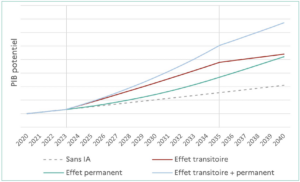
Expected overall effects of AI adoption on economic growth.
Institutions
The key to steering the revolution
This “runaway horse” cannot be tamed on its own. Its direction depends on institutions—public policy, regulation, and competition. The economist warns against a familiar risk: excessive concentration of economic power. As in previous technological revolutions, a small number of firms could capture most of the gains, to the detriment of innovation.
This calls for a delicate balance:
- encouraging investment, particularly in computing infrastructure
- ensuring effective competition
- avoiding excessive regulation that could hinder new entrants
The challenge is to build an ecosystem capable of fully harnessing AI’s potential.
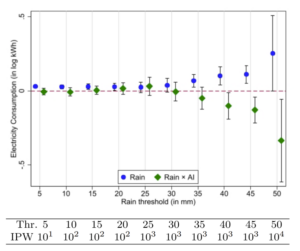
AI makes it possible to anticipate rainfall events (rather than relying on traditional reactive approaches) and to respond intelligently to dilution episodes (more water, lower pollutant concentration).
Employment
A transformation to be managed
Employment remains one of the central concerns surrounding AI. Here again, Philippe Aghion takes a nuanced position:
AI will lead to job destruction, but it will also create jobs.
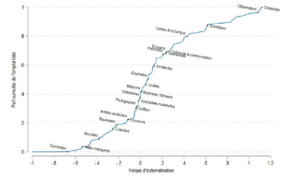
In many cases, productivity gains enhance firms’ competitiveness, stimulate demand, and ultimately support employment. However, impacts vary significantly across occupations: repetitive and administrative tasks are most exposed, while activities involving creativity, interaction, or judgment are more resilient. The real issue is therefore less the overall number of jobs than the speed of their transformation.
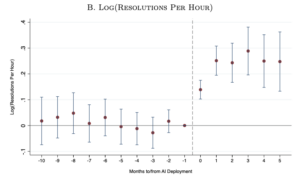
Impact of AI on productivity from the first month (+14%), increasing further in the second month and remaining stable and persistent through the end of the sample (+25%).
In response, Aghion emphasizes the critical role of public policy. First, education—not only integrating AI into learning, but also preserving core skills:
We need a school system that teaches how to learn.
Reading, writing, reasoning, and demonstrating remain essential to adapt in a constantly evolving world.
Second, lifelong learning and support for career transitions. Aghion advocates a “flexicurity” model, inspired by Denmark, combining worker protection with high mobility, aiming to make transitions “as smooth as possible” in an uncertain environment.
AI, climate, and beyond
A collective responsibility
Assessing AI’s contribution to the ecological transition—alongside potential rebound effects and underlying energy challenges—is unavoidable. The compatibility between artificial intelligence and ecological transition is now a critical question requiring urgent answers.
AI offers real opportunities: optimizing energy systems, improving resource management, and accelerating scientific research, particularly in climate science. However, these promises must be weighed against its costs, as AI relies on energy-intensive infrastructure. More fundamentally, it is embedded in a growth model that has historically contributed to rising greenhouse gas emissions. Can technological innovation and sustainability truly converge, or are they inherently in tension?
Going further
“Major Economic and International Issues”: a series to inform decision-makers
Three questions to understand how government, scientific research, and decision-makers interact today around major global economic transformations.
In this video, Laurent Amice (Executive Education Director at Mines Paris – PSL), Dorothée Rouzet (Chief Economist at the French Treasury), and Pierre Fleckinger (Professor and Director of the Center for Economics and Public Decision-Making) present the origins and objectives of a conference series dedicated to major international economic challenges.
In a world marked by geo-economic fragmentation, ecological transition, and technological disruption, this partnership between the French Treasury and Mines Paris – PSL is built on strong complementarity: the expertise of a strategic state and the academic excellence of a leading multidisciplinary engineering school, serving economic decision-makers.
The objective: to provide public and private sector leaders with the analytical tools needed to inform their strategic decisions. Together, they create a unique forum for dialogue between policymakers, researchers, and business leaders. In doing so, Mines Paris – PSL asserts its distinctive position: a multidisciplinary engineering school at the heart of contemporary economic and strategic challenges.