
Marseille: A Climate Lab for Tomorrow? The Destination Earth Project
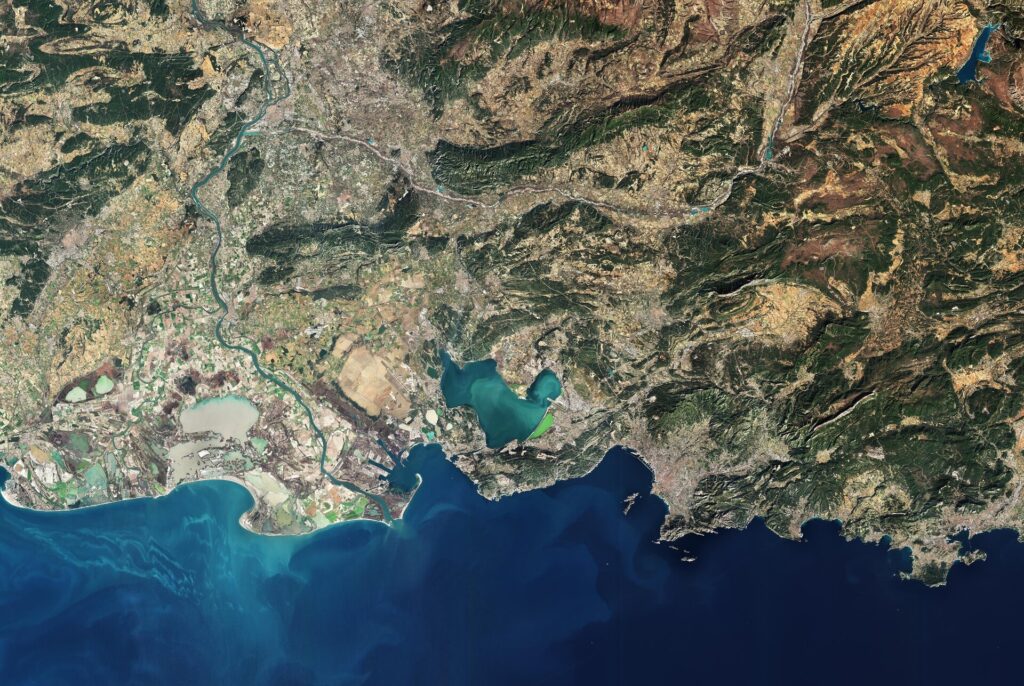
At the Fifth Destination Earth User eXchange, teams from Mines Paris – PSL—bringing together researchers from the Centre de Gestion Scientifique (CGS) and the Centre Observation, Impacts, Énergie (OIE)—are presenting an innovative approach to making climate data truly actionable. Led by Alexandre Azoulay (postdoctoral researcher at CGS), Malik Terfous (PhD candidate at CGS), Mohamed Skander Ben Yahia (research engineer at CGS), and in close collaboration with the work of Nicolas Fichaux (research engineer at OIE) and Thierry Ranchin (Director of OIE), their shared goal is clear: transform the power of climate models into practical tools for local communities. In Marseille, this vision is already taking shape.
Simulating Earth to Drive Real-World Action
Creating a digital twin of our planet to better anticipate its future may sound daunting. Yet that’s the ambition of Destination Earth (DestinE), a European Commission initiative that leverages satellite data, artificial intelligence, and supercomputers to simulate Earth’s systems with unprecedented precision.
Fine-scale climate simulations, long-term projections, scenario testing—on paper, it’s all there. But beyond theory, how can these data be put to practical use? How can stakeholders handle and exploit them? Because between cutting-edge technology and the operational needs of local governments, a gap persists.
A Problem More Human Than Technical
This gap is all too familiar to researchers. In Earth Observation (EO), data often exist in abundance but remain underused—not due to a lack of interest, but because local actors struggle to adopt them in ways that address their real-world challenges.
The co-design toolkit developed for DestinE puts this issue into words: a “great distance” persists between data producers and potential users. This distance is multifaceted—rooted in language, skills, and timelines. A climate model engineer and a local official planning urban development don’t share the same tools or priorities.
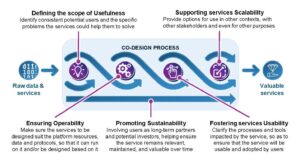
This is where the joint work of CGS and OIE comes into play: bridging that gap. Their method aims not only to develop operable services but also useful, user-friendly, sustainable, and scalable ones, as illustrated below.
Co-Designing, Not Delivering Ready-Made Solutions
Rather than trying to “translate” data after tools are developed, the Mines Paris – PSL teams propose a different approach: involve potential users from the start. Co-design, as formalized in the DestinE toolkit, is not just consultation—it’s a structured process based on the principle that a service only has value if it’s designed within its intended context.
In practice, the method unfolds in several stages:
- Identifying stakeholders
- Diagnosing needs
- Collaborative workshops
- Formalizing results
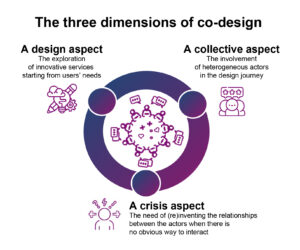
But above all, it relies on progressively building a shared understanding. The work of CGS and OIE shows that the challenge isn’t just designing a tool—it’s designing the relationships between stakeholders.
Interdisciplinary Collaboration Within Mines Paris – PSL
This project also reflects an internal convergence at the school. On one hand, CGS contributes expertise in innovation, design, and complex systems management. On the other, OIE brings skills in Earth observation, climatology, and data processing. This collaboration embodies a broader sectoral shift often called the “Twin Transition”—a dual digital and environmental transformation.
It also marks a conceptual shift. We no longer just talk about “Earth Observation (EO)” but about “Earth Intelligence”. In other words, the focus is no longer just on collecting data but on integrating it into systems that inform action.
Marseille: From Climate Models to Public Decision-Making
This approach is now being applied in a highly concrete way in Marseille. The city has committed to achieving carbon neutrality by 2030, but like many Mediterranean metropolises, it faces complex challenges: heatwaves, flood risks, dense urbanization, and social vulnerabilities.
In this context, having data isn’t enough—it must be translated into decisions. That’s the goal of the project led with Mines Paris – PSL: developing a decision-support tool, built on the DestinE platform, co-created with local stakeholders. The work in Marseille is turning models into action.
Through co-design workshops, researchers and city actors have:
- Identified priority issues (urban heat islands, city planning, energy)
- Defined relevant scenarios to simulate
- Developed truly actionable indicators
The TwinCity, tool is available with a free account, allows users to explore the effects of urban policies or assess the mid-term impact of decisions. Features aren’t predetermined by developers; they emerge from dialogue with users.
The Marseille Case—and Beyond
Marseille highlights several key challenges:
- The complexity of urban systems: A single urban planning decision can affect temperature, energy consumption, or quality of life. Tools must account for this multiplicity.
- Temporal alignment: Policymakers need to act quickly, while climate models often operate on long-term scales. Co-design helps bridge these timeframes.
- Adoption: Even the most advanced tool will only be used if it fits into existing practices. This is a central focus of the approach.
But the relevance of this method extends far beyond one city. By addressing the tension between tailored solutions and generic tools, the Mines Paris – PSL teams are helping build services that are both locally adapted and replicable elsewhere. In other words, Marseille is becoming a testing ground for European-scale solutions.
This work also opens up new perspectives in training, research, and partnerships, helping to shape an ecosystem where data, technology, and usage are no longer siloed.
Demonstration at the Fifth Destination Earth User eXchange
These findings will be presented at the Fifth Destination Earth User eXchange, held in Brussels on June 9–10, 2026, to an international community of researchers, developers, and policymakers. The event is an opportunity to demonstrate that climate data only reach their full potential when integrated into collective decision-making processes.
What the Marseille experiment shows is that the challenge is no longer just technological—it’s also organizational, social, and political. Building a digital twin of Earth is a scientific feat. But creating the conditions for it to be used, understood, and adopted is an equally critical challenge.
The CGS and OIE teams are thus working toward a collective climate intelligence: ensuring that data intelligence becomes shared intelligence.
Learn More
- TwinCity: a demonstration service by the city of Marseille, available with a free account. e-shape at the EuroGEO Workshop: Earth Observation Data for the Ecological Transition
- e-shape Project Coordination
- EuroGEO Website
- Co-design for DestinE – Research, Method, Principles, Toolkit
- Decision-Support Tool for the City of Marseille, Co-Designed Using ESA’s DestinE Tools
- Start with Users, End with Impact: Co-Designing DestinE Services