
Understanding polymers to recycle them better: Christelle Combeaud’s goal
How can we give a second life to the plastic we throw away every day? This question, which lies at the heart of today’s environmental challenges, guides the work of Christelle Combeaud, a professor and researcher at the Center for Material Forming (CEMEF) at Mines Paris – PSL.
On International Day of Women and Girls in Science, Mines Paris – PSL is highlighting her research, which explores the physical and mechanical behavior of polymers subjected to mechanical stress during bottle blowing or thermoforming processes. Mines Paris – PSL is keen to promote research that has become a benchmark in the field of recycled polymers, at the crossroads of science, industry, and ecological transition.
Applied research rooted in industrial realities
It was during her training as a plastics engineer at INSA Strasbourg that Christelle Combeaud discovered her taste for applied research. Very early on, she became interested in scientific issues directly related to industrial needs, with a clear goal in mind: to understand plastics in order to use them more effectively.
As her research progressed, another dimension emerged: that of meaning. Giving meaning to her work by contributing to concrete solutions for society. This approach was consistent with her scientific commitment, which focused on a major challenge: plastic recycling.
Removing a major obstacle to plastic recycling
While recycling appears to be an essential solution to plastic pollution, it faces a major challenge: the variability of recycled polymers. Unlike standardized and homogeneous petroleum-based polymers, recycled plastics have highly variable mechanical and thermal properties, which complicates their industrial processing.
This variability has a direct impact on manufacturing processes such as extrusion, stretching, bottle blowing, and thermoforming, all of which require precise control of the physical and mechanical behavior of the material. Understanding, anticipating, and optimizing these mechanisms is at the heart of Christelle Combeaud’s research.
Observe matter undergoing transformation
Polymers, which are found in many plastics and elastomers, have a complex internal structure organized at the microscopic level. When heated or stretched, this local organization changes, altering their final properties, whether mechanical, thermal, optical, or barrier properties.
Christelle Combeaud’s research falls precisely within this pivotal area between:
- the physics of matter: how polymer macromolecular chains organize and structure themselves
- mechanics: how the material deforms depending on temperature and stretching speed
- and industrial processes: hollow body blowing, thermoforming, biaxial stretching, etc.
Its objective: to link microscopic phenomena to macroscopic behaviors observed at the scale of industrial objects.
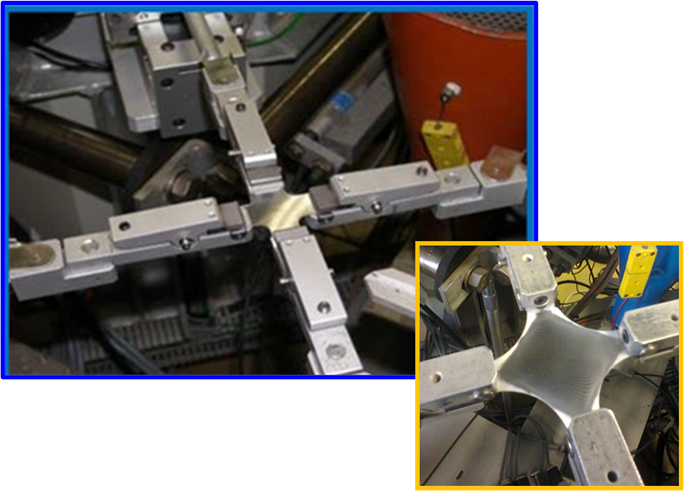
Balanced bi-stretching of an amorphous PET, stretched at a temperature of 95°C and a strain rate of 1.4 s-1.
Stretching and developing microstructures: a material in motion
In her work, Christelle Combeaud studies in particular the stretchability of polymers above their glass transition temperature. At this critical temperature, an amorphous polymer changes from a brittle/glass-like state to a ductile/rubbery state, which allows it to be shaped.
By subjecting these polymers to controlled stretching, she shows that:
- their internal structure reorganizes itself
- specific microstructures appear and become textured
- and these transformations directly influence their mechanical, thermal, and barrier properties
By studying the links between temperature, deformation path, and internal organization of matter, it sheds light on fundamental mechanisms while addressing very concrete issues of production and durability of deformed polymer materials.
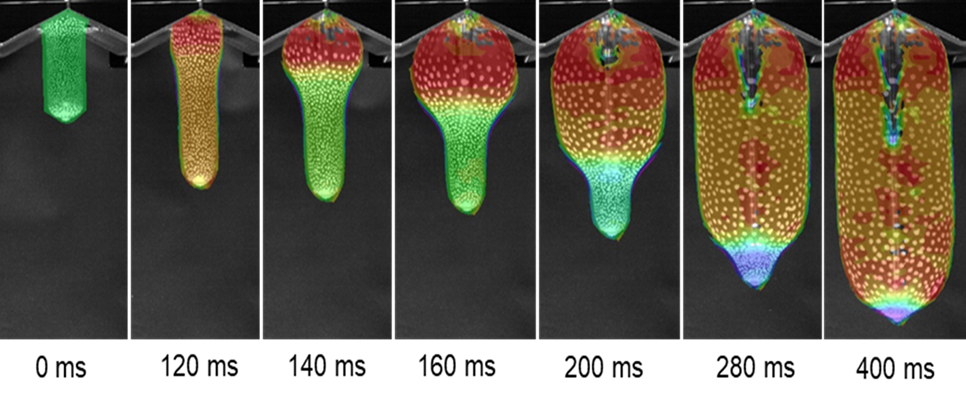
Longitudinal deformation fields of a recycled PET preform, blown at 107°C.
From the laboratory to the factory: science serving society
To meet these challenges, the researcher is conducting numerous projects in partnership with the plastics industry. Her current goal is to help them better understand the influence of incorporating recycled plastic into virgin reference materials and to adapt their production processes to these new materials.
She is currently leading the CYCLADES industrial chair project at CEMEF, in collaboration with IPC (Industrial Technical Center for Plastics and Composites). The objectives of this chair are to understand the influence of incorporating recycled raw materials (RRM) on the behavior of polymer or composite materials in various fields of application (automotive, aeronautics, packaging, construction, etc.). The scientific strategy adopted is to link the shaping process, microstructure developments, and final properties in order to optimize shaping processes. This initiative paves the way for new collaborations between academic and industrial research, which are essential for accelerating the transition to a circular economy.
A diverse and committed scientific career

A recognized specialist in a field that is both applied and useful to society, Christelle Combeaud embodies committed research focused on ecological transition. Alongside her scientific work, she is currently training to teach yoga, sharing its benefits with those around her and striving to find a balance between her professional and personal life.
This diversity of background and skills makes her an inspiring example of what research can be: demanding, humane, and connected to the challenges of our time.
Women and science: making scientific careers visible
Through this scientific journey, the School affirms its commitment to promoting the visibility of women in engineering and materials science, and highlights how diversity of backgrounds drives creativity and scientific excellence. Promoting this research also shows younger generations that research careers are open to everyone and that they play a central role in industrial and technological transitions.
To go further
- Vincent Rohart, Christelle Combeaud. Stretchability above glass transition of mechanically recycled poly(ethylene terephtalate), PET. Polymer, 2022, 257, pp.125218. ⟨10.1016/j.polymer.2022.125218⟩. ⟨hal-03894430⟩
- Laurianne Viora, Marie Combeau, Monica Francesca Pucci, Didier Perrin, Pierre-Jacques Liotier, et al.. A Comparative Study on Crystallisation for Virgin and Recycled Polyethylene Terephthalate (PET): Multiscale Effects on Physico-Mechanical Properties. Polymers, 2023, 15 (23), pp.4613. ⟨10.3390/polym15234613⟩. ⟨hal-04342848⟩
- Emilie Forestier, Christelle Combeaud, Nathanael Guigo, Nicolas Sbirrazzuoli, Gabriel Monge, et al.. Poly(ethylene 2,5-furandicarboxylate) pole figures to determine the microstructural scheme upon uniaxial stretching: Link between orientation and crystallisation. Polymer, 2024, 312, ⟨10.1016/j.polymer.2024.127613⟩. ⟨hal-04869841⟩
- Nathan Sylvestre, Jean-Luc Bouvard, Guillaume Corvec, Mikaël Derrien, Xavier Monnier, et al.. Correlations between blowability and uniaxial stretchability of PET before and after mechanical recycling. Polymer Testing, 2025, 146, pp.108774. ⟨10.1016/j.polymertesting.2025.108774⟩. ⟨hal-05441976⟩
- Sacha Pérocheau Arnaud, Véronique Michelet, Sandra Olivero, Patrick Navard, Alice Mija, et al.. Impact and Interaction of Additives on the Formation of Non Intentionally Added Substances (NIAS) and Polystyrene Rheology. ACS Omega, 2025, 10 (48), pp.58724-58737. ⟨10.1021/acsomega.5c07043⟩. ⟨hal-05442094⟩