
Civil engineering degree : the third year
The third year of the Civil Engineering program allows each student to tailor their academic path by delving deeper into a scientific, technological, or socio-economic field aligned with their career goals. Through a balanced mix of specialized coursework, electives, projects, and immersion in a company or laboratory, this year represents a decisive step toward a career in engineering and prepares students to tackle major scientific, industrial, environmental, and societal challenges.

Third Year: The Pivotal Year Toward a Professional Future
A Two-Pronged Approach
- To provide a high-level, well-rounded education expected upon graduation from the School.
- To support each student in their aspirations and choices regarding their professional future.
Objectives
- To deepen scientific knowledge and working methods in a field with a promising future.
- To develop the ability to map out the key players in a sector and their positions, in order to synthesize this information and make decisions for one’s organization or project within a given regulatory framework.
- To prepare students for the roles of innovator, organizer, and integrator as generalist engineers in the professional world.
Semester 5
30 ECTS
| UE | Field | Subjects | Credits |
| UE51 | Law | Introduction to Law | 2 ECTS |
| Employment Law | 2 ECTS | ||
| UE52 | Controversies | 4 ECTS | |
| UE53 | Specialized Courses | 4 × 2 ECTS | |
| UE54 | Elective Period | 12 ECTS | |
| UE56 | Languages and Certification | 2 ECTS | |
Semester 6
30 ECTS
| UE | Field | Subjects | Credits |
| UE61 | Management | Financial Accounting | 1 ECTS |
| Cost Analysis | 1 ECTS | ||
| Corporate Governance | 1 ECTS | ||
| Guest Lecture | 1 ECTS | ||
| UE62 | Key Issues | “Engineers and Transitions” Seminar | 2 ECTS |
| Ethics, Engineers and Citizens | 1 ECTS | ||
| Imagining Crises | 1 ECTS | ||
| UE63 | Specialized Courses | 2 × 2 ECTS | |
| UE64 | Elective Project | 18 ECTS | |
The option
Develop expertise in a field of your choice
This elective will allow each student to apply, in a field of their choice—without necessarily committing to a definitive career path—the skills developed throughout the program: versatility, a keen sense of observation and practicality, scientific rigor and mastery of fundamental theoretical tools, the ability to adapt quickly to a specific technical field, strong methodology, and the ability to communicate and collaborate while tackling cutting-edge topics in a variety of settings.
The capstone project concludes the program and certifies the student’s ability to define a complex problem in a real-world setting and to provide an innovative solution that is practically implemented within the host company or laboratory.
There are 17 options available across 6 major fields
- Mathematics and Digital Sciences
- Physics and Materials Science
- Energy and Environment
- Management, Economic, and Social Sciences
- Health and Bioengineering
- Innovation & Entrepreneurship
Core Curriculum and Electives
Analyzing Complex Issues to Inform Better Decision-Making
The third-year core curriculum provides students with the essential knowledge needed to understand the legal, economic, and strategic dimensions of organizations. Courses in law, governance, business strategy, and cost analysis develop their ability to analyze complex situations, understand decision-making processes, and support organizational change.
This approach is enriched by the innovative course Description of Controversies, which invites students to analyze scientific, technological, and societal issues from multiple perspectives, as well as by the lecture series Major Issues, dedicated to major contemporary questions. In addition, a wide range of specialized courses allows each student to delve deeper into a field related to their career goals or to explore new topics, in order to build a path consistent with their ambitions.
Controversies
Analyzing complex issues to inform decision-making
The objective of this course is to raise engineering students’ awareness of changes in their professional, scientific, and civic environments. Today, engineers are called upon to apply their knowledge in contexts marked by uncertainty, complexity, and a diversity of viewpoints. Beyond their scientific and technical skills, they must be able to analyze controversial situations—such as technological risks, scientific uncertainties, a multitude of possible scenarios, or conflicts of values—in order to inform decision-making.
The goal of this program is to prepare future graduates to meet these challenges by developing their analytical skills, critical thinking, and ability to understand complex issues.
To this end, students conduct a genuine qualitative research project. This begins with a literature review drawing on a variety of sources (the press, the web, scientific publications, and reports) to identify the key players and issues at stake in the debate.
Next, they conduct interviews with various stakeholders involved in the controversy. Finally, they present their analysis in the form of a public website, which provides a well-reasoned overview of the different aspects of the topic under study.
The EU 62
A series of courses designed to prepare engineers for major challenges
Mines Paris – PSL trains well-rounded, enlightened, and committed engineers—students ready to solve complex problems by developing solutions and putting them into practice. In this context, UE 62 enables students to better understand the issues behind the environmental and energy transitions, meet with experts on pressing current topics, and develop an action plan to address a crisis.

Seminar: “Engineers and Environmental Transition”
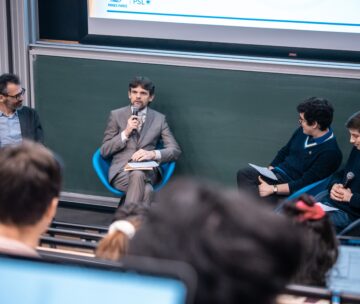
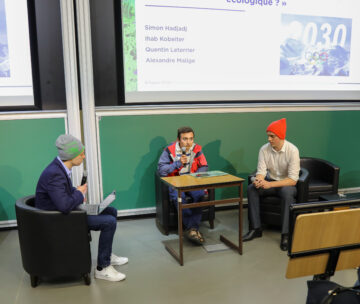
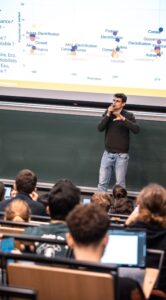
The seminar, organized by third-year civil engineering students, offers an annual collective reflection on the challenges of environmental and energy transitions and on the role of engineers in these transformations. Through lectures, roundtable discussions, and workshops, it explores ever-evolving themes such as “Being an Engineer Today: Between Legacy and Transformation,” “Democracy and Transitions,” and “Social Justice.” Now in its seventh year, the seminar serves as a forum for reflection and debate, allowing students to examine the scientific and technical dimensions of these transitions in relation to their social, political, and civic implications.
Imagining Crises
The course is a culmination of the engineering students’ three-year program. Faced with time and resource constraints, the students must synthesize scientific, technical, economic, and social factors—among others—to develop forward-looking and realistic scenarios for the occurrence of crises, using the thought experiment method.
Ethics, the Engineer, and the Citizen
The course examines the role of ethics in the engineering profession and in the technical decisions that shape society. It encourages students to develop a critical perspective on their professional and civic responsibilities by considering scientific and technical issues in light of their social, environmental, and political dimensions.