Where the River Meets the Groundwater
A Key Issue for Water
As a river flows, it is never isolated from its underground environment. Through the riverbed, water can seep into the groundwater, or conversely, flow out of it. These groundwater–river exchanges play a fundamental role in regulating flow rates, water quality, the temperature of aquatic environments, and the resilience of ecosystems in the face of droughts or floods.
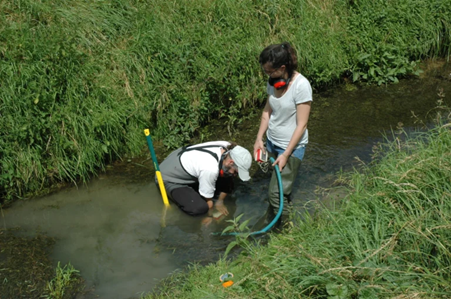
However, these flows are difficult to observe directly. It is precisely this challenge that the MOLONARI project—standing for Monitoring LOcal Groundwater–River Exchanges—addresses: observing the river… from the inside.
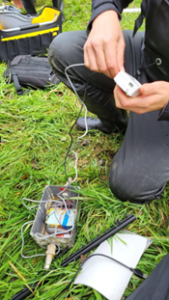
Pre-deployment checks of the device
MOLONARI
Observing water with simple, open-source sensors
Developed at Mines Paris – PSL as part of the Equipex+ TERRA FORMA program, MOLONARI is based on a principle that is both robust and ingenious. The MOLONARI-1D device combines temperature and pressure sensors, placed at different depths beneath the riverbed, generally between 0 and 40 centimeters.
Why temperature? Because heat propagates differently depending on whether water is flowing downward or upward. By closely tracking temperature variations in the sediments, researchers can deduce the direction and intensity of water flows between the river and the groundwater, as well as certain physical properties of the environment.
Designed from the outset as a low-tech, reproducible, and participatory tool, MOLONARI provides manufacturing plans and open-source code, allowing other teams, communities, or researchers to build and deploy their own sensors.
From the field to the model
Measure, transmit, understand
MOLONARI’s uniqueness lies in its comprehensive approach, which links fieldwork to scientific analysis. The project is organized around three major complementary components, developed in close collaboration:
- Sensors (Hardware): designed to be inexpensive, robust, and easy to install, they are connected to Arduino-type data loggers capable of long-term operation in natural environments.
- Data transmission and visualization: thanks to a LoRaWAN network and a dedicated interface, Molonaviz, data can be tracked in near real time, facilitating diagnostics and the scaling up of the devices.
- Scientific analysis: Using the Python module pyheatmy, the collected data is analyzed using advanced modeling and Bayesian inversion methods to derive physical environmental parameters and water flows from raw measurements.
This comprehensive workflow, from the submerged sensor to the numerical model, enables the transformation of local observations into actionable knowledge for water management and river restoration.
A scientific project… and a powerful educational tool
MOLONARI is also a unique educational initiative. Each year, engineering students from Mines Paris – PSL actively participate in the project, divided into interdisciplinary teams. They design the sensors, develop the algorithms, test the models, and ensure data transmission.
Supervised by researchers such as Nicolas Flipo, they experience research-based training, where learning happens through doing, testing, and confronting the constraints of the field and the complexity of the real world. From designing a 3D-printed sensor rod to performing frequency analysis of temperature signals, the students build the scientific tools they use themselves.
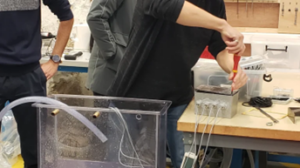
Testing the device
A dedicated team bringing MOLONARI to life
The MOLONARI project is the result of close collaboration within Mines Paris – PSL. Supervised by Nicolas Flipo, who coordinates the project, designs the infrastructure and oversees its educational and scientific aspects, it also draws on the expertise of his colleagues. Aurélien Baudin and Agnès Rivière, alongside Nicolas Flipo, oversee the development and field deployment of the measurement devices. The design of the scientific software and interfaces is led by Thomas Romary, who co-supervises the pyheatmy modelling module, whilst Fabien Ors has contributed to the conceptualisation and security of the Molonaviz interface. Since 2024, Pierre Guillou has been responsible for the security and deployment of the software.
In addition to the teaching staff, there are contributions from students, spread across four cohorts since 2021, who have actively participated in the development of the sensors, software and scientific models. The significant contributions of these students are listed here: list of MOLONARI contributors.
All these coordinated efforts enable MOLONARI to combine scientific innovation, practical training and operational robustness, whilst forming part of the French Equipex+ TERRA FORMA project.
Comprendre pour préserver : MOLONARI face aux défis de l’eau
Dans un contexte de changement climatique, de tensions sur la ressource et de besoin croissant d’indicateurs fiables, MOLONARI apporte une réponse concrète : mieux comprendre les mécanismes fins du cycle de l’eau pour mieux anticiper et agir.
En rendant visibles les échanges invisibles entre rivières et nappes, le projet illustre l’engagement de Mines Paris – PSL pour une science ouverte, utile à la société et tournée vers la formation des ingénieurs et chercheurs de demain. Une manière, à l’occasion de la Journée mondiale de l’eau, de rappeler que la protection de l’eau commence par une compréhension fine de ses dynamiques les plus discrètes.
Learn more
MOLONARI website