Large-scale nonlinear optimization
Equations to maintain equilibrium
To solve these problems, François Pacaud relies on methods derived from mathematical optimization, in particular methods known as “interior point methods.” The principle behind these methods is to gradually approach the best possible solution by performing a series of successive calculations. At each stage, the algorithm must solve large systems of equations, known as Karush–Kuhn–Tucker (KKT) conditions, which mathematically translate all of the network’s physical and technical constraints.
The main obstacle is not so much the formulation of the problem as its numerical solution. KKT systems are huge, mostly composed of zeros (they are said to be “hollow”) and often difficult to manipulate numerically. Their size and structure make calculations long and memory-intensive. Scaling, i.e., the ability to process entire networks rather than simplified models, is one of the central challenges in this field.
Accelerating calculations with GPUs
A major advance in François Pacaud’s recent work is to exploit the computing power of graphics processing units (GPUs), which are massively parallel architectures, to solve these optimization problems. GPUs work differently from conventional processors: they are particularly good at performing thousands of small calculations in parallel, rather than solving them step by step on a single processor. GPUs thus contributed greatly to the deep learning revolution in the 2010s.
In collaboration with researchers at MIT and Argonne National Laboratory, he contributed to the development of new methods known as “condensed space” methods, which consist of reformulating KKT equation systems in a mathematical form better suited to parallel computing. These reformulations make it possible to use specialized numerical libraries capable of efficiently factoring and solving very large sparse systems on GPUs. Thanks to these approaches, it is now possible to solve problems representing an entire large national power grid in less than twenty seconds, where hours of computation were previously required.
Beyond the performance gains, these results make it possible to optimize very large networks in near real time, which is essential for dynamic and secure management of energy infrastructures.
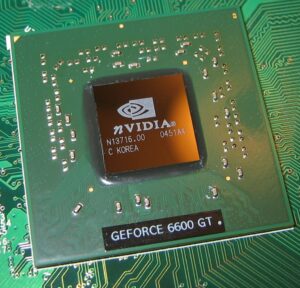
Nvidia GeForce 6600GT graphics processing unit (GPU)
A coherent set of optimization projects
This research is not limited to electrical networks. It focuses more broadly on large-scale nonlinear and stochastic optimization, i.e., finding the best possible solution when mathematical relationships are nonlinear and certain data are uncertain or variable, for example due to weather or user behavior.
To this end, François Pacaud develops and improves solvers, software programs capable of automatically solving very large mathematical problems. Among them, MadNLP and MadNCL are optimization solvers designed to handle thousands or even millions of variables, numerous physical constraints, and phenomena of uncertainty. These tools have a variety of applications: energy networks, signal processing, and robotics. The challenge is not only to find a solution, but to ensure that it is reliable, stable, and calculable within a reasonable time frame, which until now has been beyond the capabilities of conventional algorithms.
Between theoretical mathematics and industrial applications
Trained in applied mathematics, François Pacaud worked as an optimization engineer in industry before pursuing his research in major international laboratories. Today at Mines Paris – PSL, he develops advanced computational mathematics methods while collaborating with players in the energy sector. His career path reflects the link between theory and practice that is so important to the School, with a dual focus on science and industry. Mathematics thus becomes a decision-making tool, capable of transforming vast sets of data and physical constraints into concrete strategies for infrastructure management.
Mathematics plays a central role in modern energy infrastructure. Optimizing an electrical grid is not just about solving an equation: it is about ensuring the stability of a vital system, supporting the integration of renewable energies, and securing the electricity supply. On this International Mathematics Day, the research conducted at Mines Paris – PSL illustrates the power of mathematical tools when combined with scientific computing and engineering. Far from being abstract, equations can make a very concrete contribution to meeting today’s energy challenges.