Beyond models: more reliable strategies
Numerous approaches have been proposed in scientific literature to solve this problem: aerodynamic models, reinforcement learning using artificial intelligence, “black box” optimization methods that seek the best solution without a specific model, and “game theory,” which describes the various interactions between multiple objects. While some of these approaches yield good results in simulations, their actual performance often falls short of expectations.
Delphine Bresch-Pietri’s research aims to overcome these limitations by using Extremum Seeking Control methods, a family of algorithms capable of optimizing a system without knowing its precise model, based solely on available measurements. Her work focuses in particular on adapting these methods to systems with delays, introducing predictive mechanisms that anticipate the delayed effects of control actions.
The goal is to design control strategies that are compatible with real operating conditions and capable of adapting to wind variations while limiting the mechanical stress on wind turbines.
The Research Quarter as an educational laboratory
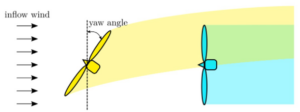
This research is not only carried out in the context of theses or scientific projects, but also as part of the training of engineering students. At Mines Paris – PSL, the Research Quarter (TR), particularly in the CONTROL field, allows second-year students to immerse themselves in a laboratory for three months, working on a real research topic. Supervised by Delphine Bresch-Pietri, Aurélie Chopard-Lallier worked on determining, through calculation, the best strategy for orienting wind turbines when the effects of the wind propagate with a delay from one machine to another.
Her project consisted of formulating this question as an optimal control problem, i.e., finding the evolution of orientation angles that maximizes overall electricity production, with a given dynamic model and subject to knowing the exact wind forecasts. To solve the problem of the effect of actions subject to a delay linked to wake dynamics, it is necessary to introduce specific tools, in particular numerical methods that simplify temporal information and transform continuous equations into systems that can be used by computers. This solution can then serve as a reference for other control techniques.
From a scientific standpoint, this work contributes to better integrating the dynamic effects of wakes into wind farm control models, which is essential for designing more realistic strategies. From an educational standpoint, it places students in a real research environment: building a model, choosing a solution method, and analyzing results. The Research Quarter thus illustrates the close link between education and research, particularly in mathematics, by showing how theoretical tools can be used as concrete levers to optimize energy systems.
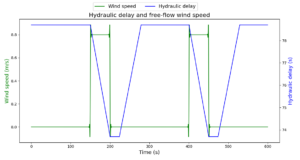 Hydraulic delay (blue) over a 600-second time interval, calculated from filtered real-time LIDAR wind speed data that has been interpolated (green).
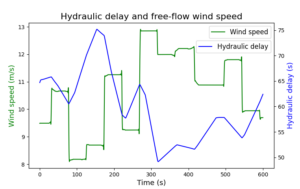
Hydraulic delay (blue) over a time interval of 600 seconds, calculated based on fictitious wind speed assumptions (green): here, a constant speed, except for two stages of 50 seconds each.