A forest unlike any other
A former royal estate, the world’s first protected area for its cultural value, birthplace of the International Union for Conservation of Nature (IUCN), biosphere reserve… The Forest of Fontainebleau occupies a unique place in French and international environmental history.
But like all ecosystems, it is also a territory affected by contemporary tensions: climate change, drought risks, pressure from recreational uses, the legacy of former hydraulic and industrial developments, and energy projects such as geothermal energy.
It is precisely this complexity that makes it an ideal study site for the FORET project, coordinated by Béatrice Cointe, research fellow at the Center for Sociology of Innovation (CSI – Mines Paris-PSL), and Samuel Abiven, director of CEREEP-Ecotron (Center for Research in Experimental and Predictive Ecology).
Understanding a socio-ecosystem in transition
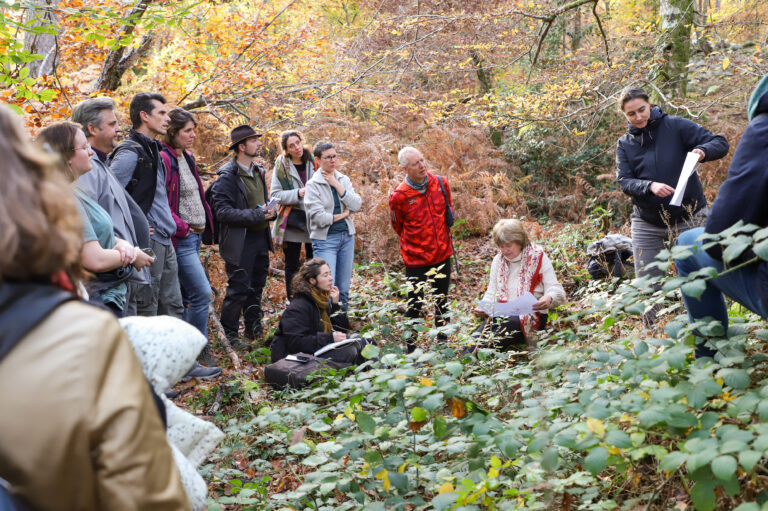
The FORÊT project is based on the observation that a forest is not only a natural ecosystem, but also a socio-ecosystem, shaped by centuries of human use, including royal hunting, logging, water management, tourism, and heritage protection.
The objective is twofold:
- To better understand how this territory has evolved in the past
- To analyze how it could adapt to future global changes
Researchers are studying what they call the “critical zone”: the whole formed by the forest, the soil, the subsoil, the water, living beings… and the human societies that interact with them.
To do this, the project draws on a wide range of disciplines: sociology, geology, ecology, hydrogeology, paleoecology, architecture, history, biogeochemistry, and even photography.
Understanding a socio-ecosystem in transition
The FORÊT project is based on the observation that a forest is not only a natural ecosystem, but also a socio-ecosystem, shaped by centuries of human use, including royal hunting, logging, water management, tourism, and heritage protection.
The objective is twofold:
- To better understand how this territory has evolved in the past
- To analyze how it could adapt to future global changes
Researchers are studying what they call the “critical zone”: the whole formed by the forest, the soil, the subsoil, the water, living beings… and the human societies that interact with them.
To do this, the project draws on a wide range of disciplines: sociology, geology, ecology, hydrogeology, paleoecology, architecture, history, biogeochemistry, and even photography.
Reading the landscape as an archive
One of the unique features of the project is that it combines natural archives with human archives. Soils, for example, preserve chemical and biological traces of past fires or climatic variations. The landscapes themselves bear the imprint of past choices: forest roads, viewing points, underground canals, protected areas. This approach is also based on artistic and historical work. The Photographic Observatory of the Landscapes of the Fontainebleau Massif, led by the National Forestry Office with photographer Claire Tenu, allows iconic sites to be compared with pictorial references from the Barbizon school, an informal term referring both to the geographical and spiritual center of a succession of colonies of landscape painters established around Barbizon, and their desire to work “en plein air and from nature” in the forest of Fontainebleau. The work of landscape architect Frédérique Mocquet, devoted to the study of photographic landscape observatories, also provides a reference for understanding the scientific and sensory scope of these approaches. This observatory, independent of the FORET project, thus provides methodological and cultural support for documenting the evolution of the forest landscape. A sensitive and scientific way of documenting the evolution of the forest landscape.
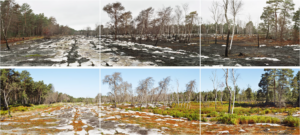
A sandstone ridge called a “platière,” which is the alternation of long sandstone ridges, a few months (top) and then two years (bottom) after a fire. A dense stand of Pinus sylvestris is visible on the left. Claire Tenu, 2021, 2022. Plot 619 after the August 2020 fire, Fontainebleau Forest, winter 2021/summer 2022. Photographic observatory of the landscapes of the Fontainebleau Forest, viewpoint no. 42B. © Claire Tenu for the National Forestry Office.


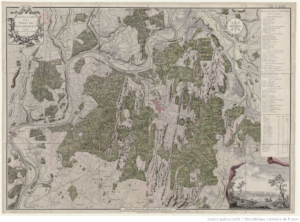 Map of the Fontainebleau Forest in 1778 showing vast open areas (in light pink) in the central and southern parts of the forest, around the sandstone ridges. Guillaume-Nicolas Delahaye [author, illustrator], Sampierdarena [publisher/printer], 1778. New map of the Fontainebleau Forest based on the best plans. Source: gallica.bnf.fr / Bibliothèque nationale de France.