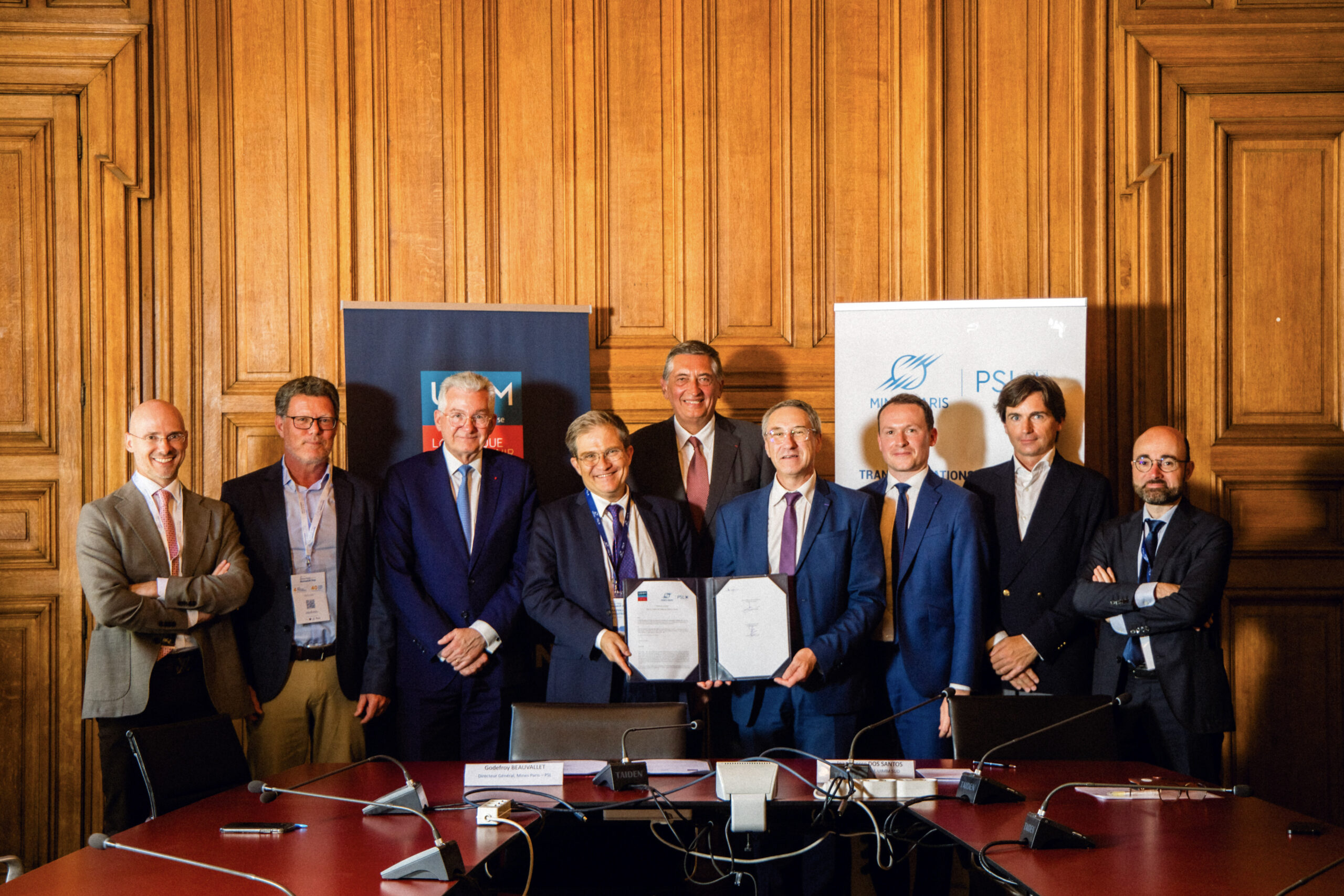

Mines Paris – PSL, EDEIA, and the Naval Academy sign a tripartite agreement at UIMM Wagram to strengthen dual-track research within the College of Naval Sciences

Mines Paris – PSL, the School of Advanced Industries (EDEIA), the new engineering school of theUIMM dedicated in particular to marine and underwater robotics, and the École Navale, a prestigious engineering school that trains officers for the French Navy and has its own research institute, have signed a five-year tripartite agreement to involve the École Navale in the activities of the College of Naval Sciences (CSN). Created in June 2025 by Mines Paris–PSL and EDEIA, this interdisciplinary research center—located at the heart of Toulon’s scientific, military, and industrial ecosystem—is dedicated to advancing research and innovation in the field of naval and underwater robotic systems.
Based on the complementary nature of their expertise, this collaboration combines the scientific and industrial expertise of the CSN with that of the Naval Academy and its Institute for Naval Research and Studies (IRENav), closely aligned with the technological and operational challenges facing the French Navy. It focuses in particular on unmanned naval vehicles—submarines or hybrid vessels, whether remotely operated or autonomous.
An Alliance Between Scientific Excellence and Operational Expertise
This partnership aims to bring together academic research, technological innovation, and an understanding of operational constraints at sea. By promoting joint scientific projects and the integration of different approaches, the three institutions intend to contribute to mastering critical technologies, preparing the naval systems of tomorrow, and developing expertise.
The Naval Sciences College was born out of our conviction that the most fruitful research arises from the convergence of academic excellence and industrial challenges. Following a strategic scientific and technological partnership signed last spring with Ifremer, we are taking a new step forward with the École Navale: we are bringing our researchers into closer contact with leading scientific expertise and operational realities, so that together we can foster the innovations that marine technologies require.
Godefroy Beauvallet, Director General of Mines Paris – PSL
The Navy must have young officers who are immediately combat-ready, proficient in increasingly complex systems, and capable of constantly adapting to a more fragmented world and a more unpredictable and dangerous maritime environment. Research and innovation are essential to meeting this requirement. This partnership with the Collège des sciences navales opens up new avenues for collaboration along the Mediterranean coast. These complement the already extensive opportunities offered by the Brest ecosystem and our historic partnership with ENSAM. This complementary expertise enriches our training and research and fosters collaborations with the defense industrial and technological base.
Rear Admiral Benoît Hédé-Haüy, Commandant and Director General of the Naval Academy
From Toulon, we are building an engineering school closely aligned with industry needs and supported by high-level research. The Naval Academy’s affiliation with the College of Naval Sciences adds an extra dimension to this ambition. It brings together, alongside Mines Paris – PSL and EDEIA, complementary scientific and operational expertise to anticipate the use of technologies and train engineers with a deep understanding of the marine environment who will shape the naval industry of tomorrow.
Hervé Guillou, President of the School of Advanced Industries
Three Priority Scientific Areas
The agreement defines three areas of cooperation, which may be expanded as scientific and operational needs evolve:
- Propulsion: propulsion system architecture, hydrodynamic and acoustic signatures, integration onto platforms, and modeling in digital twins for design, training, and operational simulation.
- Energy and energy systems: energy balances and optimization of vehicles, energy storage and conversion, intelligent resource management during missions, and simulation of onboard systems.
- Hydromechanics, hydroacoustics, and payloads: associated flows and noise, turbulence, cavitation, fluid-structure interactions, reduction of acoustic signatures, and the study of multiphysical phenomena in complex environments.
Open Cooperation in Research, Education, and Commercialization
The three partners plan to develop exchanges between scientific, technical, and educational teams; organize seminars and workshops; facilitate researcher and faculty mobility; and jointly supervise internships, academic projects, and theses. They will be able to share scientific data and simulation resources, produce joint publications, and jointly respond to calls for proposals—particularly at the national and European levels—while respecting confidentiality and intellectual property rules.
The agreement establishes a five-year framework for cooperation. Each project will, where applicable, be the subject of a specific agreement detailing its implementation terms. A steering committee comprising representatives from the three institutions will coordinate activities and facilitate the development of a common scientific roadmap.