

“Imagining Crises”: Engineering Students’ 2026 Projects Featured in a Virtual Exhibition
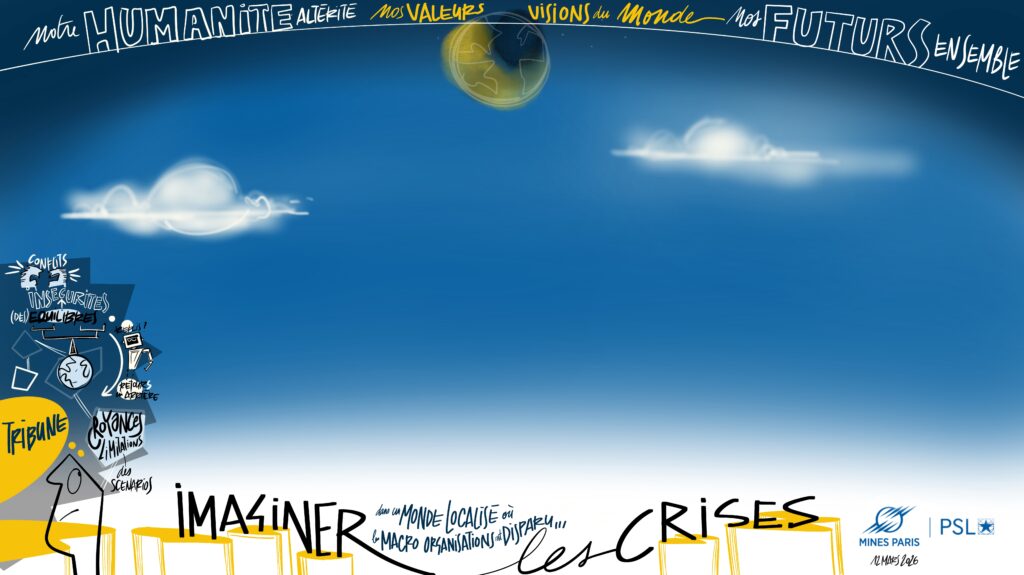
Unveiled on October 3 during the Fête de la Science on the Paris campus, the virtual exhibition “Imagining Crises” showcases the work created by third-year students in the Civil Engineering program at Mines Paris – PSL as part of the 2026 edition of the course.
Twelve Scenarios for Imagining Crises
In 2026, the course “Imagining Crises” invited students to engage in a thought experiment centered on a forward-looking question: “What kinds of crises might arise in a localized world where macro-organizations have disappeared?” ”
Over the course of five half-days, divided into twelve groups, the students imagined fictional yet plausible situations in which local communities must cope with complex crises. Starting from a thought experiment, they developed their scenarios by drawing on scientific, technical, economic, and social knowledge, while testing their hypotheses against expert perspectives.
Each group thus developed its own world, territory, and characters to explore the onset of a crisis and its consequences. Whether it was a dam failure, the disappearance of bees, an epidemic, a resource shortage, a breakdown in trade, or the collapse of an energy system, the scenarios highlighted the interdependencies between systems and the cascading effects of their failures.
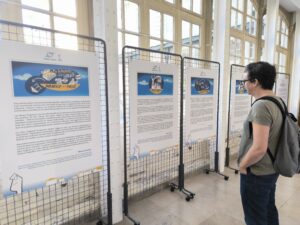
Course exhibition during the Science Festival on the Paris campus on Saturday, October 3, 2026
A presentation in various formats
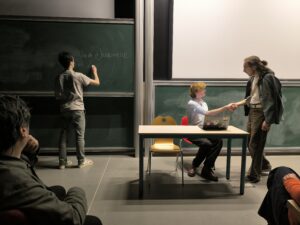
The virtual exhibition allows visitors to explore each of the twelve scenarios and the worlds imagined by the students.
From Mineatlantis—where the discovery of 21st-century archives upends a city organized around collective survival—to Doucemerre, which faces a water and energy crisis, each story begins with a concrete situation to explore the choices a society may face when its usual points of reference and structures disappear.
The scenarios also showcase different narrative forms: diaries, newspaper articles, letters, reports, testimonials, and even multi-voiced narratives. These choices allow students to embody the crises and explore their consequences on different scales.
A mural to connect imaginations
The presentation continues with a graphic mural created by Frédéric Debailleul, a graphic facilitator. Produced as the oral presentations unfolded, it connects the events, systems, actors, and crisis dynamics explored in the various scenarios.
A collective panel discussion also takes a step back from these fictional narratives to examine the values, concerns, and worldviews they bring to light.
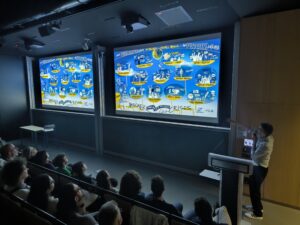
A few scenarios illustrated graphically
The virtual exhibition showcases the 12 scenarios created by the students, each of which has its own dedicated page.


The 2026 Edition: A Virtual Exhibition
“What Crises Exist in a Localized World Where Macro-Organizations Have Disappeared?”