

How effective are low-tech solutions for cooling our homes?

While temperatures higher than usual for this time of year have persisted since early September 2026 in the southeastern quarter of France, the country continues to be affected by the extreme heat waves that have been felt throughout the summer. What strategies can we use to keep our homes cool?
This article is republished from The Conversation under a Creative Commons license. Read theoriginal article.
Authors
- Morgan Meyer, CNRS Research Director, sociologist, Mines Paris – PSL
- Eléonore Morand, Lecturer and researcher, National School of Architecture of Versailles (ÉNSA Versailles)
As unseasonably high temperatures have persisted since early September 2026 in southeastern France, the country continues to be affected by the extreme heat waves experienced throughout the summer. What strategies should we adopt to cool our homes?
Many people have turned to air conditioners, a solution that, despite the comfort it provides, has the drawback of being energy-intensive and constituting an individual response to a collective problem. This is because these devices have collective consequences in that they heat the outside air near homes, contributing to what is known as an urban heat island.
However, there are many low-tech solutions for coping with the heat. Sticking emergency blankets on windows, promoting passive ventilation, rethinking common areas, building with alternative materials, and redesigning urban spaces: strategies for coping with the heat range from individual DIY projects to more systemic architectural and urban planning solutions.
How effective are they? Here’s an overview of a few low-tech strategies for coping with heat waves.
Survival blankets, Meudon white… “micro-tips” that have gained popularity
Let’s start with a few of the “micro-tips” that have gained the most traction this summer.
Among these strategies are, for example, taping survival blankets to windows or painting them with Meudon white (that is, the chalk powder typically used to cover storefronts and windows of businesses undergoing renovations).
What these solutions have in common is that they’re DIY, “disposable,” and aim to reduce the impact of solar radiation by compensating for the lack of permanent installations (such as shutters or blinds).
These tips, widely covered in the media and on social media, have been so successful that many stores have run out of stock.
To cool down our homes, we can also use other makeshift methods: placing a frozen water bottle or a wet cloth in front of a fan, turning off unnecessary electronic devices, avoiding cooking hot meals, buying plants, and, of course, remembering to close windows and shutters as soon as the sun comes out.
Other Less-Known but Effective Solutions
Beyond these relatively well-known low-tech tips, there are also more unconventional strategies that deserve our attention. The heat wave has made us more aware of the strategies used by those around us.
For example, consider the story of a couple of architects, Deborah Feldman and Baptiste Potier (from the firm 127af), who live in a Parisian apartment facing in only one direction.
To take advantage of the coolness in the common areas, they keep their landing door open during the day and have reinforced the door’s safety mechanism to keep it slightly ajar at night. This allows them to cool their apartment by maximizing air circulation.
Alice, a student at ENSAAMA and an intern at the Depeyre Morand Architectures firm during the heat wave, lives in an attic maids’ room measuring 9 m² on Place de la Nation. She tried everything to cool her living space, documenting her experiments in drawings, some of which illustrate this article.
She implemented a similar solution: leaving the doors open to allow air to circulate through the common areas and a neighbor’s room on the opposite side of the building, thereby attempting to create a cross-ventilated space.
What may seem like a makeshift solution is in fact a genuine strategy that has long been employed in cities historically prone to overheating. A similar strategy has been observed in the M’zab region of the Algerian desert, in the ksour of Ghardaïa and Beni Isguen.
Students in the ENSAV “Atelier du désert” master’s program, coordinated by Eléonore Morand and Alice Grégoire, faculty members at ENSAV, noted the systematic practice of leaving doors open, which enables the principle of thermal convection inherent in the patio house typology to function.
The open door draws in outside air, while the patio opening (chebbek) allows hot air to escape. Today, the open door is sometimes secured with a grille, while interior privacy is preserved by a zigzag entrance (called a taskift).
Rethinking the Use of the Building
In this same desert region of Algeria, ENSAV students observed the daily habits of the Mozabites.
To cope with extremely high temperatures, the Mozabites frequently move around their homes throughout the day to maintain thermal comfort. Desert nights are cool: during the night and morning, outdoor spaces are occupied, and families sleep on the terrace at night.
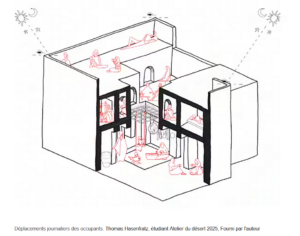
During the day, as the temperature rises, the family goes down to the ground floor, where the thermal inertia of the walls and the lack of windows help keep the space cool. They have lunch there and, most importantly, take a nap, which allows the body to rest and helps them get through the hottest part of the day. In the evening, residents return to the upper floors, which cool down thanks to natural ventilation and the onset of night.
Some studies have shown that passive cooling—without the use of air conditioning—can significantly lower indoor temperatures, by about 5 °C to 7 °C compared to outdoor temperatures.
In cities, the limited size of private apartment spaces often does not allow for this type of movement within homes. However, common areas could offer solutions worth exploring—for example, by sharing entry halls, expanded landings, or landscaped terraces—while identifying, depending on the time of day, how these spaces can help us recharge.
The exhibition Parties communes, hosted from November 2025 to March 2026 by the Pavillon de l’Arsenal in Paris, shows that common areas deserve more attention, not only to promote air circulation but also to be “rehumanized”.
Focusing on Alternative Materials
The materials used in construction must also be taken into account. Raw earth, for example, has a long history and has been experiencing a resurgence in recent years.
Raw earth construction techniques require little mechanization and allow for more environmentally friendly building. Raw earth requires minimal transportation, is recyclable, and emits less CO2 than standard materials such as concrete. Above all, it significantly cools homes, as has been demonstrated by scientific studies.
We should also mention the climate-responsive plaster from the M’Zab region, created by spraying Timchemt, a local plaster that has been sourced and used for many years in the Saharan region.
In addition to being a local and traditional material, applying it by spraying onto facades creates a relatively rough, textured surface, which in turn casts micro-shadows on the facade, thereby cooling it.
In many European countries, however, the use of materials such as rammed earth and clay faces numerous obstacles: restrictive regulations and standards, the difficulty of insuring certain structures, a negative image, and opposition from the concrete industry.
A City-Wide Problem
But the solutions to be implemented cannot ignore the city itself.
An article published in the journal Nature listed various decentralized, local, low-tech strategies that cities are implementing to cope with heat waves: using lighter-colored paint, creating shade, planting more trees, etc.
Two researchers in architecture and urban planning outline the factors to consider at the urban scale:
Density, the orientation of the urban fabric and the urban network, compartmentalization, intersections, the size of blocks and their permeability, central courtyards, semi-open spaces […], the design and proportions of openings and shading elements, the color and thermal capacity of materials, as well as the greening of courtyards.
Planting more densely in public spaces is a cost-effective solution for providing shade in the city, but this strategy can be constrained by underground utilities and existing infrastructure.
It has been observed that in areas with less dense underground infrastructure, some condominium complexes have taken the initiative to plant extensively in their shared outdoor spaces. During heat waves, these condominiums have directly experienced a significant temperature difference between these spaces and the street. Encouraging and expanding these types of initiatives—while adding carriage entrances to connect them to public spaces—would allow for heat transfer via convection, similar to that of the patio house.
Will the future necessarily rely on air conditioning?
All of these solutions—as books such as The Architecture of Natural Cooling (2019) or Cooling Without AC: A Guide to Eco-Friendly Alternatives (2004) remind us—show that it is possible to cool our homes without necessarily installing air conditioners.
This is all the more true given that the widespread use of air conditioners could raise the temperature on the streets of a city like Paris by up to 2 °C, which is why some stakeholders recommend air conditioners only for places such as hospitals, nursing homes, or schools.
This position appears to be supported by research:
It is possible to ensure indoor thermal comfort using only passive measures,” wrote the authors of a research article examining the situation in Portugal […] “The high thermal inertia of the building envelope, adequate solar orientation, shading devices, and appropriate organization of interior spaces are fundamental elements for maintaining indoor air temperature within the thermal comfort range.