
Underwater Crimes: Robots—A New Tool for Underwater Investigators
In the dark waters of Lake Saint-Cassien (Var), the silhouette of an airplane appears in fragments on the investigators’ cameras. First a wing, then the fuselage, and finally objects scattered around the wreckage. What is its exact location? Are there signs of fire or an explosion? Were objects scattered around the wreckage by the force of the impact? Should divers be sent in immediately?
The scene appears real. It calls for the same procedures as those in a criminal investigation: locate, observe, preserve, and document. However, this is neither an ongoing case nor a case that has already been adjudicated, but rather an experimental scenario.
This article is republished from The Conversation under a Creative Commons license. Read theoriginal article.
Authors
- Franck Guarnieri – Director of the Center for Research on Risks and Crises and researcher at the College of Naval Sciences, Mines Paris – PSL
- Tom Gournay – Ph.D. candidate in Underwater Robotics, Mines Paris – PSL
- Samuel Olampi – Research and Development Engineer in Underwater Robotics, Mines Paris – PSL
Our work was based on the deliberate sinking, in September 2022, of a former Cessna 152 aircraft destined for the scrapyard. Carried out by the National Gendarmerie for the training and practice of its divers, this operation enabled us, in July 2026, to evaluate the contribution of a remotely operated underwater drone to underwater forensic investigations.
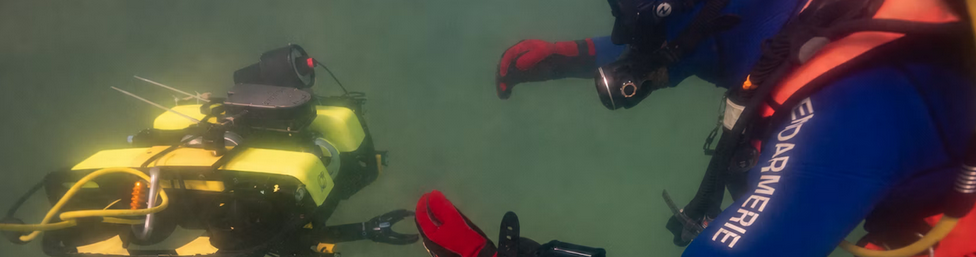
ROV Victor 300 Mission to the Airplane Wreckage. College of Naval Sciences (Mines Paris – PSL/EDEIA)
Victor 300, a Prototype Underwater Drone for Underwater Investigations
There are two main categories of underwater drones: autonomous underwater vehicles (AUVs) and remotely operated vehicles (ROVs). ROVs, connected to the surface by an umbilical cable, receive control commands while transmitting the data they collect in real time.
Ours belongs to the second category; it has been named Victor 300, in homage to the Ifremer Victor 6,000, which, as its name suggests, is capable of reaching a depth of 6,000 meters. Weighing in at 15 kilograms, our Victor 300 can’t compete with the roughly five metric tons of its illustrious namesake. About the size of a carry-on suitcase, it is certainly not designed to explore the abyss, but it can nevertheless descend to a depth of 300 meters—which is more than enough for most surveys.
It is equipped with a high-definition camera, a stereoscopic vision system designed to produce three-dimensional images, a multibeam sonar, its batteries, and lighting adapted to the prevailing visibility conditions.
Victor 300 was designed using open-source software and technology components from the ecosystem developed by the American company Blue Robotics. Originally intended for general-purpose use, it has undergone extensive modifications, particularly regarding the arrangement of its motors. This is crucial in an environment as turbid as the bottom of a lake, where the ROV’s movements can stir up sediment and significantly reduce visibility.
Remote Operation: A New Skill for Investigators
In France, the National Gendarmerie has been training underwater investigation technicians since 1962. They learn to search for and preserve evidence, document findings, collect submerged evidence, and ensure the integrity of the chain of custody.
Based in Antibes, the National Gendarmerie Nautical Training Center (CNING) plays a central role in their training. In collaboration with the National Gendarmerie Criminal Research Institute (IRCGN), it helps develop investigative methods tailored to the specific characteristics of aquatic environments.
In this context, operating an ROV is not viewed as a separate specialty, nor as a service provided by a third party, but rather as an additional skill for the underwater investigator. The person operating the ROV does more than simply maneuver a vehicle: they analyze a scene, develop a search strategy, examine points of interest, and, when necessary, prepare for the deployment of divers.
What the Saint-Cassien experiment demonstrated
The experiment conducted at Saint-Cassien addressed a very practical challenge: how to explore a submerged scene without disturbing it? Around the aircraft, the Victor 300 had to move slowly, maintain a sufficient distance, illuminate the area without overexposing the image, and avoid stirring up the sediment. Its thrusters could disturb the water, its umbilical cable could snag on the seabed or a part of the aircraft, and the slightest accidental contact risked dislodging a clue before it could be identified.
This need for caution requires a rigorous method. Before any sampling, each object must be precisely located and described: at what depth is it? Is it resting on the seabed, wedged in, or partially buried? What is its orientation? Is it located near another object? In the case of the aircraft, a structural fragment, a cable, a bag, or a metal object does not carry the same significance depending on its position relative to the fuselage.
The use of an ROV extends and enhances exploration capabilities. Its underwater endurance—five to ten times longer, depending on depth, than a diver’s dive time—allows for sustained observation of the scene, enables multiple image captures, and facilitates verification of points of interest without unnecessarily exposing personnel to risk. Divers can thus devote their necessarily limited time on-site to operations that require their physical presence: close-up inspections, sample collection, and delicate manipulations. By allowing observation before physical contact, the ROV helps preserve evidence, better prepare for human intervention, and, ultimately, save precious time for the investigation.
Observe, Record, Prove
Viewed from the surface, an underwater video may give the impression that the invisible is finally becoming manageable. However, in a criminal investigation, seeing is not enough. Turbidity distorts the perception of distance, spotlights cause glare, particles obscure contours, and even a high-performance camera can prove ineffective in murky water.
Underwater photogrammetry uses images taken from multiple angles to reconstruct a scene or object in three dimensions. It can thus determine the relative positions of features observed around a shipwreck or a submerged vehicle, provided that lighting, distance, and image quality are properly controlled.
Already used by investigative divers, this technique is integrated into the Victor 300. However, even with equivalent optical quality, the diver remains more effective: his direct perception of the environment, his mobility, and his ability to immediately adjust his framing and lighting allow him to capture more precise images. The remote pilot, on the other hand, remains limited by the cameras’ field of view, cable drag, and the movements of the thrusters, all of which can stir up sediment. In the absence of a human diver—particularly when conditions make their deployment impossible or too dangerous—the images captured by the underwater drone are nonetheless invaluable: when properly contextualized and documented, they provide the investigation with essential observational and analytical data.
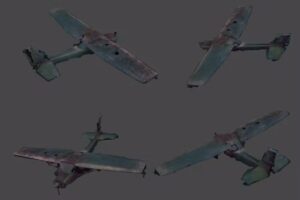
3D images of the plane submerged in Lake Saint-Cassien. National Gendarmerie
Multibeam sonar, on the other hand, overcomes certain limitations of video imaging. By using sound waves rather than light, it proves extremely effective in very turbid water, even when visibility is completely zero. It can detect shapes, measure distances, reconstruct the seafloor topography, and map the immediate surroundings of the wreck. While it does not replace optical imaging, it complements it by revealing structures or anomalies invisible to the camera and by guiding the ROV remote operator to areas that require closer inspection.
A Tool in the Service of the Method
The Saint-Cassien experiment underscored this point: technology is only useful if it respects the scene. Underwater, everything is slower, more fragile, and more uncertain. The ROV does not decide what constitutes evidence. It provides the investigator with an additional perspective, time for observation, and enhanced documentation capabilities.
Only under this condition can underwater drones truly advance underwater investigations: not as autonomous machines, but as tools supporting human expertise, investigative methods, and the chain of evidence.
This article was written in collaboration with Captain Julien Fabrini and Adjutant Pierre Vadam of the CNING. It is part of the research project “DIVER: Design and Development of an ROV (Remotely Operated Vehicle) to Assist Underwater Forensic Investigators During Deep Dives,” supported by the Defense Innovation Agency (AID). The authors would like to thank Lieutenant Colonel Philippe Baron, commander of the CNING; Colonel Alexis Bourges, commander of the National Gendarmerie Research Center (CRGN); and Colonel David Bièvre, former deputy director of the CRGN and director of the PRISMES interdisciplinary research program, for their careful review.