
Control and Quantum Systems: An International Scientific Dialogue for the Technologies of Tomorrow
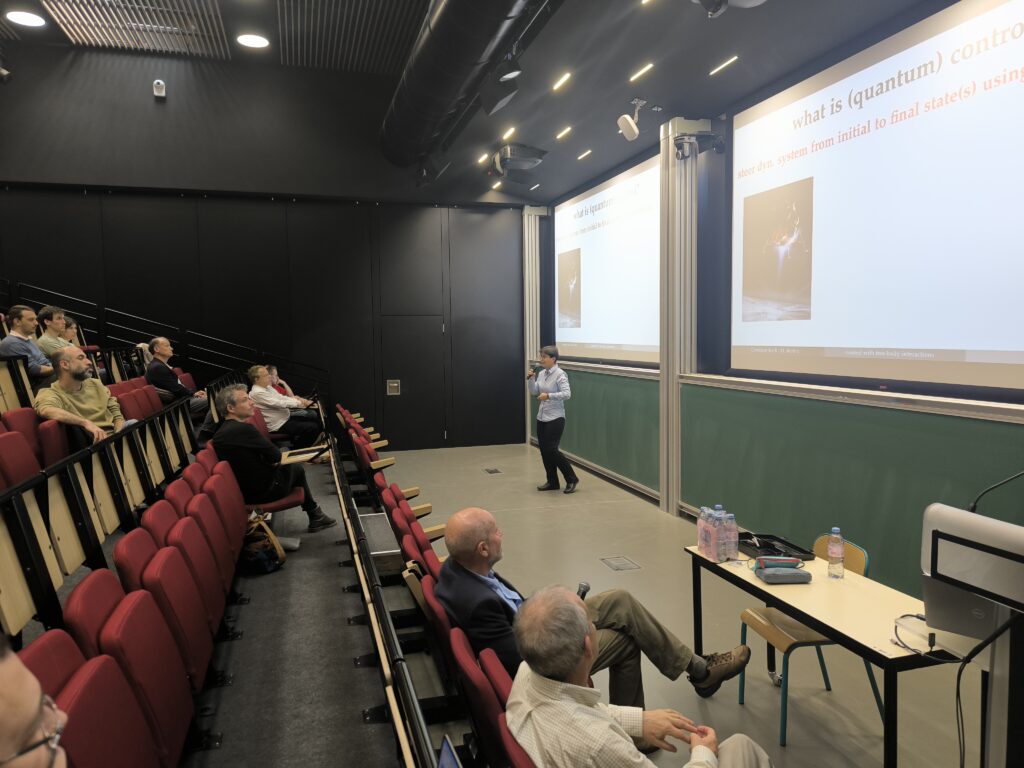
How can we make quantum systems robust enough to serve as the building blocks of tomorrow’s technologies? As interest in quantum computers and ultra-secure communications continues to grow, we must ask ourselves how to control systems whose states are extremely sensitive to environmental disturbances. From June 2 to 5, 2026, Mines Paris – PSL brought together international specialists in control theory, applied mathematics, and quantum physics for the workshop “Dynamics and Control of Classical and Quantum Systems”, including Michel Devoret, a professor at theUniversity of California, Santa Barbara within theQuantum AI Lab and winner of the 2025 Nobel Prize in Physics, and Christiane Koch, a professor of theoretical physics at theFreie Universität Berlin. Organized to mark the conclusion of the ERC Advanced Grant project “Quantum Feedback Engineering (Q-Feedback)” led by Pierre Rouchon, a faculty member at the Center for Control and Systems (CAS) at Mines Paris – PSL, in theQuantic team (Mines Paris – PSL, ENS – PSL, Inria), and a member of the French Academy of Sciences, this event provided an opportunity to bring together two disciplines that, at first glance, seem quite distant: quantum physics and control theory.
Autopilot Meets the Quantum World
In our daily lives, control systems are everywhere: they stabilize an airplane in flight, maintain a constant temperature, and even keep a robot balanced. The principle is simple: observe the state of a system, compare that information to the desired goal, and then correct any deviations. In control engineering, this is known as a feedback loop—a mechanism that has been tried and tested for decades in industrial systems and allows a system’s behavior to be continuously adapted to external disturbances.
The building blocks of these technologies—qubits—harness the laws of quantum mechanics to store and process information. Unlike a classical bit, which has a value of either 0 or 1, a qubit can exist in multiple states simultaneously. This property, known as “quantum superposition,” is one of the keys to the power of quantum technologies. But it also makes them extremely sensitive to their environment, risking disruption of the system’s state and causing a gradual loss of its quantum properties. This phenomenon, known as decoherence, is currently one of the main obstacles to the development of reliable quantum devices capable of operating on a large scale.
The challenge is twofold: to understand these systems and to learn how to control them without destroying them. This is precisely the goal of the ERC Q-Feedback project, whose workshop marked the culmination of this work while opening up new research avenues—work that fully exemplifies the institution’s identity.
This ERC grant has served as a catalyst. It has enabled the development of equipment, brought teams together, and fostered fruitful interactions between theory, experimentation, and industrial applications. This collaborative effort places us in an excellent position to participate in what is becoming an ambitious French policy—both industrial and scientific—centered on quantum technologies.
Godefroy Beauvallet, Director General of Mines Paris – PSL
An International Community to Tackle the Challenge of Quantum Control
Over the course of four days, researchers from leading international institutions compared their approaches. Experimental physicists, control theory specialists, mathematicians, and engineers discussed ways to make quantum systems more stable, more reliable, and capable of operating at a scale compatible with future industrial applications.
Michel Devoret, a professor at the University of California, Santa Barbara, and a world-renowned pioneer in superconducting circuits, reflected on forty years of research that led to the emergence of “artificial atoms.” These electrical circuits, made from superconducting materials and cooled to temperatures near absolute zero—and whose behavior obeys the laws of quantum mechanics—are now at the heart of the most advanced quantum processors.
Unlike natural atoms, these systems can be designed and fine-tuned by researchers. By modifying the circuit’s geometry or its constituent components, it is possible to control certain fundamental properties, such as their energy levels or their interactions with other qubits.
“The great advantage of these systems is that they allow for a continuous transition from the classical to the quantum state. ”
Michel Devoret, professor at the University of California, Santa Barbara in the Quantum AI Lab and 2025 Nobel Laureate in Physics
This mastery lays the foundation for increasingly powerful quantum processors. But it also raises a fundamental question: how can a stable quantum state be maintained when any measurement or interaction risks disturbing it? For Michel Devoret, the answer lies in the contributions of classical control theory, already widely used in industrial systems: observing the system’s state, estimating its evolution, and then acting in real time to correct deviations. One of the current challenges is adapting these methods to the quantum world, where observation itself alters the observed system.
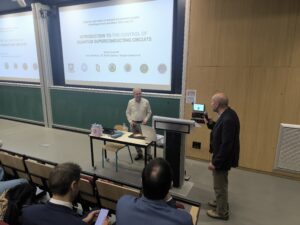
Michel Devoret and Pierre Rouchon at the workshop “Dynamics and Control of Classical and Quantum Systems.”
Rethinking Control at the Qubit Scale
Christiane Koch, a professor at Freie Universität Berlin and an internationally renowned expert in quantum control, presented her work, which aims to determine how to control a quantum system as efficiently as possible.
In theoretical models, quantum computers are often depicted as vast networks of interconnected qubits, on which perfectly controlled logical operations are performed in sequence. But between these idealized models and experimental devices, the reality is much more complex. Each technological platform has its own physical constraints, imperfections, and limitations. For the researcher, it is precisely at this level that the future of quantum technologies is at stake:
Quantum control and engineering take place at the level of physical hardware. When speaking with experimentalists, one must always return to this reality.
Christiane Koch, professor of theoretical physics at the Freie Universität Berlin
The control methods developed by Christiane Koch make it possible, in particular, to optimize the electrical, magnetic, or light pulses used to manipulate qubits, in order to speed up certain operations while minimizing errors. More broadly, her work invites us to rethink the very design of quantum technologies. Phenomena long considered constraints—such as certain interactions with the environment or energy losses that are difficult to avoid—can sometimes be harnessed to make quantum systems more stable or easier to control.
This line of thinking illustrates one of the major trends in current research: as quantum technologies move closer to practical applications, their development depends as much on mastering physical phenomena as on algorithmic or theoretical advances. The challenge is no longer merely to demonstrate what is possible in theory, but to determine what is feasible, reliable, and efficient in a real-world device.
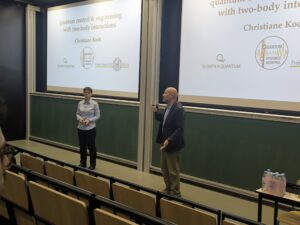
Christiane Koch and Pierre Rouchon at the workshop “Dynamics and Control of Classical and Quantum Systems.”
A Catalyst for French and European Quantum Research
Beyond scientific advances, the workshop highlighted the pivotal role of the ERC Advanced Grant project “Quantum Feedback Engineering” (Q-Feedback) in building a research ecosystem bringing together Mines Paris – PSL, the ENS – PSL, Inria, and numerous academic and industrial partners. Q-Feedback has served as a catalyst, facilitating the acquisition of state-of-the-art equipment, the recruitment of new researchers, and the strengthening of interdisciplinary collaborations.
This workshop demonstrated that this was not an endpoint, but rather a new beginning. Discussions among leading international figures in the field—including Jean-Michel Coron, professor at Sorbonne University and member of the Academy of Sciences; Karine Beauchard, professor at ENS Rennes and recipient of the Michel-Monpetit–INRIA Prize from the Academy of Sciences; and Nicolas Petit, a faculty member and researcher at CAS and also a recipient of the Michel-Monpetit – INRIA Prize from the Academy of Sciences, highlighted the vitality of a fundamentally interdisciplinary scientific community.
At a time when quantum technologies are entering a phase of global acceleration, Mines Paris – PSL is thus affirming its role as a bridge between fundamental research, control theory, and industrial innovations, in the service of future quantum computers and networks.