

Pressurized Hydrogen: Understanding It to Better Protect Steel – 3 Questions for Yazid Madi
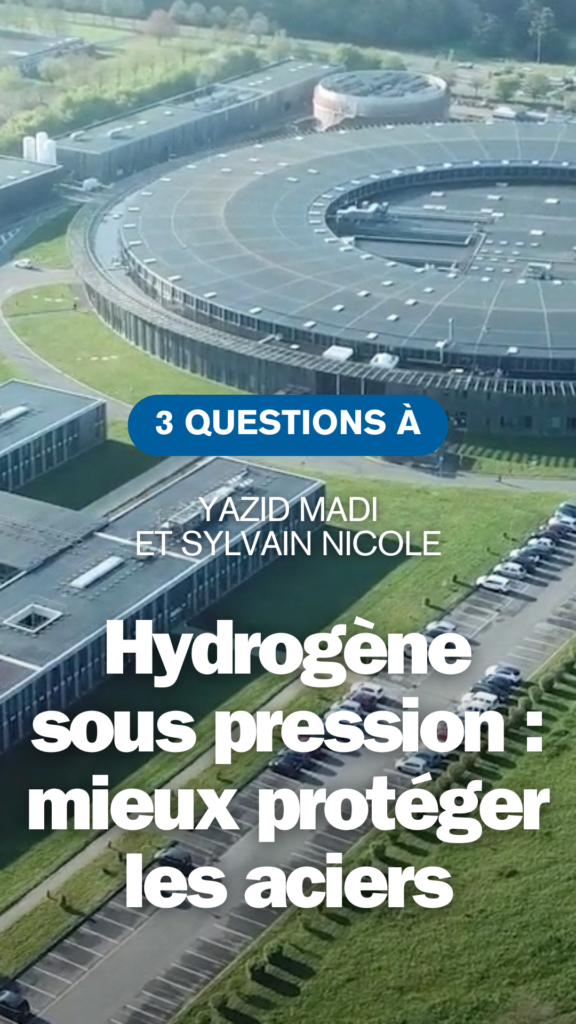
In this video, Yazid Madi, a professor at CMAT, and Sylvain Nicole, technical director at Top Industrie, discuss this groundbreaking experiment. AlongsideAndrew King, a beamline scientist, and Jean-Pierre Deslandes, an assistant engineer—both at the SOLEIL synchrotron—they introduce us to this facility, a veritable giant X-ray microscope located on the Saclay plateau. A major breakthrough achieved at the SOLEIL Synchrotron by the Center for Materials (CMAT) at Mines Paris – PSL, in collaboration with the French SME Top Industrie. Last summer,
Research teams succeeded in observing in real time how hydrogen gas embrittles the steels used in transportation infrastructure—a key challenge for the safety and sustainability of future hydrogen networks.
On the PSICHE beamline, dedicated to studying materials under extreme conditions, an innovative tensile testing machine designed with Top Industrie enabled real-time 3D imaging of the deformation of steel subjected to high-pressure hydrogen.
This experimental approach, now described in a scientific publication co-authored by Yazid Madi, Andrew King, and Sylvain Nicole, among others, marks a major methodological breakthrough: the observations reveal that the strain rate influences fracture mechanisms: at low rates, hydrogen penetrates deeper and promotes internal crack propagation, whereas at higher rates, cracks form mainly on the surface.
Presented at EUROMAT 2025, these initial results have established a link between the microstructure of steel and its brittleness, opening new avenues for designing stronger materials.
This work is now part of the European HYWAY project (2024–2028), coordinated by Mines Paris – PSL, which aims to establish new testing protocols and design criteria for materials intended for the hydrogen infrastructure of the future.
These groundbreaking observations shed unprecedented light on the mechanisms of embrittlement and pave the way for the design of stronger steels. This is a decisive step forward in supporting the development of carbon-free energy by ensuring the reliability of the materials at the heart of these systems.
To read this publication: https://doi.org/10.1016/j.ijhydene.2026.154770