

Meteorite classification
DEFINITION OF A METEORITE
A meteorite is any mineral object of extraterrestrial origin found on Earth, either by chance or after the object’s fall was observed. Most of these objects are very small and vaporize in the atmosphere, but some of them reach the Earth’s surface.
The fall of stones from the sky does not go unnoticed; the meteor or shooting star leaves a luminous trail that fades in the dense layers of the atmosphere, giving way to a whitish trail of water vapor accompanied by explosive sounds caused by the shock wave ahead of the meteor. This is followed by a whistling sound as the various fragments pass through the air, and finally, the more or less deafening impact on the ground.
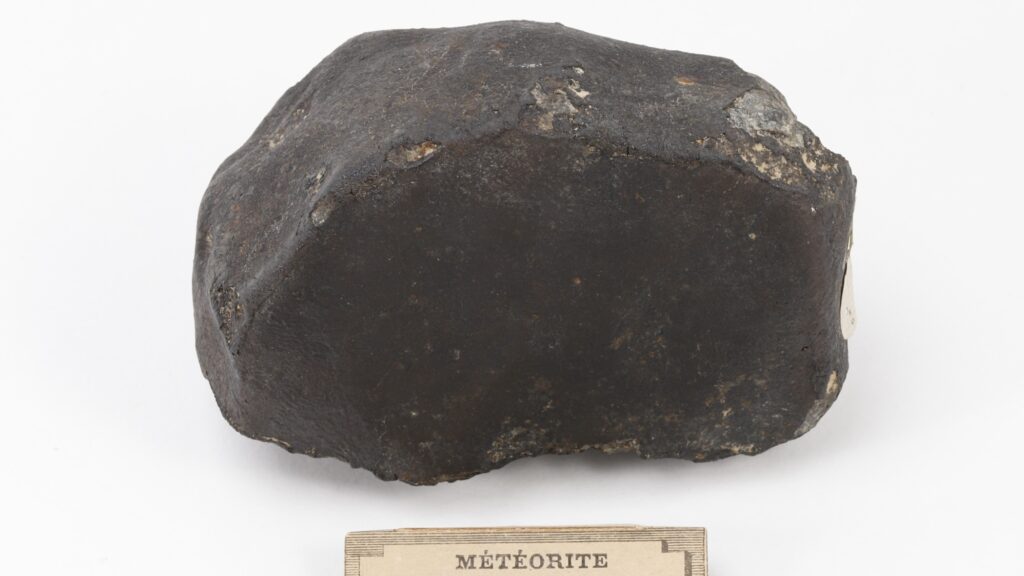
Meteorite called “L’Aigle”, fallen near the town of L’Aigle in Orne, France, in 1803 (ENSMP 6043). © Musée de Minéralogie Mines Paris – PSL / E. Gaillou.
How are meteorites classified?
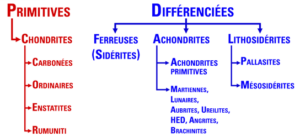
Meteorites are classified into two distinct groups, depending on the nature of the celestial body from which they originated: primitive meteorites (also called undifferentiated meteorites) and differentiated meteorites.
Primitive Meteorites
Primitive meteorites (also called undifferentiated meteorites) originated from a primordial body that retained the original material from which all objects in the Solar System were formed. Grains of silicates and metal are found side by side within them. Chondrites are composed of small, more or less deformed spheres (chondrules) aggregated together. There are four main groups, the two most significant of which are:
– “ordinary chondrites” They account for nearly 80% of chondrites and consist mainly of olivine, pyroxene, feldspar, iron, nickel, etc.
– “carbonaceous chondrites” They consist of feldspar and carbonaceous elements, and sometimes contain very little iron.
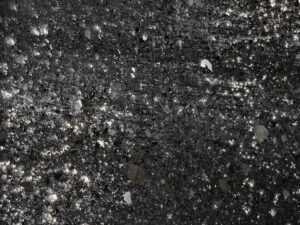
“Farmington” meteorite: ordinary L5 meteorite. Close-up photo of the meteorite, showing visible chondrules (ENSMP 1513). © Musée de Minéralogie Mines Paris – PSL / L’ECOLE des Arts Joailliers / Benjamin Chelly.
Differentiated meteorites
They originate from a differentiated body, meaning that the celestial body was large enough for its original material to melt and then separate into different layers. The Earth, for example, is a differentiated body with a crust, a mantle, and a core.
– Achondrites These are meteorites originating from the surfaces of large asteroids or planets. They resemble Earth’s rocks.
– Iron meteorites (siderites) These are fragments of asteroid cores. They consist mainly of iron and nickel.
– Lithosiderites These are mixed meteorites composed of iron-rich parts (iron and nickel) and silicates. There are two types of lithosiderites: mesosiderites and pallasites.
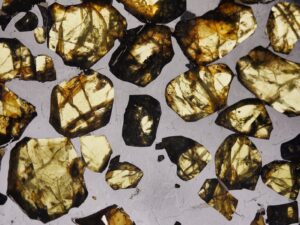
“Esquel” meteorite: a close-up of the pallasite, showing yellow-green olivine crystals in a metallic matrix (ENSMP 76760). © Musée de Minéralogie Mines Paris – PSL / L’ECOLE des Arts Joailliers / Benjamin Chelly.