

Minerals
A journey into the heart of the mineral world.
Minerals form the cornerstone of the museum’s collection, which was assembled starting in the late 18th century to train mining engineers. Composed of tens of thousands of samples, the collection encompasses all known mineral families, featuring specimens that are remarkable for their crystal quality, rarity, or historical significance.
Large display cases showcase spectacular pieces from historic French mines, European deposits, and iconic sites around the globe. Organized according to rigorous scientific principles, the collection serves as an educational resource, an exceptional heritage asset, and a source of wonder for all visitors.
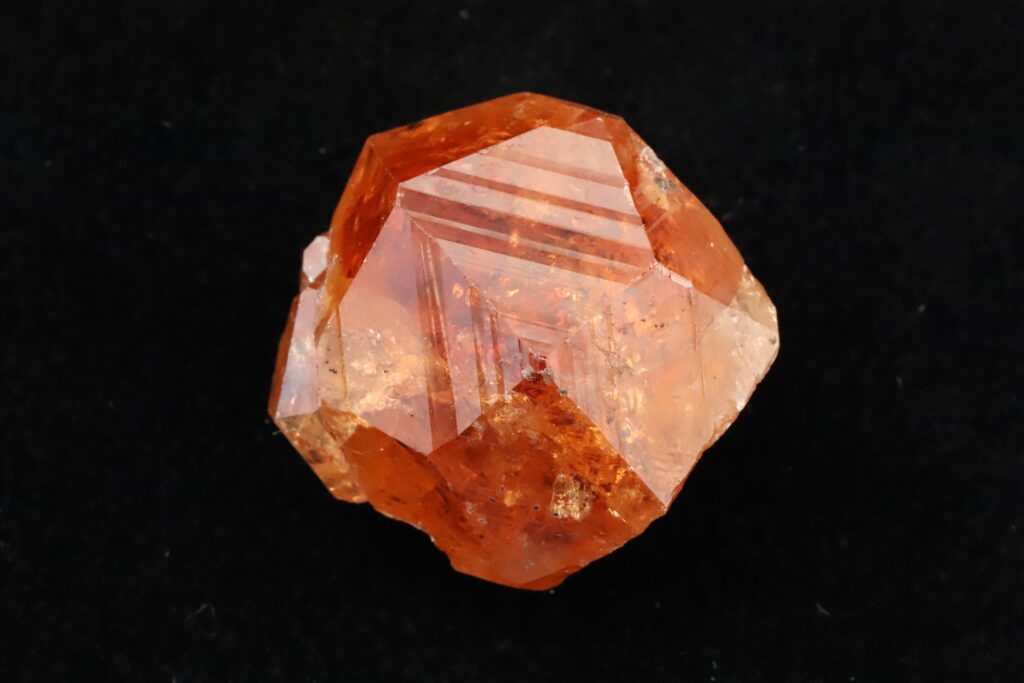
A world renowned collection
With nearly 5,000 specimens on display and over 100,000 in its collections, the Museum boasts one of the world’s largest mineral collections. The gallery showcases 832 different mineral species, so be sure to plan ample time for your visit!
The collection has significant scientific value, particularly with its type minerals: these are the minerals used in the scientific analyses that led to the description of a new mineral species. The Museum is one of the world’s largest repositories of these highly valuable scientific specimens.
But beyond their scientific value, the specimens also hold historical significance: leading figures in mineralogy have contributed to the collections, passing on this legacy to us today. For example, we can name Abbé René Just-Haüy, the first curator of the Museum from 1794: a priest who refused to comply with the civil constitution of the clergy in 1791, he is considered the father of crystallography.
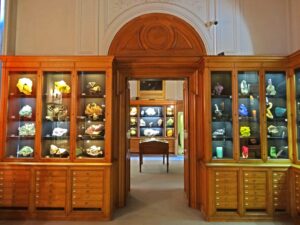
What is an ore?
- An ore is a naturally occurring material from which one or more economically valuable minerals can be extracted.
- Chalcopyrite, an iron and copper sulfide, for example, is one of the main copper ores. Lepidolite, for example, is a major lithium ore.
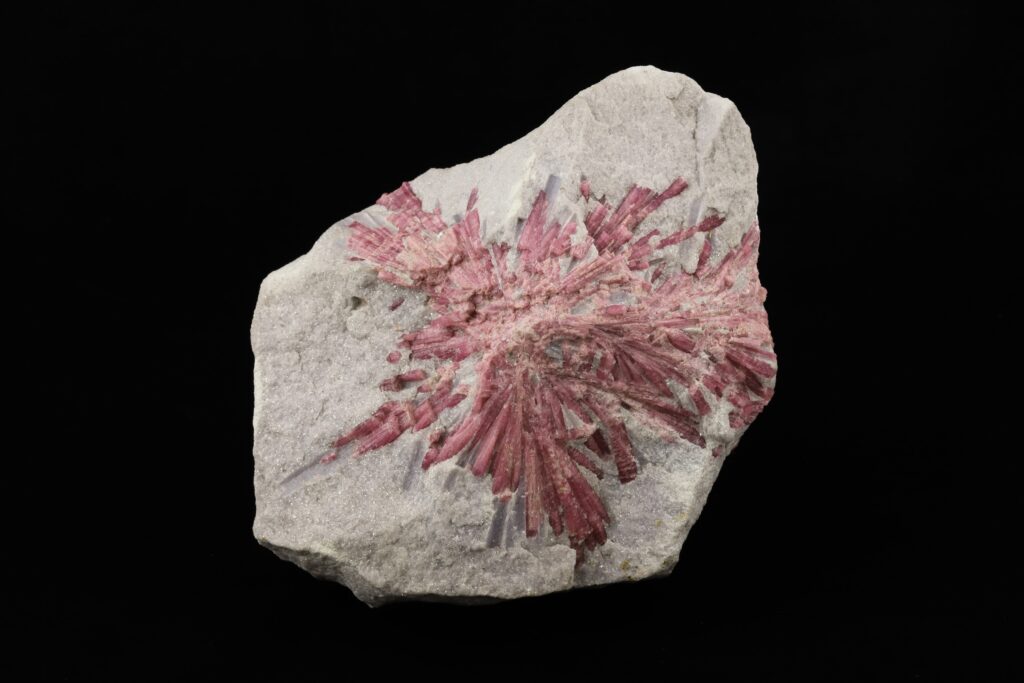
Lithium ore : a rock composed of lepidolite (lithium-rich mica) and pink elbaite tourmaline (also composed of lithium), from Pala, California, USA (ENSMP 4758). © Musée de Minéralogie Mines Paris – PSL / E. Gaillou.
What is a mineral?
- A mineral is a naturally occurring crystalline solid characterized by a specific chemical composition and atomic structure. A mineral can be composed of a single element (which is rare; these are called native elements), but more often, they are compounds (containing at least two chemical elements).
- There are a few exceptions to this simplified definition, such as mercury, which is a mineral but is liquid at room temperature. Some solid minerals lacking an atomic arrangement (amorphous) are also considered minerals, such as opals.
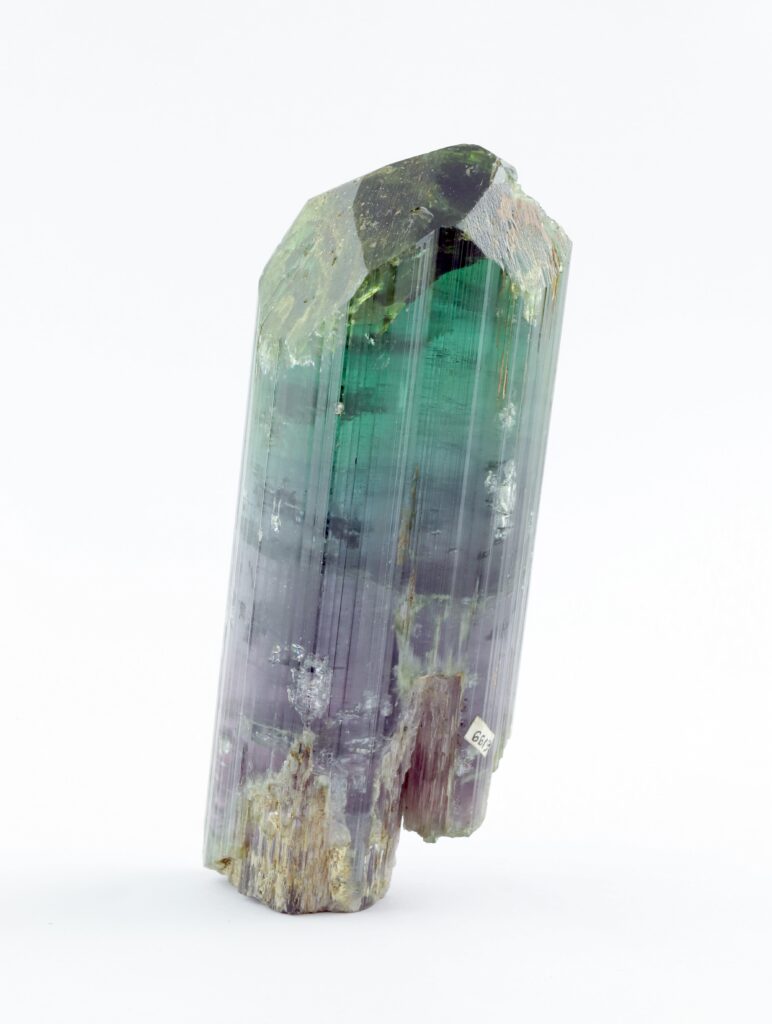
Multicolor elbaite tourmaline, from Brazil (ENSMP 6199). © Musée de Minéralogie Mines Paris – PSL / E. Gaillou.
How are minerals classified?
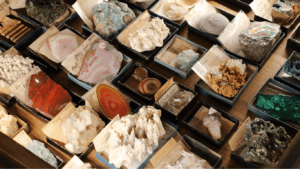
Specimens in the Drée / Dolomieu collection drawer. © Musée de Minéralogie Mines Paris – PSL / E. Gaillou.
Several systems exist to classify the more than 6,000 mineral species currently found in the world. The Dana classification of 1837, named after the American geologist James Dwight Dana, has been adopted internationally. It has been revised several times since, primarily by Strunz (1941) and then Nickel and Strunz (2002), and is currently maintained by Mindat.org. This classification contains 10 major mineral families, organized according to their chemistry. It is by this classification that the International Mineralogical Association updates new species and their classification.
During a major reorganization of the collection beginning in the 1960s, the minerals were naturally reorganized into these 10 “classes,” both within the storage area and in the exhibition space.
Thus, the distribution of samples in the Museum follows this classification: each room of the Museum houses a different family, ranging from native minerals to silicates. This allowed students and enthusiasts to visualize and illustrate the scientific classification of minerals simply by walking through the gallery.
Where do the minerals in the collection come from?
The samples come from a wide variety of sources, reflecting the evolution of the École des Mines throughout its history. The museum’s collection truly took shape with the creation of the “Cabinet of Mineralogy” in 1794, established by a decree from the Committee of Public Safety. This cabinet was formed to gather and preserve “all the products of the globe and the Republic, arranged according to locality.” Significant resources were devoted to building this national collection, which cataloged minerals based on both their geological deposits and their mineral species.
Initially, the Cabinet of Mineralogy’s collection was built through the purchase of entire collections, field expeditions undertaken by professors and students, and revolutionary confiscations.
The 19th century was the collection’s most flourishing period, enriched by the return of major scientific expeditions and field missions, acquisitions from World’s Fairs, the purchase, donation, and bequeathal of collections, and various exchanges.
The geographical origins are also highly diverse: while the majority come from France and Europe—reflecting the Museum’s original mission to inventory, map, and catalog all of France’s mineral resources—a significant portion of the minerals originate from former colonial empires, resulting in great variety within the collections, with over a hundred countries represented.
The collection was digitized starting in 1995, and each specimen was assigned an “ENSMP” inventory number (standing for the *École Nationale Supérieure des Mines de Paris* collection) and registered in the national inventory of French heritage. Specimens listed in this national inventory can no longer be exchanged; the collection can only grow.
Since 2011, the museum has acquired new items exclusively through donations, whether monetary or in-kind. Approximately fifty specimens are added annually; the donor’s name is recorded in the database and displayed on the label accompanying the mineral, whether it is on public display or stored in a drawer. Today, specimens entering the collection are selected with a focus on ensuring their traceability.