
Types specimens
When a new species is described, the specimen (or, more commonly, specimens) used to determine its crystallographic, physical, and chemical properties is considered the “type mineral.” These specimens must be deposited with an institution (such as a museum or university) to ensure their preservation and future accessibility.
The Mineralogy Museum of Paris School of Mines is one of the most important repositories of these samples of great scientific interest. Two display cases are dedicated to these minerals, named after prominent mineralogists from the School and the museum, or minerals discovered by one of them.
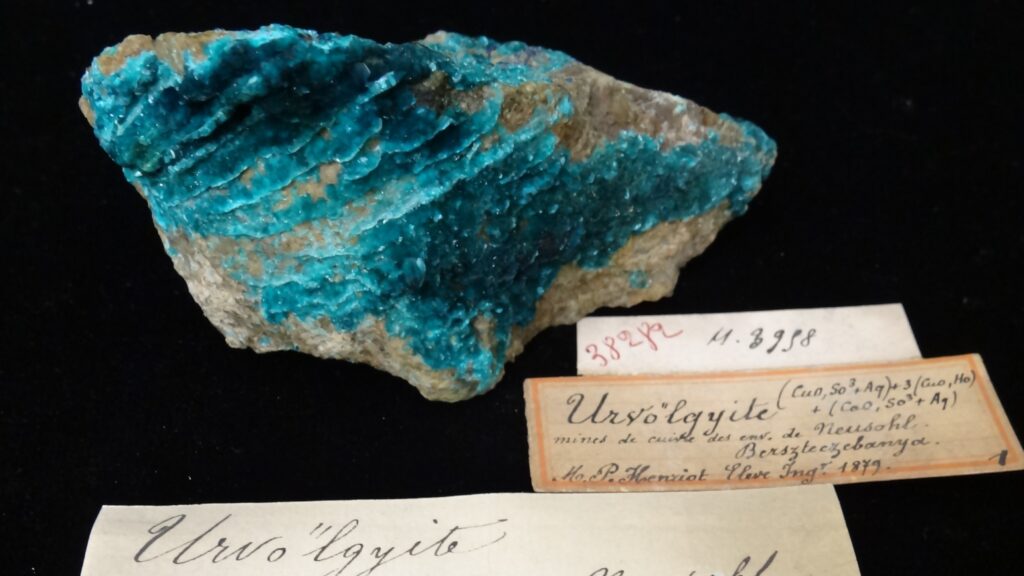
Urvöllgyite from Hungary (ENSMP 38282). © Musée de Minéralogie Mines Paris – PSL / Eloïse Gaillou.
On the importance of Type Specimens
When a new mineral species is described, the specimen(s) used to determine its crystallographic, physical, and chemical properties is considered the “type specimen”. These specimens must be deposited in a museum or university collection to ensure their preservation and future accessibility. Each must be identified by a unique catalog number and listed on the International Mineralogical Association (IMA) website. Indeed, if new studies to define a species are to be undertaken, they can yield valid results only if they are conducted on type specimens or fragments thereof, especially if these studies are likely to discredit a species because it turns out to be a mixture or corresponds to a preexisting species.
Over the past twenty years or so, the categories of type specimens to be used in descriptive mineralogy have been defined; this nomenclature is based on the degree of relationship to the holotype, which was used to characterize the species. A distinction is thus made between cotypes (specimens used to supplement the description), and metatypes (specimens recognized by the author as identical to the holotype). We also define a category named “author’s specimens”. The authors of scientific articles on these new minerals have sometimes sent samples to the museum without specifying whether it is indeed the sample used for the description or one of the samples used for that purpose. This is obviously an even more common occurrence when the species was described a long time ago; even if we are certain that a sample came from the author, it is often very difficult to confirm that it was used for descriptive studies, unless the author or the recipient of the specimen specified this on the label or unless obvious remnants of past experiments (fragments in labeled tubes, thin sections, etc.) accompany the specimen. Finally, we have grouped together under the term “dedicatory specimen” those specimens transmitted by the person to whom the mineral was dedicated. This category is of lesser interest since there is no a priori proof that the specimen actually corresponds to the material studied by the author.
All of these specimens (a total of 700 species or variety types) are stored separately and with special care. There are also two display cases in the museum that showcase some of these specimens, notably featuring mineral species discovered by professors and curators of the École des Mines, or those named after them.