

Rocks
Natural archives of the Earth and scientific exploration
The museum houses a collection of rocks of great richness, which sheds light on the major geological processes at work in the formation and transformation of our planet.
It offers an educational overview of major geological processes. Magmatic, sedimentary or metamorphic, they carry within them the traces of the upheavals that have shaped our planet.
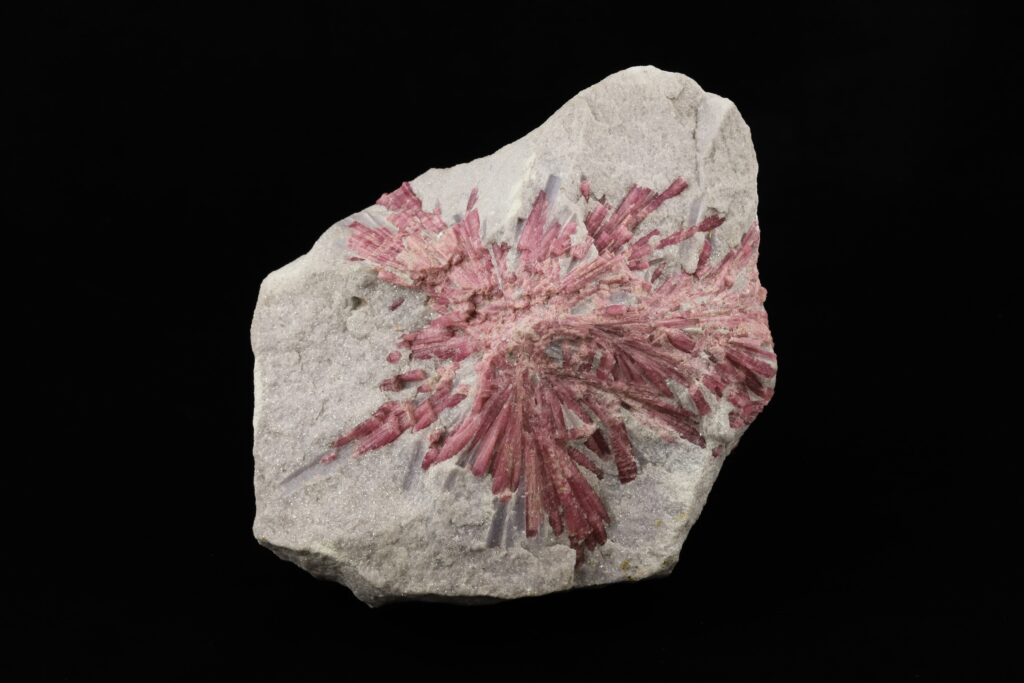
The rock collection at the museum
From a rich collection of more than (number of samples), the rocks are gathered in their dedicated room: Room F. Despite their small size, rocks are very important in industry.
Today, although mineralogy courses have been discontinued at the Paris School of Mines, the collections continue to grow. Welcoming the public and sharing knowledge are central to the Museum’s mission, as is research. Minerals, a topical subject, are omnipresent in our society (food, clothing, connected devices).
What is a rock and how is it defined?
- A rock is an aggregate of minerals
Rocks are organized in three families:
- Sedimentary rocks: they are formed by the accumulation of sediments deposited or stirred on the surface of the earth. We can notably mention sandstone or limestone. Sediments are particles composed of geological detritus (like minerals) and/or biological detritus (like organic matter): all this forms what is called sedimentation. the igneous rocks: also called igneous rocks, they are formed by cooling and then solidification of magma or lava. Solidification occurs either at depth in the form of so-called “intrusive rocks” (such as granite), or on the surface in the form of so-called “extrusive rocks” (such as basalt).
- The igneous rocks: also called igneous rocks, they are formed by cooling and then solidification of magma or lava. Solidification occurs either deep underground in the form of so-called “intrusive” rocks (such as granite), or on the surface in the form of “extrusive” rocks (such as basalt).
- Finally, metamorphic rocks: these are the result of the transformation of existing rocks into a new type of rock by what is called metamorphism. During this transformation, the rock remains in a solid state but gradually metamorphoses into a new texture and a new mineral composition. The original rock, called protolith, can be one of three types of rock: depending on the nature of the protolith and the pressure and temperature conditions experienced, the resulting metamorphic rock has a characteristic texture and chemical composition.