
The Cabinet of Curiosities
Un voyage au cœur du monde minéral.
Les minéraux constituent les piliers de la collection du musée, réunie dès la fin du XVIIIe siècle pour former les ingénieurs des Mines. Riche de plusieurs dizaines de milliers d’échantillons, la collection couvre l’ensemble des familles minérales connues, avec des spécimens emblématiques par leur qualité cristalline, leur rareté ou leur origine historique.
De grandes vitrines présentent des pièces spectaculaires issues d’anciennes mines françaises, de gisements européens et de sites emblématiques à travers le monde. Classée selon une logique scientifique rigoureuse, la collection est à la fois un outil pédagogique, un patrimoine d’exception et un émerveillement pour tous les visiteurs.
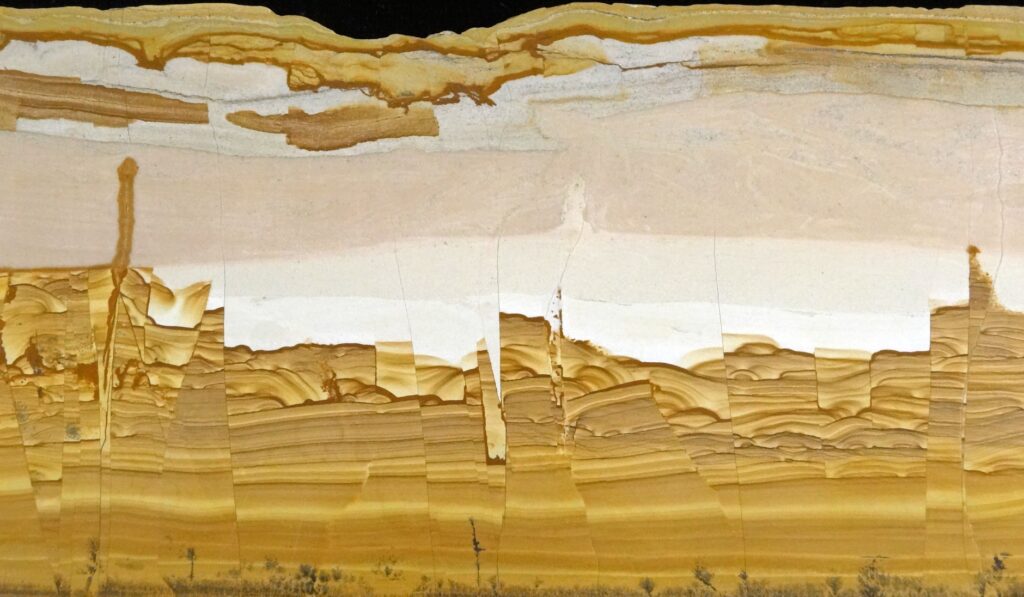
Paesina (ruiniform limestone), Florence, Tuscany, Italy (ENSMP 80081). © Musée de Minéralogie Mines Paris – PSL / E. Gaillou
Collectionism and historical objects
Fossils
A fossil represents the trace, more or less mineralized, of an ancient living organism or its past activity (e.g., footprints, burrows), preserved in sedimentary rock. It can be a cast (internal or external) of the organism, or even entire parts or simple fragments of the animal (e.g., teeth) or plant (e.g., a leaf).
The fossils displayed in the Museum are the survivors of a larger collection assembled during the 19th century. These specimens, sometimes of remarkable size, mostly left the Museum’s collections in the 1970s to join the reserves of the National Museum of Natural History in Paris and the Musée des Confluences in Lyon, where they remain today.
Formerly, an entire floor was dedicated to them within the École des Mines, directly above the Mineralogy Museum. These spaces have now been converted into offices and meeting rooms. A small portion of the collections remained at the school and were integrated into two display cases in the Museum, which you can see in Room G. To showcase the fossil collection still held at the School, a room adjoining the museum was set up to house some of the specimens. Several thousand specimens are still preserved in the School’s collections.
During special events such as the European Heritage Days or the European Night of Museums, you can see the remaining fossils from the collection in this room (now used as a meeting and classroom).
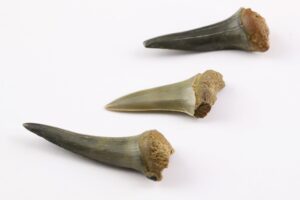
Fossilized Lamna Elegans shark teeth, from the historical fossil collection of the Paris School of Mines. © Mines Paris – PSL / E. Gaillou.
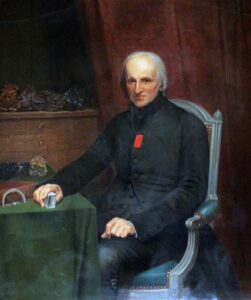
Portrait of René Just-Haüy by Nicolas Gosse (1787-1878), 1843, oil on canvas. © Musée de Minéralogie Mines Paris – PSL.
Paintings and Artwork
Upon arrival at the Museum, you are immediately immersed in exceptional geological landscapes: canvases depicting major geological sites overlook the Museum’s grand staircase and accompany you to the entrance.
Painted by the artist Hugard de la Tour, these works were commissioned by the School of Mines in 1842.
You can also admire large allegorical representations of science and its scientists, painted by Abel de Pujol between 1852 and 1856.
Throughout the Museum’s galleries, you will also find portraits of prominent scientists who worked at the Museum or who played a crucial role in the fields of Mineralogy and Geology.
For more information and to help you plan your visit, you can download the guide de visites PEINTURES (in French only) :
Pigments
A pigment is a substance, usually in fine powder form, used in art or construction for its decorative or protective properties. Several types of pigments exist, including inorganic pigments created from minerals.
Components of many ancient and medieval frescoes and paintings, pigments have long been extracted from minerals, particularly for coloring or protecting paintings. This sometimes had harmful effects, especially on the health of painters: when ingested in volatile form, some minerals are detrimental to health, such as cinnabar, the source of vermilion red.
A display case dedicated to these pigments is located in Room N of the gallery.
A more specific presentation on the role of pigments in art history is available as an audio guide: created by students from the École des Mines, it is part of an end of the year project.
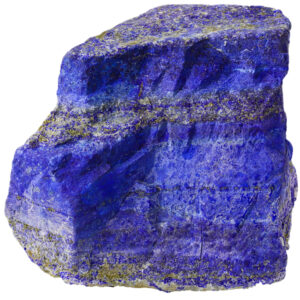
Lapis lazuli, the origin of ultramarine blue, from Sar-e-Sang in Afghanistan (ENSMP 84355).
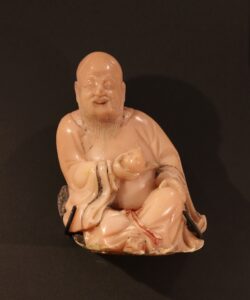
Serpentine representation of Lao Tzu holding an apple, object from the collection of Henri Bertin (Bertin catalogue n° 271, n. 31-61 ; ENSMP 68353 ; 10 x 6,5 x 3.3 cm). © Musée de Minéralogie Mines Paris – PSL / E. Gaillou.
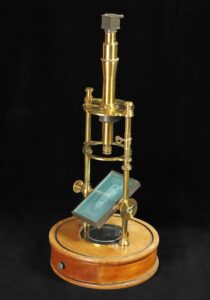
Microscope, developed by Emile Bertrand. © Musée de Minéralogie Mines Paris – PSL / E. Gaillou.
Art Objects and Instruments
The museum’s collections include unusual objects, such as those from the Bertin Collection: Bertin, a minister under Louis XV, was passionate about Chinese culture and art. Confiscated during the French Revolution, his art objects were nationalized and integrated into the museum’s collections. These include primarily jade and serpentine objects.
The museum also possesses a collection of busts representing prominent scientific figures, as well as some scientific instruments, such as microscopes, spectrographs, hydrostatic balances, and wooden models, mainly dating from the 19th century.
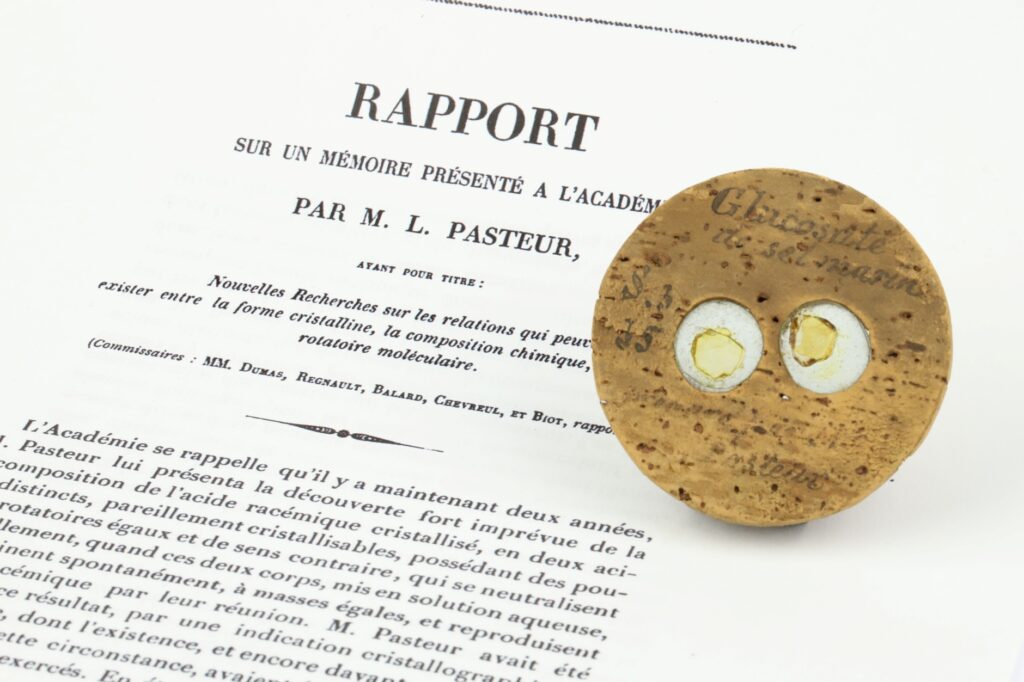
Microscope identification slide, created by Pasteur. © Musée de Minéralogie Mines Paris – PSL / E. Gaillou.