

LIVING STONES
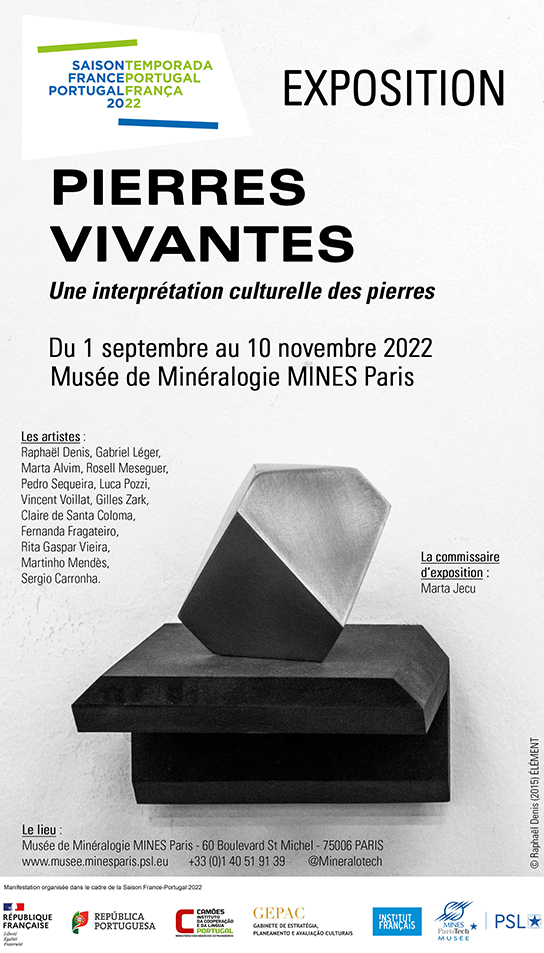
Artistic exhibition LIVING STONES: from September 1 to November 10, 2022
Presentation
The artistic exhibition “LIVING STONES” is proposed successively in two historical scientific collections: at the Geological Museum of Lisbon (founded in 1859) and at the Mineralogy Museum MINES Paris (of the School of Mines, founded in 1783). Two versions of the exhibition will be presented, including Portuguese and French artists. The exhibition is complemented by an educational program developed for the general public with interdisciplinary events, in each museum, where art and science mingle.
As part of the France-Portugal Season, and co-financed by the French Institute and PSL University, this artistic event aims to pay tribute to these two European museums and the role they have played in the cultural history of both capitals. The exhibition allows to connect rocks and minerals, true works of natural art, with contemporary artistic objects, reinforcing the perpetually innovative potential of these collections.
The exhibition launches a reflection on the pollination between scientific and artistic information centered on stone – as a primordial symbol both of artistic practice (being the “material of art”) and of the production of scientific knowledge. (encompassing fields such as geology, astronomy, geodesy, archaeology, etc.). These themes are applied in the contemporary context, where stone is a living material, constantly reinventing – through scientific and artistic practice – between the natural and the artificial, between the virtual and the real. The exhibition asks the question: what is the potential of stone today? Each of the artists will apply certain aspects of the stone and aspects of the history of the two museums to their own cultural context.
Curator: MARTA JECU
The exhibition is accessible with a standard paid entry (no additional cost for the exhibition).
Find all the information about the exhibition in the press kit here.
ORIENTATION BOOKLET AND DESCRIPTION OF THE WORKS in pdf format here.
EXHIBITION BOOKLET downloadable for free here.
Artistes invités
RAPHAEL DENIS
Raphaël Denis proposes a set of sculptures inspired by the engraving of Albrecht Dürer, Melencolia I (1514) evoking the fall in 1492 of the so-called Tonnerre stone at Ensisheim, represented by a polyhedron. The polyhedron is a paradigmatic element for the indistinctiveness of sciences (mathematics, astronomy) and occult arts (alchemy). Denis recharges this element in a series of forms that reproduce our contemporary scientific imagination on the structure of organic and inorganic matter, linked to high technology. This work shows the stone at the center of interdisciplinary researchers by connecting with a metaphysical dimension of knowledge and intuition.
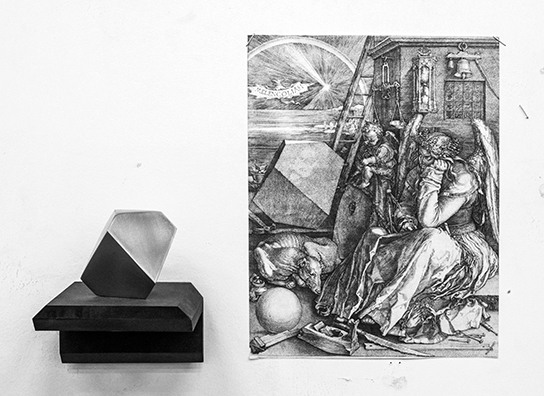
Crédit: Raphaël Denis(2015), ÉLÉMENT. 60 x 54 x 54 mm, Acier, Plomb. MELENCOLIA I, d’après Dürer par Johannes Wierix. 26.1 x 20.5 cm. Gravure : 1602.
LUCA POZZI
Luca Pozzi explores techniques that merge virtual and real materials and information, concrete and abstract. For him, the stones encapsulate a future-oriented message concerning the connection between the atomic micro-universe and the vast macro-universe. Pozzi is an “art scientist” and experiments with digital techniques for crossing materials. The work of Pozzi presented here is a work of art in reality crossed which exists simultaneously on different platforms, and which was created with the participation of Carlo Rovelli (doctor), Alain Connes (mathematician), Michelangelo Pistoletto (artist) and Garrett Lisi (doctor).
GABRIEL LEGER
Gabriel Léger uses matter and its infinite temporality to connect with a knowledge that humans have lost in the course of history. In his works, he mixes pieces of ancient art with pieces of inorganic matter from time immemorial and references to our history of civilization. By reproducing actions, gestures, moments that come from the past and by joining these sources, he creates contemporary rituals that produce new knowledge and information.
In the new version of Nebulae, developed specifically for this exhibition, he uses the photographic technique of cyanotype on canvas using bursts of stone from a path of the Villa Medici on which Galileo walked during his famous trial in Rome in 1633.
MARTINHO MENDES
The work of Martinho Mendes is related to the socio-geological history of Madeira and to the mineral pigment found in the field. His minimalist and conceptual exhibitions are unitary installations in which he tells and interprets local stories related to the exploitation of stone and territory in Madeira. Historical figures and facts mingle with fantastic elements from local folklore linked to a popular memory of the ecosystem.
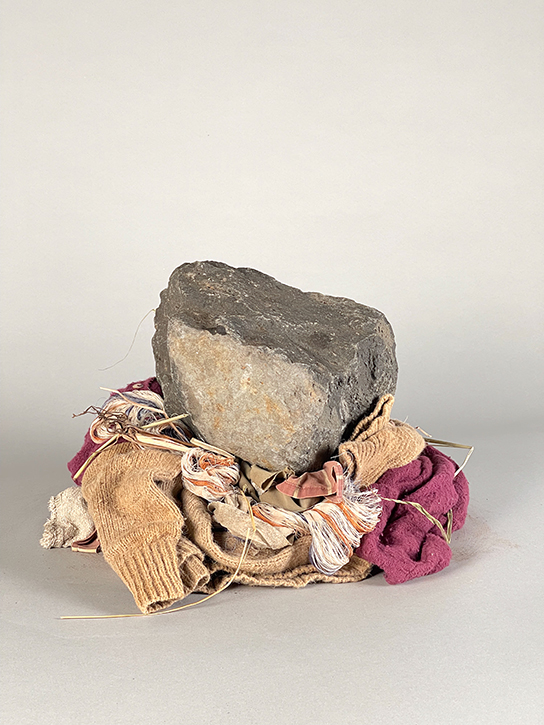
Crédit : Martinho Mendes (2021), Tornadoiros: as pedras de Sísifo. Digital photography.
SERGIO CARRONHA
Sérgio Carronha works mainly with terrestrial materials – some permanent and others ephemeral. He is currently based in Alentejo, where he develops a long-term project related to the Earth and the development of civilizations in relation to the territory. He collects his materials and produces his works by intervening in the given ecosystem and testing the effects of his interventions. Its concerns are the complex links between minerals, fossils, weather conditions, topography and the biosphere.
The paintings exhibited at the museum result from a process of introspection, the artist reproduces different techniques and pigments used in prehistoric signs and writings.
GILLES ZARK
Gille Zark works at the Institut Géographique National de Paris and also as an artist. He created two works specifically for this exhibition. He worked with stone samples (carrots) from the collection of the Museum of Geology in Lisbon. These cores were originally used to collect geological information from the territory. The medallions that are inserted in various showcases of the museum are slices of engraved carrots with geographical coordinates and drawings from two important prehistoric drawing “schools” in France and Portugal (Foz Coa and Lascaux), which, according to recent studies, seem to have influenced each other.
PEDRO SEQUEIRA
Pedro Sequeira works not only on the theme of stone, but also with stone powder, as the material of his paintings, sculptures and drawings.
A collector of minerals and precious stones, he is interested in the aesthetics of stones but also in their rarity in relation to the territory. He is a collector of minerals from the mountains of Portugal, a gem cutter and a research scientist in gemstones. His workshop in which he produces contemporary art works and jewelry is a connoisseur’s laboratory in which his large-scale paintings emerge, thanks to the powder produced by the cutting of precious stones. For him, carving precious stones or realizing his conceptual and minimal works are the different consequences of the same subject.
As a mineral collector, Pedro Sequeira is interested in the rarity of stones with regard to their origin. He is both a mineral collector from the mountains of Portugal, a gem cutter and a scientific scholar of gemstones.
RITA GASPAR VIEIRA
Operating in the field of drawing and three-dimensionality, Rita Gaspar Vieira’s work questions the relationship between private memory and collective memory of inhabited places, highlighting the relationship between everyday practices and artistic procedures. In his practice, the production of cotton paper and the reproduction of stone and wood textures are recurrent, which constitutes the genesis of the design of his installations.
In the three cotton canvases in red, yellow and black exhibited at the museum, Rita Gaspar Vieira takes up the imprints of her workshop in the manufacture of a paper made of cotton and graphite. In the exhibited artist’s book, the artist took prints of a Roman stone engraved with the word Liberti, which commemorates the liberation of a slave in Roman Portugal.
MARTA ALVIM
Marta Alvim is an artist and filmmaker whose works are investigations that explore the convergences between thought, narrative, and image. In his work Excerpt of a dream, the notions of time, consciousness and reality are present in discourses centered on Nature, knowledge and subjectivity. In the film presented in this exhibition, experimental cinema encourages reflection on possible ecological utopias.
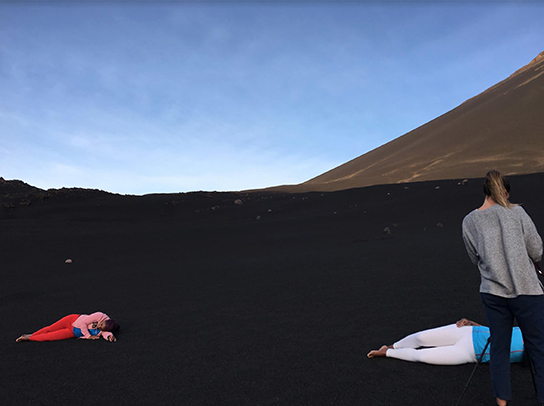
Crédit : Marta Alvim (2022), Theory of Discomfort. Film stills. (images 1, 2 & 3).
VINCENT VOILLAT
Vincent Voillat works with the expressive powers of stones, provoking at the same time hybrid stone forms, going beyond the natural. His minimal work alludes to the cosmic movements of the stone, from the scale of a river stone found to that of the planets and rotating constellations. The artist presents two installations, including a video and a series of collages made of plant fibers, a kind of paper produced by the chewing of rotting wood by Asian hornets, which they use to build their nest. These collages represent an enlarged section of fossil stromatolite. The form is quite abstract, composed of brown and beige strata.
ROSELL MESEGUER
Rosell Meseguer has a constant interest in the subject of mineral colonization. In a geopolitical reading, she talks about the excessive exploitation in South America, with serious consequences related to the destruction of territories, ecosystems and cultures of indigenous populations. The artist hand-paints countless pages of books with mineral powders, as if in an effort to repair and commemorate the dark legacy of these exploitations.
The stones also bear witness to a pre-human era. They carry memories of a cosmic time when the earth was forming. The stone reveals the cosmic heritage of our civilization and the micro-cosmos/macro-cosmos correspondences. The internal layers of the earth with their configuration of gems, as well as the configuration of each gem, reproduce constellations and astral landscapes – and they represent a kind of universal DNA.
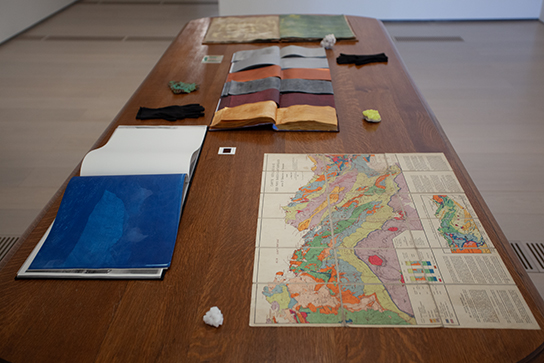
Crédit: Rosell Meseguer. Projet “Rare earth elements” 2017-2022. Installation: Economic notebooks painted page by page, Blueprint book, Minerals, Archive documentation, Polyptich Publication par l’artiste: Quadra Minerale, 2017-2022.
FERNANDA FRAGATEIRO
The work of Fernanda Fragateiro is characterized above all by an interdisciplinary approach, where fields such as sculpture, installation, ceramics, architecture and design intersect and relate to modernism.
The exhibition presents books of stones created by Fernanda Fragteiro. The works, both incorporating books by the French writer Arthur Larrue, tell the story of the group of Russian dissidents and activists – Voina, whom he accompanied in their artistic actions against Putin’s system.
CLAIRE DE SANTA COLOMA
The goal of Claire de Santa Coloma’s work is the idea of sculpture itself, with materials such as wood, fossils and stones that are a central part of it. His work shows affinities with abstract sculpture of the 20th century.
In the sculpture presented at the museum, the artist explores possible new natural forms that result from possible contaminations between animal, plant and human. The stone is both linked to the exploitation of the territory and resources and the history of the museums themselves (was linked to research with the aim of mining).