
Our History
240 years of science, passion and transmission
The Mineralogy Museum of Mines Paris – PSL is the direct heir to a scientific and human adventure that began in the 18th century. This adventure blends exploration, research, education, and, at times, the upheavals of French history.
Here is a look back at these two centuries of heritage.
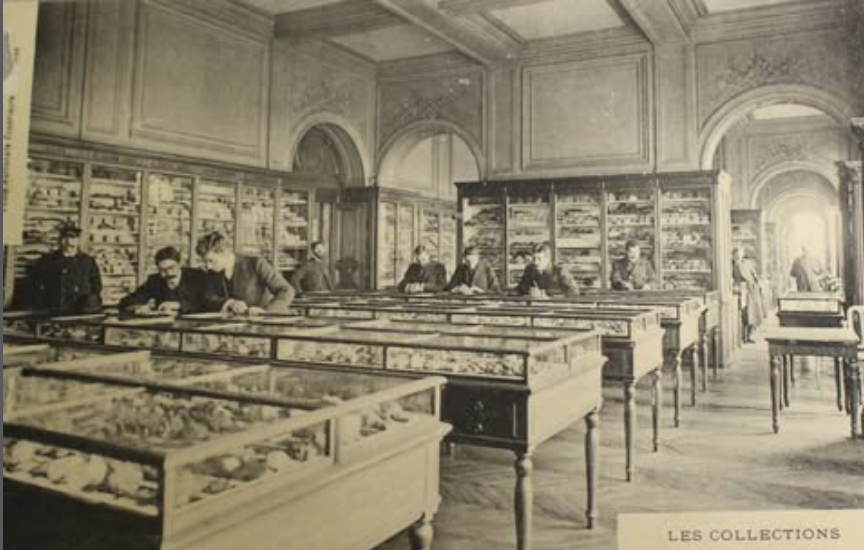
The Collections. Postcard, early 20th century. Paris, Mines Paris – PSL Library.
The Mineralogy Museum is much more than an exhibition space: it is a living witness to the evolution of science, knowledge and the way we look at the Earth.
The Birth of a Mining Policy
Until the mid-18th century, mining had barely flourished in France. A few sovereigns, ministers, and advisors had made some efforts, but unfortunately, these came to nothing. Charles VI, with his letters patent of 1413, granted privileges and therefore obligations to mine owners and miners; Louis XI, with his “Ordinance on the Exploitation of Mines in the Kingdom” of 1471; Henry IV, with his edicts of 1597, 1601, and 1604; and Colbert, between 1679 and his death. However, at the end of Louis XIV’s reign, absolute freedom was restored to all landowners to exploit the subsoil, resulting in a proliferation of tiny, and disastrous, mines.
It was not until 1739, with the takeover of Mines and Bridges and Roads by the Grand Intendant Trudaine, that a true mining policy emerged. The January 1744 ruling clearly expresses an essential principle of French mining law: the independence of land ownership from subsoil ownership, which can only be exploited with state authorization. This ruling also establishes a comprehensive set of technical regulations for mining operations.
1783: Creation of the School of Mines
The need for engineers and technicians without always having to rely on foreigners (especially from Central Europe) became apparent. These engineers were considered uniquely capable of organizing what would become a, in less than a century, “large-scale industry” and could help transform the art of mining into a true science. Creating a favorable intellectual environment, treaties, translations of works on mining research and exploitation, and accounts of mineralogical expeditions proliferated. As early as 1766, mine concession holders were taxed for the upkeep of the “future” School of Mines. The following year, Guettard, soon assisted by Monnet, began the inventory of the kingdom’s mineral resources, leading to the work of Jars, Gensanne, Grignon, and Schreiber. In 1778, Balthazar Georges Sage, a “distinguished” mineralogist and chemist, succeeded in establishing a public school of mineralogy and mineralogy in what is now la Monnaie, where he lavishly installed his collections in the grand salon. He held the sole professorship there. Through this school, and through the engaging lectures he delivered to students, he helped create a favorable environment for the establishment of the School of Mines, which led to the decree issued by the King’s Council of State on March 19, 1783:
“The King, having been informed that the art of discovering and exploiting mines has not made the progress it could have in his Kingdom, and that among those who have obtained concessions, some have made no use of them, while others have employed considerable funds without profit; And that those who succeeded did not reap all the benefits they should have expected, due to the difficulty of finding intelligent directors: His Majesty has been informed of the various means that could be employed to stimulate a type of industry from which neighboring states derive such great advantages, and he has recognized that it was not enough to encourage those who wished to engage in the search for and exploitation of minerals, that it was also necessary to train individuals to conduct the works with as much safety as economy; it is for these reasons that His Majesty has resolved to establish a School of Mines… »
1794: The Revolution and the Mineralogy Collections
In the midst of the Reign of Terror, by a decree of the Committee of Public Safety dated 24 Messidor of Year II of the Republic (July 12, 1794), the School was reorganized.
Placed under the authority of the Mines Agency, the School of Mines was established in the Hôtel de Mouchy, located at 293 rue de l’Université in Paris. The decree specified the creation of a “Mineralogy Cabinet” containing all the minerals produced worldwide and all those produced in the Republic, arranged according to their origin. To this end, mining engineers were to “collect all fossil substances… and send the properly labeled collection” to the Mining Agency. The Cabinet also received certain private collections, some of which had been seized by the Committee of Public Safety.
The first curator: René Just Haüy
As early as October 1794, mineralogist Haüy was appointed curator, and Jérôme Tonnelier became keeper of the Mineralogy Cabinet. In 1795, the purchase of the so-called Nottin collection allowed for the acquisition of the large sulfur from Cadiz, fine nagyagite, and siderite from Allevard in 1796. The Agency received the majority of the Boutin collection (named after the former Treasurer General of the Navy), a significant portion of which came from the sale of Jacob Foster, a collector and English merchant (1739-1806), made in February 1783.
1816: The move to the Hôtel de Vendôme
In August 1815, the École des Mines moved to the Hôtel de Vendôme. In 1816, Brochant de Villiers assembled a mineralogical collection of 800 specimens, following the French system. As early as 1819, Dufrénoy participated in organizing the “orictognostic” collection, which, a year later, comprised nearly 4,000 specimens. These specimens came in part from the Heuland and Lefebvre d’Hellancourt collections, the Patrin collection (beryl, topaz, zircon, from the Urals and Siberia), specimens from the Moutiers School of Mines, and some very fine cuprite and azurite specimens from Chessy, donated by Jars in 1817.
After a period of “decentralized” schools during the Empire, the School of Mines was permanently established in Paris in 1816, in what is now the Hôtel de Vendôme, in the heart of the Saint-Germain-des-Prés district. It was in this location, which has been preserved to this day, that the collections flourished and took shape.
The 19th Century: The Golden Age of Donations and Discoveries
Throughout the 19th century, the museum’s collection grew thanks to donations from prominent geologists, collectors, and former students: cuprites from Chessy, topaz from Siberia, minerals from Chile, and the renowned collection of the Marquis de Drée, boasting 15,000 specimens.
Rare pieces accumulated: emeralds, lapis lazuli, calcite from Iceland, fluorspar from Transylvania… The collection quickly became one of the most prestigious in Europe.
The architecture of the Museum and its adjoining spaces took on its current form in the 1840s: the custom-made display cases in Hungarian oak were constructed in 1842. The paintings, frescoes, and busts also date from this period.
Modern Times
While the Museum was relatively spared by the two World Wars (despite the German occupation of the School between 1940 and 1944), the period after 1945 saw a relative decline. In 1957, the School’s administration asked Claude Guillemin to reorganize the collection, a task he undertook with members of the Bureau of Geological and Mining Research (BRGM). This reorganization work lasted five years. It was not enough, in fact, to simply adopt a more modern classification system: a complete overhaul and a streamlining of the presentation was also necessary, eliminating a large number of exhibited specimens in order to better showcase the remaining pieces.
From 1957 until 1990, the collection grew rapidly thanks to the work of the Mineral Species Conservation Service (SCEM), created by the Bureau of Geological and Mining Research (BRGM) to collect, store, and redistribute mineralogical samples. In 1988, the Association of Friends of the Library and Collections of the School of Mines (ABC Mines) was founded to continue the work of enriching the Mineral Species Conservation Service (SCEM), which ceased operations in 1990. The association continues its activities today, providing invaluable financial and material support.
The Museum and its Role Today
Today, the museum is internationally recognized for its collections, exhibitions, collaborations with international institutions, and scientific research. Through these activities, it works to promote and enhance the value of its historical collections as well as the École des Mines de Paris.
What are the Museum’s main missions?
- The transmission of geological and mineralogical knowledge: making this knowledge accessible to the widest possible audience and promoting the use of minerals in industry.
- The preservation of heritage.
- Participation in research and training at the school.