

Gems
Beauty, rarity, and the science of precious stones.
The Mineralogy Museum’s gem collection includes precious and semi-precious stones—diamonds, sapphires, spinels, opals, and tourmalines—cut and polished to reveal their play of light, as well as rough, educational, and rare gems.
Some pieces are directly linked to the history of French gemology and the research conducted at the School. This section explains the optical properties and classification of gems, as well as the challenges of identifying them, distinguishing between natural and imitation.
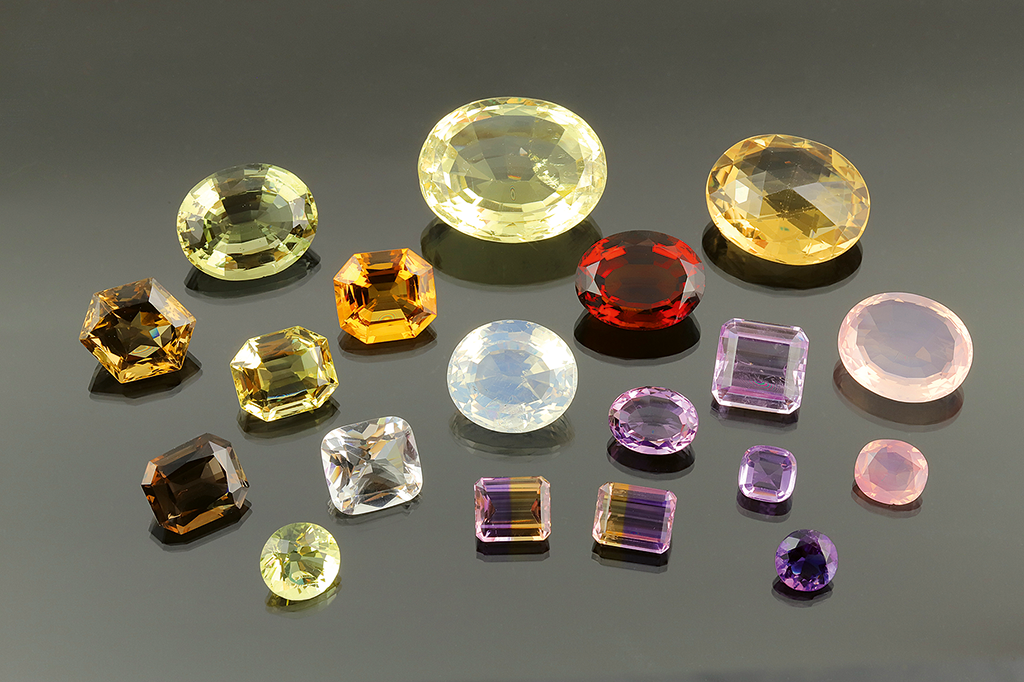
Collection of cut quartz gemstones of different colors, from the ENSMP collection : citrine, amethyst, ametrine, rose quartz and girasol quartz. © Musée de Minéralogie Mines Paris – PSL / E. Gaillou.
What is a gem?
A gemstone is a natural material, including minerals and rocks, that is both beautiful and rare, and sufficiently durable to be cut, polished, and used in jewelry. Purity, color, hardness, brilliance, and other qualities play a determining role in the gemstone’s intended use. Thus, there are different qualities of gemstones, ranging from the most transparent and purest, which are ideally faceted, to highly included or opaque stones, prized for their color or luminous effect, generally cut as cabochons (e.g., microcrystalline minerals such as turquoise or malachite; or ornamental stones such as lapis lazuli or jade).
The term “gemstone” is currently preferred to the terms “precious” and “fine.” The term “semi-precious stone” has been officially prohibited in trade since the Décret n°2002-65 du 14 janvier 2002.
Gems have been used since the beginning of time and have had applied uses since antiquity. Some have been known since ancient times, but some gems that are very popular today were only mined starting in the 1970s: tanzanite, discovered in Tanzania in 1968, is a prime example.
The Museum’s collection includes more than a thousand gems, the vast majority of which are uncut, but some are still mounted on small objects (such as votive offerings).
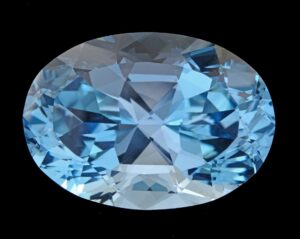
233.46 ct blue topaz (46.69 g !) from Volhynie, Ukraine, donated by the ABC Mines association in 1997 (ENSMP 46129).
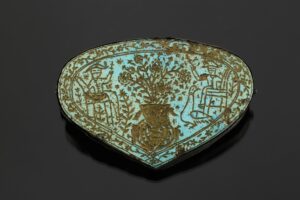
Engraved turquoise votive offering, unknown origin (ENSMP 684201). © Musée de Minéralogie Mines Paris – PSL / E. Gaillou.
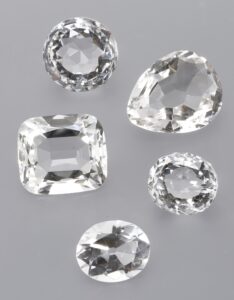
Glass reproduction of the celebrated diamonds, from top to bottom: the Great Mogol, the Cullinan I, the Cullinan II, rhe Orlov (189.62 ct) et the Koh-i-Noor. © Musée de Minéralogie Mines Paris – PSL / E. Gaillou.
Historic Gems: The French Crown Jewels
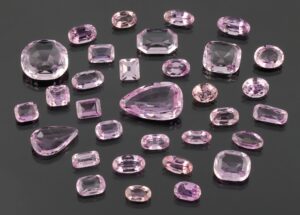
A selection of “Brazilian Rubies” (pink topaz) from the French Crown Jewels, deposited at the Mineralogy Museum of the Paris School of Mines in 1887. These topaz stones were originally part of Empress Marie-Louise’s grand parure of “Brazilian Rubies,” created by the jeweler Nitot in 1811. © Musée de Minéralogie Mines Paris – PSL / E. Gaillou.
The “French Crown Jewels” (or “Crown Diamonds”) are a collection of gems, jewelry, and objects that belonged to the French monarchy and later to the emperors. They were originally established by letters patent from King Francis I in 1530, declared inalienable and the property of the Kingdom of France.
The inventory compiled by experts in 1886 listed 77,486 stones, both set and loose. Made “alienable” by decree under the Third Republic, this national treasure was largely sold in 1887, following an exhibition at the Louvre. The government was then keen to consolidate its political power in a France still marked by the Napoleonic Empire and the deposed monarchy. A small portion of the unset gems and other objects were allocated to national museums: the Louvre Museum, the National Museum of Natural History in Paris, and the Mineralogy Museum of the Paris School of Mines.
The Mineralogy Museum inherited 1,249 specimens. However, the museum’s exchange policy at the end of the 19th and beginning of the 20th centuries led to the loss of some of its treasures. The resale of two strands of over 900 pearls was even authorized by the government in 1903, while a robbery that swept through Paris in 1909 resulted in the theft of two small diamonds. The museum now owns a collection of small emeralds from Napoleon III’s Coronation Crown, “Brazilian Rubies” (pink topaz) and Ural amethysts from Empress Marie-Louise’s jewelry, created by the jeweler Nitot, as well as emerald beads seized during the French Revolution.
Note: Due to the theft of part of the Jewels from the Louvre Museum on October 19, 2025, the gems in the French Crown Jewels collection are currently not on public display as a precautionary measure. We apologize for any inconvenience.