
Meteorites
Fragments that tell the story of the origin of the solar system
The meteorite specimens in the Mineralogy Museum’s collection are of scientific and historical interest. They include fragments from the Moon and Mars, as well as several iconic chondrites and achondrites.
These specimens were collected as early as the 19th century or acquired through contemporary research. They bear witness to cosmic history, the formation of planets, and the connections between Earth and other celestial bodies. Today, they constitute a valuable tool for scientists and visitors alike, eager to understand our place in the universe.
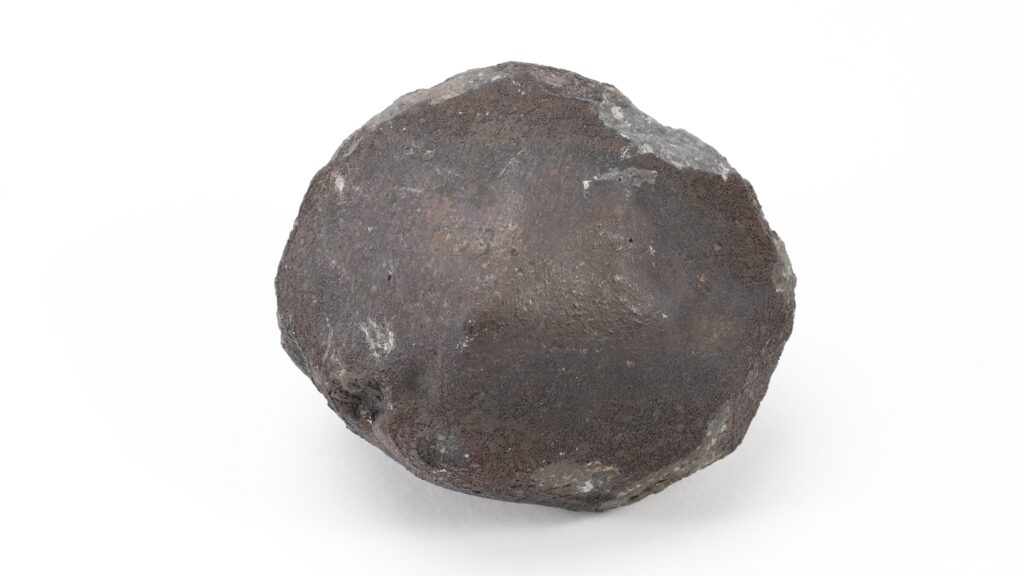
Allende meteorite, a CV3 carbonaceous chondrite, is considered the Rosetta Stone of planetary science. © Mineralogy Museum, Mines Paris – PSL / E. Gaillou
The meteorite collection of the Mineralogy Museum of the Paris School of Mines
The Mineralogy Museum houses a collection of more than 300 meteorites, 60 of which are on permanent display. The collection includes fragments from the Moon and Mars, as well as several iconic chondrites and achondrites.
These specimens were collected as early as the 19th century or acquired through contemporary research. They bear witness to cosmic history, the formation of planets, and the connections between Earth and other celestial bodies. Today, they serve as a valuable resource for both scientists and visitors eager to understand our place in the universe.
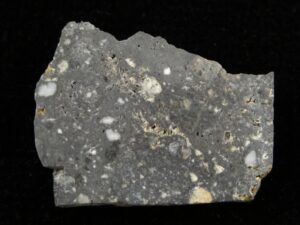
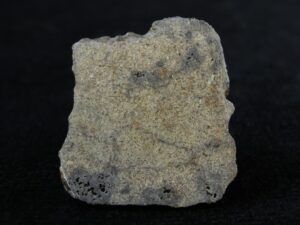
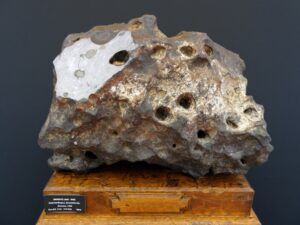
Here, we invite you to discover some iconic meteorites: those from Canyon Diablo, as well as meteorites from Mars and the Moon.
Meteorites and their classification
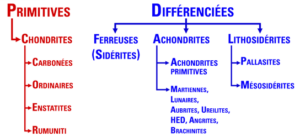
Would you like to learn more about meteorite classifications? Here you’ll find a page explaining how meteorites are classified—a process that is by no means trivial, since it is based on the nature of the parent body from which the extraterrestrial rock that reached Earth originated.
Terms like chondrites, siderites, pallasites, and others will no longer hold any secrets for you!