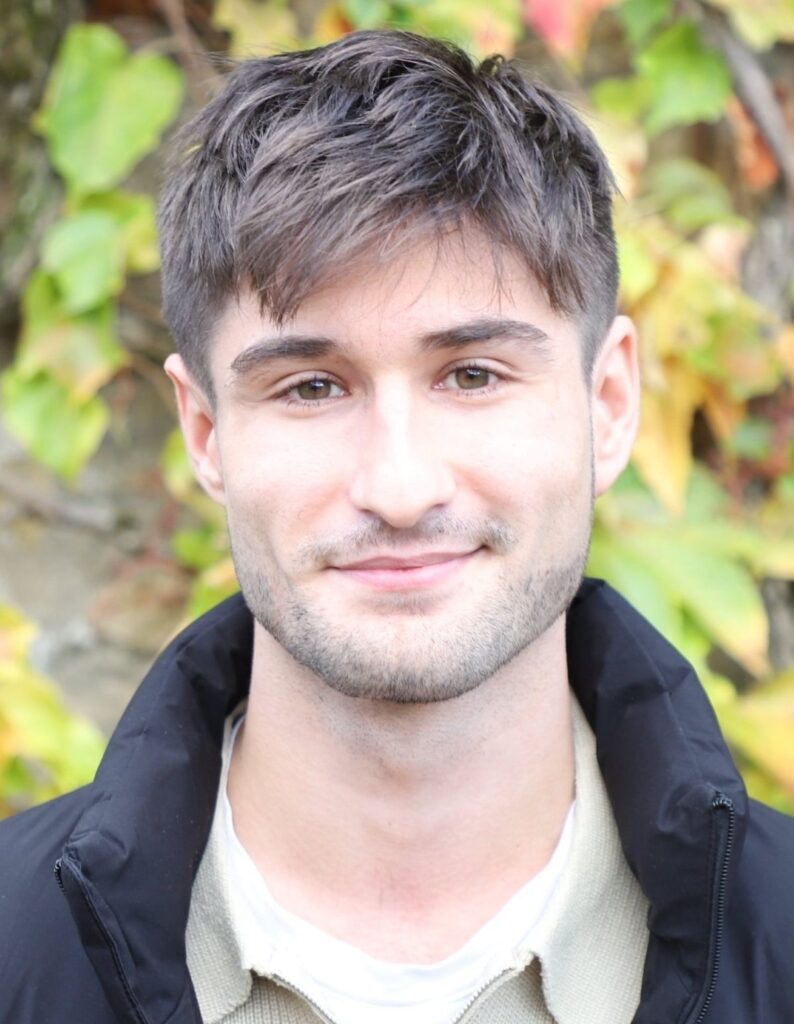
Focus on Alexandre Germouty, former EnviM student.
Meet Alexandre Germouty, a committed advocate for climate action and international cooperation, driven by an unwavering determination to make a positive impact on the planet. With an academic foundation in public and international law, he pursued a dual master’s degree in Franco-Asian trade law between Paris and Ho Chi Minh City, where he immersed himself in the complexities of ASEAN-EU relations. His journey then led him to Mines Paris – PSL, where he joined the EnvIM programme to better connect legal frameworks with the science behind environmental challenges. oday, Alexandre works within the United Nations system on climate and water governance, committed to turning knowledge into concrete solutions for a more sustainable and just future.
Could you tell us about your career journey since leaving EnvIM ?
Since graduating from the EnvIM program, I have been working with the United Nations on climate and water governance. My journey began in Bangkok at the UN Economic and Social Commission for Asia and the Pacific (ESCAP), where I analyzed digital trade policies in relation to sustainable development. I then joined the UNFCCC Regional Office for Asia-Pacific, contributing to climate mitigation strategies and the implementation of Nationally Determined Contributions (NDCs), with a particular focus on the challenges faced by Small Island Developing States.
Since 2024, I have been serving as an Associate Project Officer at UNESCO in Paris, where I coordinate major international initiatives such as the International Year of Glaciers’ Preservation (2025) and the Decade of Action for Cryospheric Sciences (2025–2034). This work involves mobilizing scientific expertise, engaging with governments and international partners, and ensuring that evidence-based knowledge informs global climate policy.
In parallel, I have been conducting long-term academic research on NDCs in Southeast Asia, a region that has deeply shaped my path, as I studied in Viet Nam and first witnessed there the urgency of climate change. My research explores how regional cooperation under ASEAN could enhance ambition, foster coherence, and accelerate a just green transition. I have presented findings at the conference ASEAN’s Path to Sustainable Development in Viet Nam and at the CNRS Summer School in Malaysia, The Ecological Shift in Southeast Asia. Parts of this work were later published in the Vietnamese Journal of Legal Sciences (https://reference-global.com/article/10.2478/vjls-2025-0012).
My path has not been linear, but each step, has brought me closer to where I feel I can contribute most: advancing climate and environmental action that is grounded in science, inclusive of diverse voices, and responsive to real-world inequalities.
What skills that you acquired in EnvIM MS have helped you in your career ?
EnvIM taught me a new language: the language of systems and science. Coming from law, I was trained to interpret norms and apply them. At Mines Paris – PSL, I discovered the science that should underpin those norms. I learned how to translate complex environmental data into clear policy recommendations, structure stakeholder consultations, assess resilience indicators, and deliver strategic notes that speak to both scientists and diplomats.
The most valuable skill I gained is the ability to build bridges across disciplines, institutions, and cultures. The programme trains you to reason like a scientist, speak like a policy analyst, and deliver like a project manager. I apply these skills every day at UNESCO: designing climate projects, coordinating actors across sectors, and ensuring that scientific knowledge informs policy decisions.
Equally transformative was the collective experience. Working with classmates from different continents during demanding projects and fieldwork taught me how to listen, adapt, and build common ground. A truly global programme instils humility: what seems self-evident in one context may be challenged in another. Learning to question assumptions, consult broadly, and build consensus is now at the core of my work: aligning legal frameworks, scientific knowledge, and international cooperation to advance shared climate solutions.
How would you describe your current role ?
My role at UNESCO sits at the crossroads of science, diplomacy, and policy. On one side, it is highly technical: I coordinate global initiatives on climate and water resilience, from the International Year of Glaciers’ Preservation to the Decade of Action for Cryospheric Sciences. This involves drafting concept notes, managing expert task forces, preparing strategic publications, and ensuring that complex research on glaciers, water, and climate is translated into knowledge that governments can actually use.
On the other side, it is profoundly diplomatic. I serve 194 Member States, providing them with a platform to collaborate through high-level events such as COPs, the UN Ocean Conference, and the World Water Forum, as well as through UNESCO’s General Conference, Executive Board, and Intergovernmental Councils. I work with partners ranging from WMO and IPCC scientists to ministries of environment and foreign affairs. The challenge, in an increasingly multipolar world, is to sustain this cooperation — because climate change is a global challenge that demands a collective response. Climate extremes do not respect borders; they are transboundary, and adaptation and mitigation require countries to think and act together.
A large part of my work is being a “translator”: helping scientists structure their findings in ways that resonate with decision-makers, while ensuring that political messages remain firmly grounded in solid evidence.
Do you have advice for current EnviM students ?
My advice would be to treat EnvIM not just as a degree, but as a laboratory of ideas for growth. You will be surrounded by classmates from all over the world, each bringing a different discipline, perspective, and story. Learn as much from them as from the courses. That diversity is your strength: in international work, no single perspective is ever enough.
Don’t be afraid of feeling out of place at times. I came from law, and in the beginning, I felt I lacked the scientific background. But EnvIM is precisely about crossing those boundaries. Trust the process, stay curious, and lean into what feels uncomfortable: that is where you grow the most.
Make the most of the freedom EnvIM gives you to shape your own path. The program opens doors to academia, international organizations, the private sector, and NGOs. Use your thesis and internships to explore what truly drives you. Some of the best experiences of my early career came from detours I hadn’t planned: an internship that didn’t lead to a job, a thesis that took longer than expected, a last-minute conference that opened a new path… Each experience adds a layer that makes your profile unique.
Finally, don’t be afraid to dare. Learn to be bold: nothing is out of reach. Your profile is already unique, so apply to opportunities that may seem “out of your league.” I didn’t have any ready-made network. What I had was a story to tell and a cause I deeply believed in. Very often, that is enough to open the first door, and the rest you’ll open by walking through with conviction, persistence, and a willingness to keep learning.